

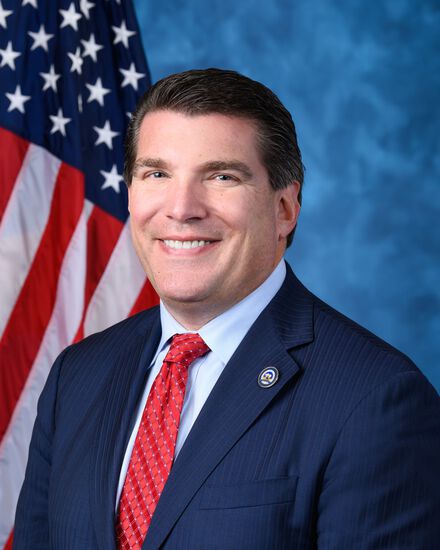
Photo of Jay Obernolte
R United States House · District 23 · California On the 2026 ballot

Rep. Jay Obernolte

Compare
Total votes
2,818
all sessions
Attendance
99%
33 missed
Near the chamber average
With party
91%
of cast votes
Near the chamber average
Bipartisan score
5%
crosses aisle rarely
Near the chamber average
Sponsored
820
bills & resolutions
Near the chamber average
Committees
7
assignments
820 bills and resolutions

Sponsored bills

Total
820
Primary
68
Co-sponsor
752
This page
820
matching current filters
Co-sponsor HR 3366
In committee · Utah House · Co-sponsor
EAGLE Act of 2025

Maddy summaryThe EAGLE Act of 2025 establishes a $10 million federal grant program to help small local law enforcement agencies (under 350 employees) pay for accredited certification. Agencies must apply demonstrating financial need and specify costs for accreditation fees, on-site assessments, or extension fees charged by recognized bodies like CALEA. Grant funds cover only direct costs related to achieving or maintaining accredited status, not general operations. The program requires the Attorney General to set up the grants within 90 days of the bill becoming law.

In committee May 13, 2025 1 co-sponsor
Co-sponsor HR 3289
In committee · Utah House · Co-sponsor
Fiscal Commission Act

Maddy summaryThe Fiscal Commission Act establishes a 16-member commission to address the federal government's fiscal challenges, including reducing debt and deficit while aiming for a debt-to-GDP ratio of 100% by 2039. The commission must educate the public about fiscal issues, identify policy recommendations, and submit a detailed report with legislative language by November 2026 (with possible extension to April 2027). This report requires bipartisan approval, needing at least two Republican and two Democratic members for majority support. If approved, the recommended legislation would become an "implementing bill" considered under expedited procedures in both congressional chambers. The commission's work directly affects federal budget decisions and public awareness of fiscal policy, with hearings required to gather input from experts and government officials.

In committee May 8, 2025 1 co-sponsor
Co-sponsor HR 3304
In committee · Utah House · Co-sponsor
Providing Child Care for Police Officers Act of 2025

Maddy summaryHR 3304, the Providing Child Care for Police Officers Act of 2025, establishes a federal grant program to help law enforcement agencies provide child care for officers' minor children during nonstandard shifts. The program awards competitive 3-year grants to state or local "lead agencies" (like state child care offices) to fund child care services through eligible law enforcement agencies or consortia, with 20% of funds reserved for small agencies (under 200 officers). Grants cover startup costs, provider training, sick child care, facility construction, and other needs, requiring local matching funds (10% to 33% over three years). The program is authorized for $24 million annually from 2026-2030 and includes studies to evaluate its impact on child care access for officers and other first responders.

In committee May 8, 2025 1 co-sponsor
Primary HR 3220
In committee · Utah House · Lead sponsor
Quantum Sandbox for Near-Term Applications Act of 2025

Maddy summaryHR 3220 establishes a "quantum sandbox" program to accelerate near-term quantum technology applications. The bill requires the Commerce Secretary, working with NIST, to create a public-private partnership focused on developing and testing quantum computing, communication, and sensing solutions that can be deployed within 24 months. This program will engage industry groups, national labs, and research centers to break down barriers to accessing quantum hardware for practical uses. The goal is to deliver tangible benefits to U.S. businesses and consumers through faster innovation in quantum applications.

In committee May 6, 2025 0 co-sponsors
Co-sponsor HJRES 78
Passed · Utah House · Co-sponsor
Providing for congressional disapproval under chapter 8 of title 5, United States Code, of the rule submitted by the United States Fish and Wildlife Service relating to "Endangered and Threatened Wildlife and Plants; Endangered Species Status for the San Francisco Bay-Delta Distinct Population Segment of the Longfin Smelt".

Maddy summaryHJRES 78 is a joint resolution seeking congressional disapproval of a U.S. Fish and Wildlife Service rule that granted endangered species status to the San Francisco Bay-Delta population of the longfin smelt, a fish native to California's Bay-Delta region. If passed, this resolution would block the rule from taking effect, preventing the smelt from receiving federal protections under the Endangered Species Act. The rule, published in the Federal Register in July 2024, aimed to protect this specific fish population from threats like habitat loss and water management practices. This resolution does not create new policy but directly reverses an existing regulatory action affecting the smelt and its ecosystem.

Passed May 5, 2025 1 co-sponsor
Primary HR 3198
In committee · Utah House · Lead sponsor
Intergovernmental Critical Minerals Task Force Act

Maddy summaryHR 3198 establishes a new intergovernmental task force to address U.S. reliance on foreign supply chains for critical minerals, which Congress identifies as a national security risk. The task force, composed of federal agency representatives, tribal and state governments, and private sector stakeholders, will assess vulnerabilities in mineral supply chains (especially dependence on China and other "covered countries"), recommend strategies for domestic production and recycling, and develop international partnerships with allies like NATO members. Key duties include evaluating how to boost environmentally responsible domestic mining and processing, identify alternative sources, and strengthen supply chain security without duplicating existing efforts. The task force must submit a final report to Congress within two years and terminates 90 days after completing its work, with no new funding authorized for its operations.

In committee May 5, 2025 0 co-sponsors
Co-sponsor HR 633
In committee · Utah House · Co-sponsor
TAKE IT DOWN Act

Maddy summaryThe TAKE IT DOWN Act makes it a crime to intentionally share intimate images or digital forgeries of people without their consent, with penalties of up to 2 years in prison for adults and 3 years for minors. It requires major online platforms to establish a 48-hour process for victims to request removal of such content, with platforms protected from liability when acting in good faith. The bill defines "digital forgery" as AI-generated content that appears authentic and applies to websites and apps primarily hosting user-generated content, excluding email services and broadband providers. The Federal Trade Commission will enforce these notice and takedown requirements. This legislation directly affects victims of nonconsensual intimate content, the platforms hosting such material, and individuals who distribute it.

In committee Apr 28, 2025 1 co-sponsor
Co-sponsor HR 2932
In committee · Utah House · Co-sponsor
CLEAR Skies Act

Maddy summaryHR 2932, the CLEAR Skies Act, creates a tax credit for producing unleaded aviation gasoline in the U.S. The credit provides $1.25 per gallon in 2026, phasing down to $1.05 per gallon by 2030, for fuel that is lead-free, meets aviation standards, and is produced domestically. Producers must register with the IRS and certify compliance with these requirements to claim the credit. The bill also mandates a GAO study to analyze price differences between leaded and unleaded aviation fuel and whether the tax credit benefits end-users. This policy directly affects U.S. aviation fuel producers and aims to accelerate the transition from leaded to unleaded aviation fuel.

In committee Apr 17, 2025 1 co-sponsor
Co-sponsor HR 2956
In committee · Utah House · Co-sponsor
DISASTER Act of 2025

Maddy summaryThis bill requires the Office of Management and Budget (OMB) to annually report all federal disaster spending to Congress, covering response, recovery, and mitigation efforts across all relevant agencies. The report must detail total spending, break it down by agency and disaster type, and distinguish between loans and grants, including costs from agencies like FEMA, USDA, and the Department of Housing and Urban Development. It aims to improve budget transparency and help Congress identify cost-saving opportunities by providing a single, public source of disaster spending data. The first report is due for fiscal year 2027, with data for the prior calendar year. This is a transparency measure, not a change to how disaster aid is delivered.

In committee Apr 17, 2025 1 co-sponsor
Co-sponsor HR 2934
In committee · Utah House · Co-sponsor
STATES 2.0 Act

Maddy summaryThe STATES 2.0 Act would allow states to regulate cannabis markets within their borders without federal interference, while establishing a low federal excise tax that doesn't compound with state taxes. It would amend the Controlled Substances Act to exempt state-legal marijuana activities from federal prosecution, remove marijuana from the federal controlled substances schedule for state-compliant activities, and allow the FDA to regulate marijuana products as food, drugs, or cosmetics. The bill would require a study on marijuana legalization's effects on traffic safety and address regulatory barriers contributing to the illicit market, which currently accounts for 75% of the marijuana market. This legislation directly affects states that have legalized cannabis, marijuana businesses, and consumers by creating a regulatory framework that supports state autonomy and reduces illegal market activity.

In committee Apr 17, 2025 1 co-sponsor
Showing 191 to 200 of 820 bills
Previous 1 19 20 21 82 Next