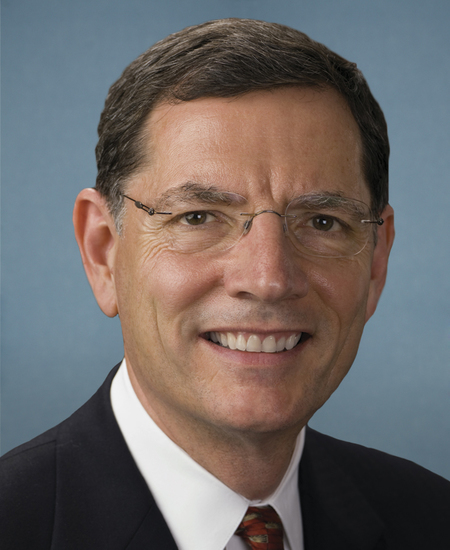
Photo of John Barrasso
R United States Senate · Wyoming

Sen. John Barrasso

Compare
Total votes
1,044
all sessions
Attendance
94%
61 missed
Higher than 92% of chamber peers
With party
96%
of cast votes
Higher than 78% of chamber peers
Bipartisan score
2%
crosses aisle rarely
Lower than 80% of chamber peers
Sponsored
1,036
bills & resolutions
Near the chamber average
Committees
13
assignments
1,036 bills and resolutions

Sponsored bills

Total
1,036
Primary
171
Co-sponsor
865
This page
1,036
matching current filters
Co-sponsor S 460
In committee · United States Senate · Co-sponsor
Supporting Made in America Energy Act

Supporting Made in America Energy Act This bill requires oil and natural gas lease sales that include certain public land and waters, prohibits lease sales in other areas, and establishes related requirements. Beginning in FY2025, the Department of the Interior must conduct a minimum of four onshore lease sales annually in each state that has federal land available for oil and natural gas leasing. If a lease sale is canceled, delayed, or deferred, Interior must conduct a replacement sale during the same year.  Beginning in FY2026, Interior must conduct a minimum of two offshore, region-wide lease sales annually in the Gulf of Mexico Region of the Outer Continental Shelf (OCS) by specified dates. The sales must include the Central Gulf of Mexico Planning Area and the Western Gulf of Mexico Planning Area. Interior must also conduct a minimum of six offshore lease sales of at least 1 million acres each over a 10-year period in the Cook Inlet Planning Area. The bill sets a 12.5% royalty rate for such leases. Interior must plan and approve the subsequent OCS oil and gas leasing programs by specified deadlines. The bill extends through 2035 a moratorium on oil and gas leasing in certain eastern and central portions of the Gulf of Mexico and expands the moratorium to include the South Atlantic Planning Area and the Straits of Florida Planning Area. The bill also requires the President to obtain congressional approval before impeding or circumventing certain federal energy mineral leasing processes.

In committee Feb 6, 2025 1 co-sponsor
Primary S 474
In committee · United States Senate · Lead sponsor
Fair Funding for Rural Hospitals Act

Maddy summaryThis bill establishes minimum annual funding levels for Medicaid Disproportionate Share Hospital (DSH) payments to states, directly affecting rural hospitals and state Medicaid programs. For fiscal years 2025 through 2029, it sets a minimum $20 million DSH allotment per state, and for 2030 onward, it requires states to maintain the prior year's minimum amount adjusted for inflation. The provision prevents states from reducing DSH funding below these specified floors, ensuring consistent support for hospitals serving high numbers of low-income patients. It applies to all states receiving Medicaid DSH payments under federal law.

In committee Feb 6, 2025 0 co-sponsors
Co-sponsor S 485
In committee · United States Senate · Co-sponsor
Regulations from the Executive in Need of Scrutiny Act of 2025

Maddy summaryThis bill would require federal agencies to submit detailed reports about new regulations to Congress before they take effect. Major rules (defined as those with an annual economic effect of $100 million or more, or significant effects on competition, employment, or public safety) would need congressional approval via a joint resolution before taking effect, with Congress having 70 days to act. Nonmajor rules would have a different, shorter review process. The bill would also require agencies to publish cost-benefit analyses and other supporting documentation, and would mandate that rules be reviewed and potentially reapproved after 10 years.

In committee Feb 6, 2025 1 co-sponsor
Primary S 425
In committee · United States Senate · Lead sponsor
Enhancing Energy Recovery Act

Maddy summaryThis bill amends the federal tax credit for carbon capture (Section 45Q) to expand eligibility for companies capturing carbon dioxide. It adds new qualifying uses for the credit, including using captured carbon as a "tertiary injectant" in oil/gas extraction projects and certain other storage methods. The credit amount is set at $17 per metric ton for 2025-2026, then adjusted annually for inflation after 2026. The changes apply to tax years beginning after December 31, 2024, directly affecting businesses engaged in carbon capture and storage.

In committee Feb 5, 2025 0 co-sponsors
Co-sponsor SRES 55
Passed · United States Senate · Co-sponsor
A resolution recognizing January 2025 as "National Mentoring Month".

Maddy summarySRES 55 is a Senate resolution designating January 2025 as "National Mentoring Month." It formally recognizes the value of mentoring relationships in supporting youth development, highlighting benefits like improved academic outcomes, mental health, career exploration, and reduced juvenile delinquency. The resolution encourages expanding mentoring programs in communities, schools, and workplaces to address the "mentoring gap" where one-third of U.S. youth lack consistent mentorship. As a symbolic measure, it aims to raise public awareness and promote cross-sector collaboration without creating new laws or funding.

Passed Feb 4, 2025 1 co-sponsor
Co-sponsor S 383
In committee · United States Senate · Co-sponsor
JOBS Act of 2025

Maddy summaryS 383 (the JOBS Act of 2025) expands Federal Pell Grant eligibility to students enrolled in certain short-term job training programs at eligible institutions of higher education. The bill creates a "job training Federal Pell Grant" for programs meeting specific criteria: 150-600 clock hours over 8-15 weeks, aligned with high-demand industry sectors, and leading to recognized postsecondary credentials that meet employer hiring requirements or licensure prerequisites. It also lowers the minimum Pell Grant award from 10% to 5% of the full annual amount. This directly affects students seeking career-focused training and institutions offering qualifying programs that validate industry partnerships.

In committee Feb 4, 2025 1 co-sponsor
Co-sponsor S 386
In committee · United States Senate · Co-sponsor
Critical Water Resources Prioritization Act of 2025

Maddy summaryThis bill creates a temporary exemption process under the Endangered Species Act for water projects meeting "critical human water needs," such as municipal drinking water, firefighting, public health, or food security. Water management agencies (federal, state, or local) must first exhaust conservation measures and alternative water sources before seeking an exemption. Exemptions last up to 180 days and require monthly reports on water use, alternative development efforts, and species impacts, with annual reports to Congress. The Secretary of the Interior must issue implementing regulations within 180 days of enactment. This directly affects water agencies managing critical infrastructure during shortages while maintaining ESA protections through strict conditions and oversight.

In committee Feb 4, 2025 1 co-sponsor
Co-sponsor S 395
In committee · United States Senate · Co-sponsor
Emergency Fuel Reduction Act of 2025

Maddy summaryThis bill allows federal land managers to skip full environmental reviews under the National Environmental Policy Act (NEPA) for specific wildfire prevention projects on federal land. It directly affects agencies managing federal lands near communities, infrastructure (like schools, power lines, and water systems), and areas with endangered species habitat. Key provisions let projects removing dead/insect-infected trees or hazardous fuels near critical infrastructure qualify for this fast-track process, but only if they cover 10,000 acres or less and meet risk criteria. The exemption does not apply to wilderness areas, lands where vegetation removal is prohibited, or lands within national monuments as of the bill's enactment.

In committee Feb 4, 2025 1 co-sponsor
Co-sponsor S 401
In committee · United States Senate · Co-sponsor
Fair Access to Banking Act

Maddy summaryThe Fair Access to Banking Act (S 401) prohibits large financial institutions ($10 billion+ in assets) and payment networks from denying services to lawful businesses based on political or reputational factors, such as the type of legal business they operate. It requires banks to justify denials using objective, risk-based standards instead of category-based decisions, and mandates written explanations for denials. The law enables lawsuits against violators with treble damages and civil penalties up to 10% of service value (capped at $10,000 per violation). It directly affects major banks, payment processors, and credit unions that serve large-scale customers, ensuring fair access for businesses operating within federal law.


In committee Feb 4, 2025 1 co-sponsor
Showing 251 to 260 of 1,036 bills
Previous 1 … 25 26 27 … 104 Next