

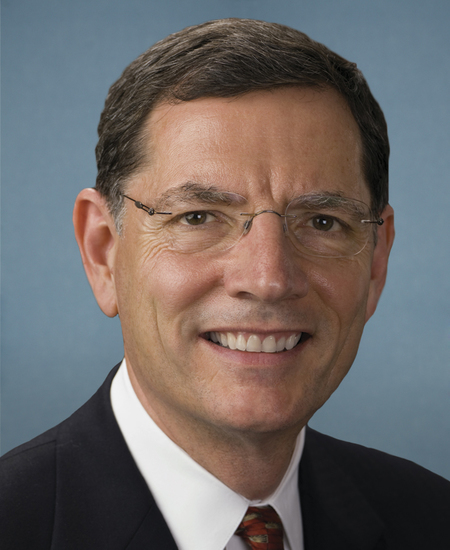
Photo of John Barrasso
R United States Senate · Wyoming

Sen. John Barrasso

Compare
Total votes
1,044
all sessions
Attendance
94%
61 missed
Higher than 92% of chamber peers
With party
96%
of cast votes
Higher than 78% of chamber peers
Bipartisan score
2%
crosses aisle rarely
Lower than 80% of chamber peers
Sponsored
1,036
bills & resolutions
Near the chamber average
Committees
13
assignments
1,036 bills and resolutions

Sponsored bills

Total
1,036
Primary
171
Co-sponsor
865
This page
1,036
matching current filters
Co-sponsor S 533
In committee · United States Senate · Co-sponsor
National Right-to-Work Act

Maddy summaryS 533, the National Right-to-Work Act, eliminates requirements for workers to join a union or pay dues as a condition of employment in private-sector workplaces and railroads. It amends the National Labor Relations Act (NLRA) and Railway Labor Act by removing language that allowed "union security agreements," meaning employers and unions can no longer mandate union membership or financial dues for employees. This directly affects workers in unionized private companies and railroad jobs covered by collective bargaining agreements. The law applies to new or renewed contracts after its enactment, changing how labor agreements can structure financial obligations for employees.

In committee Feb 12, 2025 1 co-sponsor
Co-sponsor S 537
In committee · United States Senate · Co-sponsor
Protecting Access for Hunters and Anglers Act of 2025

Maddy summaryThis bill prohibits federal agencies (like the Fish and Wildlife Service and Forest Service) from banning lead ammunition or tackle on public lands and waters used for hunting or fishing, directly affecting hunters and anglers who use federal lands. It blocks new federal regulations on lead levels in hunting gear, except in limited cases where a specific area's wildlife decline is linked to lead use and the state wildlife agency approves the restriction. The law requires federal agencies to explain in notices how any exception meets state wildlife department requirements or state law. It does not change existing state laws or allow federal bans on lead where states already prohibit it.

In committee Feb 12, 2025 1 co-sponsor
Primary S 541
In committee · United States Senate · Lead sponsor
ELITE Vehicles Act

Maddy summaryThe ELITE Vehicles Act repeals three key tax credits for electric vehicles under the Internal Revenue Code: the clean vehicle credit (Section 30D), the credit for previously-owned clean vehicles (Section 25E), and the credit for qualified commercial clean vehicles (Section 45W). It also excludes electric vehicle recharging property from the alternative fuel vehicle refueling credit. These changes directly affect individuals and businesses purchasing new or used electric vehicles, as well as those installing EV charging infrastructure, by eliminating the associated tax benefits. The repeal applies to vehicles purchased or under binding contract after 30 days following the bill's enactment.

In committee Feb 12, 2025 0 co-sponsors
Co-sponsor S 556
In committee · United States Senate · Co-sponsor
Enhanced Iran Sanctions Act of 2025

Maddy summaryThis bill imposes new sanctions on foreign entities (including banks, insurers, and logistics companies) that knowingly facilitate Iran's oil, gas, LNG, or petrochemical exports. It blocks U.S. property of sanctioned entities and bars targeted individuals from entering the U.S. via visa restrictions or revocation. Exceptions cover goods imports and certain international obligations, while the President may grant limited 180-day waivers for national security reasons, subject to congressional reporting. The law aims to disrupt Iran's energy revenue streams used for terrorism, weapons programs, and repression, with enforcement coordinated through a new interagency working group.

In committee Feb 12, 2025 1 co-sponsor
Co-sponsor S 557
In committee · United States Senate · Co-sponsor
1071 Repeal to Protect Small Business Lending Act

Maddy summaryThis bill, S 557, repeals Section 704B of the Equal Credit Opportunity Act, which required financial institutions to collect and report detailed data on small business loan applications. It directly affects banks and credit unions - especially smaller community institutions - that previously had to comply with these reporting rules. The key provision removes the data collection and reporting obligations, aiming to reduce administrative costs for lenders. This change would eliminate a specific regulatory requirement without altering how small business loans are issued or approved.

In committee Feb 12, 2025 1 co-sponsor
Co-sponsor S 510
In committee · United States Senate · Co-sponsor
Financing Our Energy Future Act

Maddy summaryThe Financing Our Energy Future Act (S 510) expands tax-qualified activities for green energy publicly traded partnerships under the Internal Revenue Code. It directly affects businesses investing in renewable energy projects by adding specific eligible activities, such as generating power from qualified renewable sources (e.g., solar, wind, or advanced nuclear), storing energy using new technology, capturing carbon dioxide, and producing low-emission fuels. Key provisions require new fuels to achieve at least a 60% reduction in lifecycle greenhouse gas emissions compared to baseline standards, and mandate that carbon capture facilities capture at least 50% of their carbon oxide output. The changes take effect for taxable years beginning after December 31, 2025.

In committee Feb 11, 2025 1 co-sponsor
Co-sponsor S 523
In committee · United States Senate · Co-sponsor
Protect Medicaid Act

Maddy summaryThe Protect Medicaid Act (S 523) prohibits federal Medicaid funds from covering administrative costs for health benefits provided to unauthorized immigrants. It directly affects states that currently offer Medicaid-like benefits to noncitizens ineligible due to immigration status, requiring them to fund these administrative costs themselves. The bill amends the Social Security Act to explicitly ban such federal spending and mandates an Inspector General report detailing how states separate costs, ensure compliance, and finance these programs (e.g., via provider taxes). The report must also analyze drug pricing impacts when unauthorized immigrants receive covered medications through Medicaid or 340B programs. This is a procedural change restricting federal funding, not altering eligibility for Medicaid benefits.

In committee Feb 11, 2025 1 co-sponsor
Co-sponsor S 522
In committee · United States Senate · Co-sponsor
Credit Union Board Modernization Act

Credit Union Board Modernization Act This bill revises the required frequency of meetings held by a credit union's board of directors. Specifically, new credit unions and credit unions with a low soundness rating must meet monthly. All other credit unions must hold at least six meetings annually, with at least one meeting held during each fiscal quarter. Currently, all credit union boards must meet at least once a month.

In committee Feb 11, 2025 1 co-sponsor
Primary S 530
In committee · United States Senate · Lead sponsor
WEST Act of 2025

Maddy summaryS 530, the WEST Act of 2025, repeals a specific Bureau of Land Management (BLM) rule titled "Conservation and Landscape Health" (88 Fed. Reg. 19583, April 3, 2023). The bill directly affects the BLM by nullifying the legal force of this 2023 regulation. It contains no new provisions or policy changes, only the repeal of an existing rule. This is a procedural legislative action with no direct impact on the public, businesses, or other entities.

In committee Feb 11, 2025 0 co-sponsors
Co-sponsor SJRES 17
In committee · United States Senate · Co-sponsor
A joint resolution providing for congressional disapproval under chapter 8 of title 5, United States Code, of the rule submitted by the Forest Service of the Department of Agriculture relating to "Law Enforcement; Criminal Prohibitions".

Maddy summaryThis joint resolution (SJRES 17) seeks to block a specific rule issued by the U.S. Forest Service under the Department of Agriculture. The rule, published in the Federal Register on November 25, 2024, established new criminal prohibitions related to law enforcement activities on federal lands. If passed, this resolution would formally disapprove the rule under Chapter 8 of Title 5, U.S. Code, making the rule legally ineffective and preventing it from taking effect. The resolution directly affects the Forest Service's ability to enforce this particular criminal prohibition rule.

In committee Feb 6, 2025 1 co-sponsor
Showing 241 to 250 of 1,036 bills
Previous 1 … 24 25 26 … 104 Next