

Democracy Is Strengthened by Casting Light On Spending in Elections Act of 2021 or the DISCLOSE Act of 2021 This bill addresses campaign finance, including by expanding the prohibition on campaign spending by foreign nationals, requiring additional disclosures of campaign expenditures, and requiring additional disclosures regarding certain political advertisements. First, the bill prohibits foreign nationals from participating in the decision-making process regarding an election expenditure. Additionally, the bill expands existing foreign money prohibitions to include disbursements for paid web-based or digital communications and federal judicial nomination communications. It also prohibits foreign nationals from contributing to campaigns related to ballot initiatives and referenda. The Federal Election Commission (FEC) must conduct an audit after each federal election cycle to determine the incidence of illicit foreign money. Next, the bill makes it unlawful to establish or use a corporation, company, or other entity with the intent to conceal an election contribution or donation by a foreign national. A violator is subject to criminal penalties—a fine, a prison term of up to five years, or both. Covered organizations (e.g., corporations, labor organizations, and political organizations) must, within 24 hours, file reports with the FEC to disclose campaign expenditures of more than $10,000 during an election cycle. Finally, the bill requires organizations to provide additional disclosures regarding political advertisements, including the donors who contributed the most money to that organization in the last year.
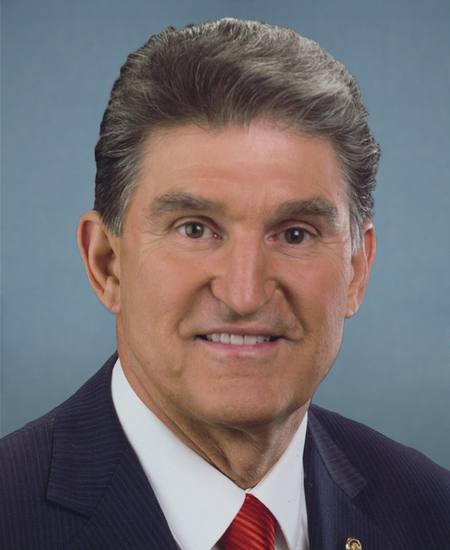
Sen. Joe Manchin, III
Sponsored bills
This concurrent resolution recognizes Hershel Woodrow "Woody" Williams, the last surviving recipient of the Medal of Honor for acts performed during World War II. The concurrent resolution also permits Williams' remains to lie in honor in the rotunda of the Capitol on Thursday, July 14, 2022, in order to honor the Greatest Generation and the more than 16 million men and women who served in the U.S. Armed Forces from 1941 to 1945.
Black Lung Benefits Improvement Act of 2022 This bill revises requirements for miners' claims for pneumoconiosis (black lung disease) benefits. Specifically, the bill requires the Department of Labor to pay the attorneys' fees of specified parties on a qualifying benefit claim, give a claimant the opportunity to substantiate a claim for benefits through a pulmonary evaluation, authorize a CT (computerized tomography) scan in diagnosing complicated pneumoconiosis, and develop a strategy to reduce delays in adjudication of black lung disease benefits claims. The bill also establishes criteria that a mining operator must meet to self-insure against claims and increases from $1,000 to $25,000 the daily penalty amount that may be assessed against a mining operator that fails to make black lung benefits payments. The bill authorizes (1) black lung disease clinics to use federal funds to help individuals file claims, and (2) certain previously denied claimants to file a new claim for black lung disease benefits within one year. The bill prohibits a person from (1) knowingly and willfully making a false statement or misrepresentation in increasing or reducing black lung disease benefits, or (2) threatening or misleading a participant in a proceeding regarding such benefits. Further, the bill revises (1) the standards of medical evidence that establish a presumption that a miner is totally disabled by black lung disease, and (2) payments to such miners. Lastly, the bill provides statutory authority for the Office of Workers' Compensation Programs.
Restoring Benefits to Defrauded Veterans Act of 2022 This bill requires the Department of Veterans Affairs (VA) to pay certain reissued benefits (i.e., benefits that were misused by a fiduciary) to a beneficiary's estate in situations where a beneficiary predeceases a payment. The VA must pay such benefits to an individual or entity in the following order: the estate of the beneficiary, a successor fiduciary serving the beneficiary when the beneficiary died, or the next inheritor determined by a court of competent jurisdiction.
This resolution recognizes that the United States has long sought to alleviate the suffering of civilians and nations hurt by war and remains committed to ensuring the long-term peace, prosperity, and territorial integrity of Ukraine. The resolution also recognizes that an effective Ukrainian reconstruction effort can only be accomplished by working in concert with other nations and international bodies. Finally, the resolution encourages the U.S. government to lead an international group of allies that will equitably contribute to provide the Ukrainian government and the Ukrainian people with a reconstruction assistance package for the purpose of increasing ties between nations that are seeking a stable international order to counter malign and rogue actors.
Protecting the Right to Organize Act of 20 21 This bill expands various labor protections related to employees' rights to organize and collectively bargain in the workplace. Among other things, it revises the definitions of employee , supervisor , and employer to broaden the scope of individuals covered by the fair labor standards; permits labor organizations to encourage participation of union members in strikes initiated by employees represented by a different labor organization (i.e., secondary strikes); and prohibits employers from bringing claims against unions that conduct such secondary strikes. The bill also allows collective bargaining agreements to require all employees represented by the bargaining unit to contribute fees to the labor organization for the cost of such representation, notwithstanding a state law to the contrary; and expands unfair labor practices to include prohibitions against replacement of, or discrimination against, workers who participate in strikes. The bill makes it an unfair labor practice to require or coerce employees to attend employer meetings designed to discourage union membership and prohibits employers from entering into agreements with employees under which employees waive the right to pursue or a join collective or class-action litigation. Finally, the bill addresses the procedures for union representation elections, modifies the protections against unfair labor practices that result in serious economic harm, and establishes penalties and permits injunctive relief against entities that fail to comply with National Labor Relations Board orders.
Air America Act of 2022 This bill establishes the service of Air America employees as qualifying service for purposes of the Civil Service Retirement System. (Air America was a government-owned airline that provided air transport for certain covert operations in Southeast Asia, including Laos and Vietnam, between 1950 and 1976.) The bill applies to U.S. citizens who were employees of Air America or another affiliated company, as specified, between January 1, 1950, and December 31, 1976. Benefit applications must be filed within two years of the date of enactment of this bill.
Homeland Acceleration of Recovering Deposits and Renewing Onshore Critical Keystones Act of 2022 or the HARD ROCK Act of 2022 This bill authorizes the National Defense Stockpile Manager (the Department of Defense) to take certain actions to address industrial base shortfalls.
COI Elimination Act This bill limits U.S. contributions to the United Nations pertaining to the U.N. Independent International Commission of Inquiry on the Occupied Palestinian Territory, including East Jerusalem, and Israel. Current law imposes a cap on the annual U.S. contribution to the U.N. budget. The bill lowers that cap by 25% of the amount budgeted for the commission unless the Department of State certifies to Congress that the commission has been abolished. After such a certification, the United States shall, subject to appropriations, provide to the United Nations an amount equal to all the contributions that were withheld under this bill. The bill also states that it shall be U.S. policy to seek the abolition of the commission and combat systemic anti-Israel bias in international bodies.
Strengthening Oversight for Veterans Act of 2021 This bill gives the Department of Veterans Affairs Office of Inspector General (VA OIG) the authority to subpoena the attendance and testimony of witnesses as necessary to carry out the duties of the office. Such authority terminates on May 31, 2025, but subpoenas issued prior to that date shall be unaffected by the termination. The bill prohibits the VA OIG from subpoenaing the attendance and testimony of current federal employees or witnesses as part of any criminal proceeding. Under the bill, the VA OIG must notify the Department of Justice (DOJ) and the intended witness of the intent to issue a subpoena. If DOJ objects to the subpoena because it will interfere with an ongoing investigation, the VA OIG may not issue the subpoena.