Maddy summaryThis Senate resolution (SRES 853) recognizes November 2022 as "National Homeless Children and Youth Awareness Month." It does not create new laws or allocate funding but formally acknowledges the issue of homelessness affecting children and youth in the U.S. The resolution encourages businesses, state/local governments, organizations, educators, and volunteers to intensify efforts during November 2022 to raise awareness about child and youth homelessness and support prevention programs. It highlights statistics on homelessness impacts but focuses solely on symbolic recognition and awareness-raising, not policy changes.
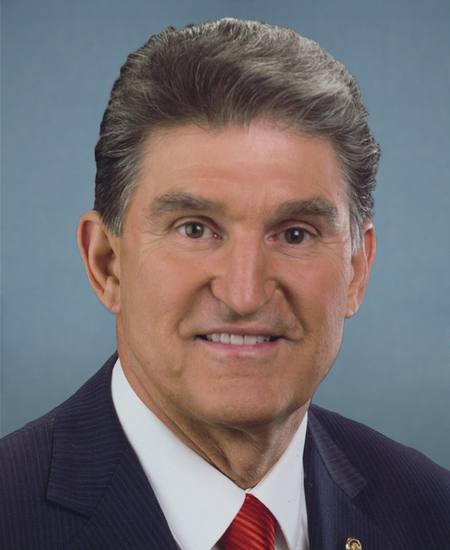
Sen. Joe Manchin, III
Sponsored bills
Clean Start Act of 2022 This bill establishes a process to seal records related to a nonviolent criminal offense committed by an individual whose substance use disorder is a substantial contributing factor in the commission of the offense. A nonviolent criminal offense is a federal criminal offense that is not a violent offense, a sex offense, a serious drug offense, or an offense with a victim under the age of 18. To be eligible for sealing, an individual who is convicted of a nonviolent criminal offense must, among other things, complete a substance use disorder treatment program or recovery program and complete service in a substance use disorder peer mentorship program. This bill also allows the Department of Justice to give preference to a Community Oriented Policing Services program grant applicant from a state that has in effect (1) a substantially similar law related to sealing adult records, or (2) a law that allows an individual who successfully seals a criminal record to be free from civil and criminal perjury laws.
Journalism Competition and Preservation Act of 2022 This bill sets out a process through which certain broadcast or digital news providers may collectively negotiate with covered online platforms (e.g., social media companies) regarding use of the news providers' content by the platforms. Specifically, the bill authorizes an eligible provider (e.g., one with no more than 1,500 full-time employees and nonnetwork news broadcasters that engage in specified news practices) to jointly form an entity with other eligible providers to negotiate the pricing, terms, and conditions by which certain online platforms use the providers' content. A covered platform is generally one that (1) has at least 50 million monthly domestic users, and (2) is owned or controlled by a person with either sales or a market capitalization that exceeds a specified amount or at least one billion monthly users worldwide. The bill establishes requirements concerning the formation, governance, operation, and termination of the joint negotiation entity. It also exempts from antitrust laws certain actions by a joint negotiation entity (e.g., providers jointly denying a platform's access to the providers' content). The bill outlines requirements governing the conduct of the negotiations by, for example, requiring the parties to negotiate in good faith. Additionally, the bill provides for private rights of action if the requirements for a negotiation are not met and establishes requirements for arbitration in limited circumstances. The Government Accountability Office must study the impact of the joint negotiations, including their effects on local and regional news and the employment of journalists. In general, the bill's provisions terminate six years after its enactment.

Saving America's Future by Educating Kids Act of 2022 This bill directs the Department of Education (ED) to develop and support implementation of an evidence-based, K-12 curriculum on the dangers of substances of misuse, including opioids and vaping. ED must review and update the curriculum every two years. ED must award grants to state educational agencies to implement the evidence-based curriculum. In awarding these grants, ED must give priority to those states that have experienced the highest drug overdose death rate per capita.
This resolution designates the week beginning on October 9, 2022, as National Wildlife Refuge Week. The resolution acknowledges the importance of national wildlife refuges for their recreational opportunities and contribution to local economies. Finally, the resolution reaffirms the support of the Senate for wildlife conservation and the National Wildlife Refuge System.
Stop Looting American Pensions Act of 2022 or the SLAP Act This bill revises certain bankruptcy requirements, including by providing additional protections for employee pay and pensions in the event of a bankruptcy. Specifically, the bill revises the bankruptcy priority requirements of claims for wages and contributions to employee benefit plans, including by increasing the cap of these payments and by eliminating the time period limitation for which unpaid wages and contributions may be claimed; increases the bankruptcy priority of minimum funding contributions towards employee pension benefit plans and withdrawal liability and requires companies to continue making these payments during bankruptcy; expands restrictions on executive pay; places restrictions on the sale of property in bankruptcy proceedings, including by requiring reasonable payment; and extends look back periods regarding fraudulent transfers from two years to six years.
Fixing Our Country Roads Act This bill directs the Department of Transportation to establish the total number of miles that may be authorized for the expansion of the Appalachian development highway system.
ARC Relocation Act This bill provides for the relocation of the headquarters of the Appalachian Regional Commission (an economic development agency focused on the Appalachian region) from the District of Columbia to West Virginia.
Electoral Count Reform and Presidential Transition Improvement Act of 2022 This bill revises the process of casting and counting electoral votes for presidential elections. The bill also revises provisions related to the presidential transition process. The bill specifies that the choice of electors must occur in accordance with the laws of the state enacted prior to election day. Additionally, the bill identifies each state's governor (unless otherwise identified in the laws or constitution of a state in effect on election day) as responsible for submitting the certificate of ascertainment identifying the state's electors. Further, the bill provides for expedited judicial review for any action brought by an aggrieved presidential or vice-presidential candidate arising under the U.S. Constitution or U.S. laws with respect to the issuance or transmission of such a certificate. The bill revises the framework for the joint session of Congress to count electoral votes and make a formal declaration of which candidates have been elected President and Vice President. Among other changes, the bill (1) specifies that the role of the Vice President during the joint session shall be ministerial in nature, and (2) raises the objection threshold in Congress to at least one-fifth of the duly chosen and sworn members of both the House of Representatives and the Senate. The bill also revises the presidential transition process, including to (1) allow more than one candidate to receive federal transition resources under certain circumstances, and (2) require additional reporting by the General Services Administration.
This resolution supports the designation of October 2-October 8, 2022, as National 4-H Week. It also (1) recognizes the important role of 4-H in youth development and education, and (2) encourages all citizens to recognize 4-H for the significant impact the organization and members have made and continue to make by empowering young people with the skills needed to lead for a lifetime.