

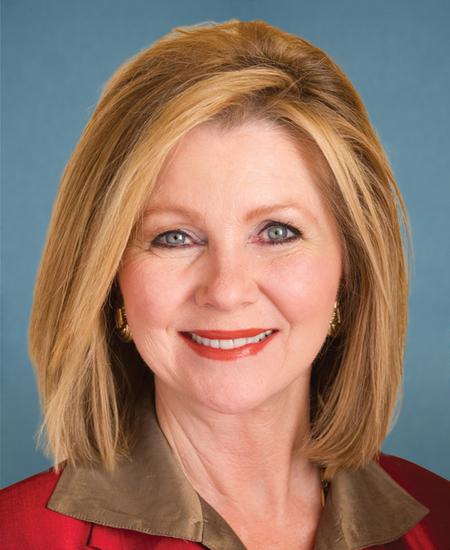
Photo of Marsha Blackburn
R United States Senate · Tennessee

Sen. Marsha Blackburn

Compare
Total votes
1,054
all sessions
Attendance
94%
65 missed
Lower than 96% of chamber peers
With party
94%
of cast votes
Higher than 83% of chamber peers
Bipartisan score
3%
crosses aisle rarely
Lower than 85% of chamber peers
Sponsored
1,896
bills & resolutions
Higher than 88% of chamber peers
Committees
15
assignments
1,896 bills and resolutions

Sponsored bills

Total
1,896
Primary
313
Co-sponsor
1,583
This page
1,896
matching current filters
Co-sponsor S 2609
In committee · United States Senate · Co-sponsor
Small Business Growth Act

Small Business Growth Act This bill increases from $1 million to $2.5 million the limitation on expensing of depreciable business assets. It also increases the asset threshold amount used to reduce the expensing limitation.

In committee Jul 27, 2023 1 co-sponsor
Co-sponsor S 2688
In committee · United States Senate · Co-sponsor
Behavioral Health Information Technology Coordination Act

Maddy summaryThe Behavioral Health Information Technology Coordination Act creates a federal grant program to help behavioral health providers - including mental health clinics, psychiatric hospitals, community centers, and specialized treatment facilities - adopt certified health information technology. Grants of up to $2 million per provider for two years will fund technology that shares patient data with primary care doctors, hospitals, and emergency departments, meeting federal interoperability standards. The program requires grantees to report on improvements in care coordination, data sharing, and outcomes, with $20 million authorized annually from 2025 through 2029. This directly supports providers serving individuals with mental health and substance use disorders by modernizing their technology systems.

In committee Jul 27, 2023 1 co-sponsor
Co-sponsor S 994
Passed · United States Senate · Co-sponsor
Strong Communities Act of 2023

Maddy summaryThe Strong Communities Act of 2023 creates a new grant program (COPS Strong Communities Program) under the Omnibus Crime Control Act. It provides competitive federal grants to local law enforcement agencies to cover training costs for officers and recruits at eligible entities like colleges or police departments, with the requirement that participants serve full-time in their local communities for at least four years within specified distances from their long-term residence. If participants don't complete this service, they must repay the training benefits, though regulations will allow for exceptions due to extenuating circumstances. This directly affects local law enforcement agencies, officers, and recruits who participate in the training program.

Passed Jul 27, 2023 1 co-sponsor
Primary SRES 318
In committee · United States Senate · Lead sponsor
A resolution raising awareness of modern day slavery.

Maddy summarySRES 318 is a symbolic Senate resolution designating July 30, 2023, as World Day against Trafficking in Persons. It also commends the annual observance of January as National Human Trafficking Prevention Month and notes ongoing efforts to combat modern slavery. The resolution does not create new laws or funding but formally recognizes the scale of human trafficking (citing global estimates of 49.6 million people in modern slavery) and calls for international action. As a procedural resolution, it focuses solely on raising awareness rather than implementing policy changes.

In committee Jul 26, 2023 0 co-sponsors
Co-sponsor SRES 288
Passed · United States Senate · Co-sponsor
A resolution observing the 150th anniversary of Vanderbilt University.

Maddy summaryThis Senate resolution commemorates Vanderbilt University's 150th anniversary by honoring its history and achievements. It commends the university for its educational contributions, research impact, and role in developing leaders across various fields. The resolution requests that a copy be sent to Vanderbilt's chancellor and board chair, but it has no binding effect or policy changes. As a ceremonial gesture, it does not directly affect any laws, programs, or individuals beyond symbolic recognition.

Passed Jul 26, 2023 1 co-sponsor
Co-sponsor SRES 166
Passed · United States Senate · Co-sponsor
A resolution honoring the efforts of the Coast Guard for excellence in maritime border security.

Maddy summarySRES 166 is a symbolic Senate resolution honoring the U.S. Coast Guard for its maritime border security work. It recognizes the Coast Guard's 2022 achievements, including interdicting over 330,000 pounds of narcotics, intercepting 12,500 illegal immigrants, and patrolling over 95,000 miles of U.S. coastline. The resolution expresses the Senate's gratitude to Coast Guard personnel for their "exemplary service" in safeguarding borders. As a non-binding resolution, it does not create new laws, funding, or policy changes.

Passed Jul 26, 2023 1 co-sponsor
Co-sponsor S 2539
In committee · United States Senate · Co-sponsor
Prevent Discrimination in Title X Act

Maddy summaryThis bill amends the Public Health Service Act to prohibit the Secretary from requiring any State, clinic, or provider to counsel or refer for abortions as a condition for receiving Title X family planning funding. It directly affects Title X-funded clinics and health centers that provide reproductive health services. The key provision explicitly adds that no entity receiving Title X funds may be compelled to offer or facilitate abortion services. This changes existing requirements by removing mandatory abortion counseling or referral as a condition for federal funding under Title X. The bill focuses on clarifying funding rules without altering other Title X program requirements.

In committee Jul 26, 2023 1 co-sponsor
Co-sponsor S 2515
In committee · United States Senate · Co-sponsor
Promotion and Expansion of Private Employee Ownership Act of 2023

Maddy summaryThe Promotion and Expansion of Private Employee Ownership Act of 2023 aims to increase employee ownership in S corporations by making it easier for companies to adopt Employee Stock Ownership Plans (ESOPs). Key provisions include extending tax deferral for sales of company stock to ESOPs, creating a Treasury Department office to provide technical assistance for ESOPs, and amending small business laws to ensure ESOP-owned businesses remain eligible for small business programs. The bill also establishes a dedicated Advocate for Employee Ownership within the Department of Labor to promote ESOP adoption, provide education, and help resolve disputes related to ESOPs. This legislation directly affects S corporations considering employee ownership transitions, their employees who would become partial owners, and small businesses that want to maintain eligibility for small business programs after an ESOP transition. The bill seeks to expand a model that studies show provides employees with retirement savings and greater job stability compared to traditional companies.

In committee Jul 26, 2023 1 co-sponsor
Co-sponsor S 2549
In committee · United States Senate · Co-sponsor
A bill to name the community-based outpatient clinic of the Department of Veterans Affairs in Monroeville, Pennsylvania, as the "Henry Parham VA Clinic".

Maddy summaryThis bill renames the Department of Veterans Affairs community-based outpatient clinic in Monroeville, Pennsylvania, as the "Henry Parham VA Clinic." It honors Henry Parham, an African-American veteran who served in the segregated 320th Barrage Balloon Battalion during D-Day and was the last surviving African-American combat veteran of the Normandy landings. The bill makes this name change official for all federal references to the clinic. (Commemorative bill; no policy changes beyond naming.)

In committee Jul 26, 2023 1 co-sponsor
Co-sponsor S 2510
In committee · United States Senate · Co-sponsor
RAPID Reserve Act

Maddy summaryThe RAPID Reserve Act (S 2510) creates a federal program to prevent critical drug shortages by requiring the Secretary of Health and Human Services to contract with eligible manufacturers and distributors to maintain 6-month reserves of key drugs and their active ingredients. It directly affects qualifying drug manufacturers (with domestic or OECD-registered facilities, strong quality records, and domestic manufacturing capacity) and distributors, focusing on drugs with vulnerable supply chains that are critical for public health emergencies or at-risk populations. Key mechanisms include mandating regular replenishment of reserves, allowing the Secretary to redirect reserves during emergencies, and prioritizing domestic manufacturing capacity. The program is funded with $500 million for fiscal year 2024, with annual reports to Congress on drug selections and program effectiveness.

In committee Jul 26, 2023 1 co-sponsor
Showing 1,051 to 1,060 of 1,896 bills