BuyAmerican.gov Act of 2021 This bill establishes requirements related to federal agencies granting waivers to Buy American laws (generally, laws that require or encourage the purchase of domestic goods in federal contracts and other activities) and addresses related issues. For example, before granting such a waiver, the agency must, with some exceptions, submit a request with certain information about the waiver to the General Services Administration, which shall make the request available for public comment for at least 15 days.
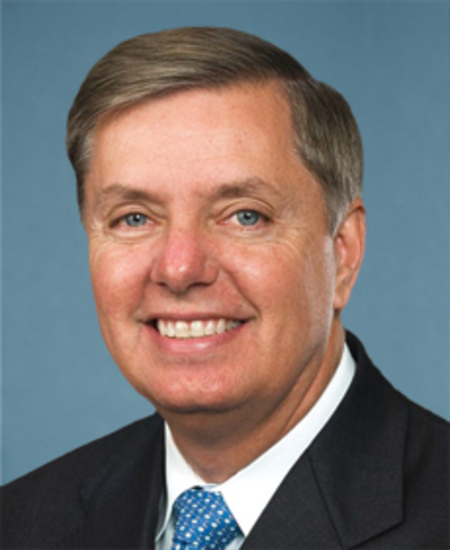
Sen. Lindsey Graham
Sponsored bills
Holding Accountable Russian Mercenaries Act or the HARM Act This bill requires the Department of State to designate the PMC Wagner Group as a foreign terrorist organization. Such designation also applies to any affiliated and successor entities undertaking malign activities against the United States and its allies or partners. (Among other things, such a designation allows the Department of the Treasury to require financial institutions to block transactions involving the organization.) The President may waive the application of sanctions against these entities if the President determines it to be in the national interest.
United States Foundation for International Conservation Act of 2022 This bill requires the Department of State to establish a foundation to provide grants for projects to manage protected and conserved areas in low- and middle-income countries with high levels of biological diversity or species and ecosystems of significant importance. Recipients of grants from this foundation must secure outside funding to match, at minimum, the amount of the grant.
Journalism Competition and Preservation Act of 2022 This bill sets out a process through which certain broadcast or digital news providers may collectively negotiate with covered online platforms (e.g., social media companies) regarding use of the news providers' content by the platforms. Specifically, the bill authorizes an eligible provider (e.g., one with no more than 1,500 full-time employees and nonnetwork news broadcasters that engage in specified news practices) to jointly form an entity with other eligible providers to negotiate the pricing, terms, and conditions by which certain online platforms use the providers' content. A covered platform is generally one that (1) has at least 50 million monthly domestic users, and (2) is owned or controlled by a person with either sales or a market capitalization that exceeds a specified amount or at least one billion monthly users worldwide. The bill establishes requirements concerning the formation, governance, operation, and termination of the joint negotiation entity. It also exempts from antitrust laws certain actions by a joint negotiation entity (e.g., providers jointly denying a platform's access to the providers' content). The bill outlines requirements governing the conduct of the negotiations by, for example, requiring the parties to negotiate in good faith. Additionally, the bill provides for private rights of action if the requirements for a negotiation are not met and establishes requirements for arbitration in limited circumstances. The Government Accountability Office must study the impact of the joint negotiations, including their effects on local and regional news and the employment of journalists. In general, the bill's provisions terminate six years after its enactment.

Maddy summaryThis bill grants a federal charter to the National American Indian Veterans, Incorporated, establishing it as a legally recognized nonprofit organization. It directly affects American Indian veterans by creating a formal entity to unite them, advocate for their needs with government agencies, and support tribal veterans services through outreach and training. Key provisions include requiring the organization to maintain tax-exempt status, prohibiting stock or dividends, mandating annual congressional reports on its activities, and granting exclusive rights to its name and emblems. The charter imposes strict governance rules to ensure the organization remains focused on veteran advocacy without distributing assets to members.
Reinvesting In Shoreline Economies and Ecosystems Act of 2022 or the RISEE Act of 2022 This bill expands the amount of revenue generated from leases for energy development on federal land or submerged lands in the Outer Continental Shelf that is shared with certain states and coastal communities. For example, the bill dedicates a percentage of the revenue generated from offshore wind leases for coastal states. Currently, this revenue is deposited in the U.S. Treasury. In addition, the bill increases the amount of revenue generated from offshore oil and gas leases that is shared with states under the Gulf of Mexico Energy Security Act. States must use the funding from the revenue for specified purposes, such as coastal restoration, conservation, or infrastructure.
Governing Unaccredited Representatives Defrauding VA Benefits Act or the GUARD VA Benefits Act This bill imposes criminal penalties and/or fines on individuals for directly or indirectly soliciting, contracting for, charging, or receiving any unauthorized fee or compensation with respect to the preparation, presentation, or prosecution of any claim for Department of Veterans Affairs benefits. The attempted commission of such offenses is also punishable by fine or imprisonment.
Electoral Count Reform and Presidential Transition Improvement Act of 2022 This bill revises the process of casting and counting electoral votes for presidential elections. The bill also revises provisions related to the presidential transition process. The bill specifies that the choice of electors must occur in accordance with the laws of the state enacted prior to election day. Additionally, the bill identifies each state's governor (unless otherwise identified in the laws or constitution of a state in effect on election day) as responsible for submitting the certificate of ascertainment identifying the state's electors. Further, the bill provides for expedited judicial review for any action brought by an aggrieved presidential or vice-presidential candidate arising under the U.S. Constitution or U.S. laws with respect to the issuance or transmission of such a certificate. The bill revises the framework for the joint session of Congress to count electoral votes and make a formal declaration of which candidates have been elected President and Vice President. Among other changes, the bill (1) specifies that the role of the Vice President during the joint session shall be ministerial in nature, and (2) raises the objection threshold in Congress to at least one-fifth of the duly chosen and sworn members of both the House of Representatives and the Senate. The bill also revises the presidential transition process, including to (1) allow more than one candidate to receive federal transition resources under certain circumstances, and (2) require additional reporting by the General Services Administration.
Maddy summarySRES 811 is a ceremonial Senate resolution designating October 2-8, 2022, as "Religious Education Week" to celebrate the role of religious education in the U.S. It does not create new laws or policies but affirms the importance of religious education for moral and civic development. The resolution references historical figures, Supreme Court cases supporting religious instruction options, and studies linking religious education to youth well-being. It urges states to accommodate religious education programs, such as school release time for religious classes, but this is a non-binding recommendation. As a resolution, it has no legal effect and solely serves to recognize religious education's contributions.
This resolution designates October 2022 as National Dyslexia Awareness Month and calls on Congress, schools, and educational agencies to recognize that dyslexia has significant educational implications that must be addressed.