

Holocaust Expropriated Art Recovery Act of 2025 This act permanently extends and expands judicial authority under the Holocaust Expropriated Art Recovery Act of 2016. The law allows and establishes procedures for civil claims and causes of action to recover artwork and other property lost between 1933 and 1945 because of Nazi persecution. Among the changes, the act removes the deadline for filing civil claims or causes of action. Currently, the filing deadline is December 31, 2026. (Claims must still be filed within six years of the claimant's discovery of the property in question.) The act permits courts to exercise jurisdiction over civil claims or causes of action against a foreign state without regard to the nationality or citizenship of the alleged victim. The art or property at issue must still have a connection to the foreign state's commercial activities in the United States. Additionally, the act authorizes nationwide service of process, which allows courts to exercise personal jurisdiction over defendants in any judicial district where they may be found, reside, have an agent, or transact business. Finally, the act limits the defenses that may be asserted against civil claims or causes of action, including by prohibiting defenses based on the passage of time, including equitable defenses such as laches (i.e., unreasonable delays); and discretionary bases for dismissal that are unrelated to the merits of the claim, including international comity (i.e., deference to the laws of other countries). These changes apply to pending and future civil claims or causes of action.
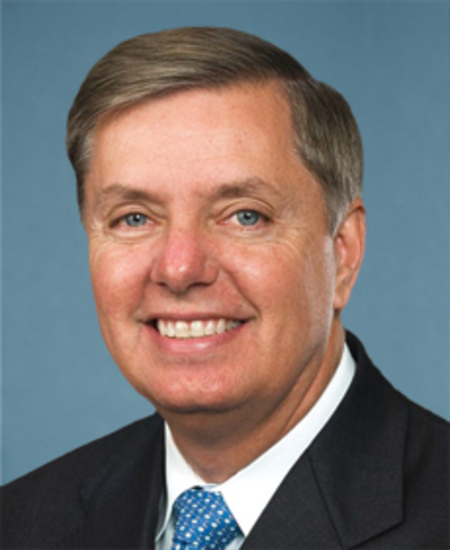
Sen. Lindsey Graham
Sponsored bills
Maddy summaryThe FARM Stability Act proposes changes to wage requirements for H-2A temporary agricultural workers in the United States. It would require the Secretary of Labor to establish a two-tiered wage system based on skill levels, with higher pay for workers who have formal training or significant experience compared to entry-level workers. The bill also mandates that wages account for housing costs by calculating an hourly adjustment factor based on average fair market rent for four-bedroom units, limited to 30 percent of the base wage rate. These provisions would directly affect employers hiring H-2A workers and the workers themselves by modifying how minimum wages are determined and adjusted annually.
Maddy summaryThis bill amends the Marine Mammal Protection Act to create new provisions specifically for sea turtles. It establishes a dedicated $5 million annual grant program (2025-2030) for sea turtle rescue and rehabilitation, funded through a new "Sea Turtle Rescue, Rehabilitation, and Rapid Response Fund" with $500,000 yearly. Eligible applicants include coastal organizations with Endangered Species Act authorizations or cooperative agreements, required to follow specific care standards and data reporting. The law directly affects wildlife rehabilitation groups and coastal communities handling stranded sea turtles by providing targeted federal funding and clear grant eligibility criteria.
Maddy summaryThe FISH Act of 2025 establishes a U.S. government "blacklist" of foreign fishing vessels, fleets, and their beneficial owners engaged in illegal, unreported, or unregulated (IUU) fishing or fishing involving forced labor. The bill prohibits listed vessels from accessing U.S. ports, receiving supplies within U.S. waters, and having their seafood imported into the United States. It creates procedures for adding vessels to the list based on evidence from international organizations, U.S. authorities, or civil society, with mechanisms for removal after corrective actions are taken. The act also authorizes sanctions against entities supporting IUU fishing and requires reports on enforcement efforts and technological solutions to combat IUU fishing.
Maddy summaryThis bill prohibits public colleges and universities receiving federal funding from denying religious student groups access to campus facilities or official recognition solely because of their religious beliefs, practices, or standards. It directly affects public higher education institutions and religious student organizations seeking equal treatment alongside secular groups. The key mechanism requires institutions to provide religious groups with the same rights, benefits, and privileges - such as meeting space, event scheduling, and official status - as non-religious student organizations. This policy change ensures religious groups cannot be discriminated against in campus activities through the threat of withheld federal funding.
Maddy summaryThis bill would allow federal law enforcement officers, including retired officers, to purchase firearms that have been retired from federal service. It requires the General Services Administrator to create a program where officers can buy these surplus weapons within six months of retirement, provided they are in good standing with their agency. The firearms would be sold at salvage value, which reflects their age and condition, and the program must be established within one year of the bill's enactment. The legislation defines eligible officers and firearms using existing legal definitions while excluding certain machineguns that were not lawfully possessed before specific federal restrictions took effect.
Maddy summaryThis resolution celebrates the 175th anniversary of the Young Men's Christian Association (YMCA), a nonprofit organization founded in 1851 that operates over 2,600 locations across the United States. The bill formally recognizes the YMCA's historical contributions, including its role in inventing basketball, providing early childcare and education services, and delivering humanitarian aid during wartime. It also acknowledges the organization's current work in offering fitness programs, youth services, and community support to millions of people annually. The Senate resolution expresses appreciation for the YMCA's staff and volunteers and encourages continued efforts to address social isolation through community-building programs.
Maddy summaryThis bill establishes a sanctions framework that would impose economic penalties on the Chinese government and Communist Party if they threaten Taiwan's security. It requires the President to identify threats and then blocks property, restricts financial transactions, and prohibits investments in sanctioned Chinese entities. The legislation also allows for increased import duties on Chinese goods and bans the trading of Chinese securities on U.S. exchanges. Key provisions include targeting Chinese officials, state-owned banks, and companies that support China's military-industrial capacity, while providing the President authority to waive sanctions for national security reasons.
Maddy summaryThe Stop Illegal Alien Cops Act amends a federal firearms law to adjust references to prohibitions on firearm possession. It replaces two existing references (to restrictions on illegal aliens and certain transfers) with four, including the current prohibition on illegal aliens (people without legal U.S. immigration status) from possessing firearms. The bill's title indicates it targets illegal aliens serving as police officers, as they would require firearm possession for their duties. However, the bill text does not explicitly state this application to law enforcement roles, only modifying the firearms law.
Maddy summaryS 3868, the Count the Crimes to Cut Act, requires the Attorney General and specific federal agencies to compile detailed reports on federal criminal offenses. The bill mandates that agencies submit lists of all criminal statutory offenses (under federal law) and criminal regulatory offenses (enforceable via regulations), including their penalties, annual prosecution numbers over 15 years, and mental state requirements. These reports will be made publicly accessible via online indexes on government websites within two years. The bill directly affects agencies like the DOJ, EPA, FTC, and others listed, aiming to increase transparency about the scope of federal criminal law without changing existing penalties or enforcement.