

Maddy summaryThis bill prohibits public colleges and universities from denying religious student groups access to campus facilities or official recognition that is available to other student organizations. It directly affects public institutions of higher education and religious student organizations by requiring equal treatment based on the institution's policies for non-religious groups. The key provision states that no federal funds can be withheld from an institution that denies a religious group access to facilities or recognition due to its religious beliefs, practices, speech, leadership standards, or conduct codes. The law applies to all public colleges receiving funds under the Higher Education Act of 1965.
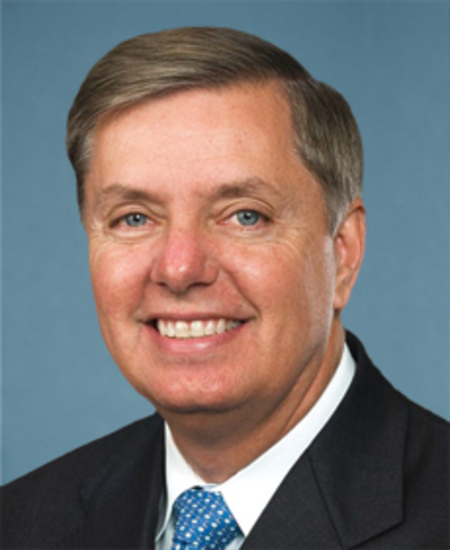
Sen. Lindsey Graham
Sponsored bills
Maddy summaryS 893, the "Let Experienced Pilots Fly Act," raises the mandatory retirement age for commercial airline pilots from 65 to 67 years old for most scheduled passenger flights. It directly affects pilots employed by airlines operating under standard commercial regulations (most major airline flights in U.S. airspace). The bill amends existing FAA rules to allow pilots over 65 to continue flying if already employed before the law's enactment or hired new, while requiring pilots aged 60+ to maintain a current first-class medical certificate. This change aims to retain experienced pilots without altering safety training requirements or medical standards for age.
Maddy summaryThis bill reduces the weight thresholds triggering enhanced federal sentencing for fentanyl and synthetic opioid offenses. It amends the Controlled Substances Act to lower quantities from 400 grams to 20 grams for mandatory minimums (and similar reductions for other penalties), directly affecting individuals convicted of fentanyl-related trafficking. The bill also directs the U.S. Sentencing Commission to update federal sentencing guidelines within 120 days to align with these changes. Additionally, it requires the U.S. Postal Service to increase chemical screening devices, dedicate personnel for 24/7 analysis, and allocates $9 million for interdiction efforts targeting fentanyl and synthetic opioids in mail shipments.
Maddy summaryThis bill modifies U.S. tax code to boost research and development (R&D) investment by businesses. It allows companies to immediately deduct R&D costs (instead of amortizing them over 5 years) and expands refundable tax credits for small businesses, raising the annual credit cap from $250,000 to $750,000 by 2032. Small businesses with gross receipts under $15 million can now qualify for higher credit rates (up to 20% of R&D costs) and may exclude years with no R&D expenses when calculating credits. The changes apply to taxable years beginning after December 2022, directly benefiting R&D-focused startups and small businesses.
Maddy summaryThis bill prohibits federal, state, and local governments from enforcing any law that restricts the right to possess, carry, or transport firearms unless the law aligns with the U.S.'s historical tradition of firearm regulation. It directly affects states and localities that have enacted gun control measures, such as bans on carrying firearms across state lines or restrictions on commonly used firearms. Key provisions allow individuals or gun rights organizations to sue to block enforcement of such laws and require courts to award attorney fees to successful plaintiffs. The bill also clarifies that state laws offering stronger gun rights protections remain valid and unaffected.
Maddy summaryThis joint resolution (SJRES 20) seeks to block a 2023 rule from the Department of Justice and Bureau of Alcohol, Tobacco, Firearms and Explosives (ATF) that classified certain firearms with stabilizing braces as rifles under federal law. If passed, it would nullify the rule, meaning firearms equipped with these braces would no longer be subject to the rule’s classification requirements. The resolution uses the congressional disapproval process under Title 5, U.S. Code, to stop the rule from taking effect, directly affecting firearm manufacturers and owners who use stabilizing braces on weapons.
Maddy summaryThis is a ceremonial Senate resolution (SRES 110) honoring the late James George Abourezk, the first Arab American to serve in the U.S. Senate (1973-1979) from South Dakota. It commemorates his legacy, including his work re-establishing the Senate Committee on Indian Affairs and co-authoring key Native American rights legislation like the Indian Child Welfare Act. The resolution directs the Senate to adjourn in his memory and send a copy to his family, acknowledging his service as a representative and advocate for Native American communities. As a procedural resolution, it has no legislative effect beyond commemoration.
Maddy summarySRES 107 is a non-binding Senate resolution recognizing that the Equal Rights Amendment (ERA), proposed by Congress in March 1972, expired when its 7-year ratification deadline passed without enough states approving it. It affirms that Congress has no constitutional authority to alter the terms of a proposed amendment after it is submitted to states or after it expires. The resolution cites legal precedents, including Supreme Court rulings and a 2020 Department of Justice opinion, stating that ratification deadlines are binding and cannot be extended retroactively. It concludes that any future effort to adopt the ERA would require a new congressional proposal, not modifications to the 1972 version. This resolution does not change current law or affect ongoing state ratification efforts for a new ERA proposal.
Maddy summaryS 821 establishes a new U.S. Ambassador-at-Large for the Arctic Region within the State Department, appointed by the President with Senate approval. This position coordinates U.S. foreign policy across Arctic-related issues - including security, environmental protection, indigenous affairs, resource management, and scientific research - reporting directly to the Secretary of State. The Ambassador will work with other federal agencies and coordinate with Arctic Council nations (the U.S., Canada, Denmark, Iceland, Norway, Sweden, Finland, and Russia) on matters affecting the defined Arctic region, which includes northern U.S. territories, the Arctic Ocean, and adjacent seas. The bill creates a dedicated diplomatic role to centralize U.S. engagement in Arctic affairs without altering existing agency authorities.