

Work Opportunity Tax Credit Disability Expansion and Enhancement Act This bill expands the work opportunity tax credit to include as a member of a targeted group a qualified SSDI recipient (i.e., an individual certified as receiving disability insurance benefits for any month ending within the 60-day period ending on the hiring date). For employers who hire vocational rehabilitation referrals, Supplemental Security Income recipients, or qualified SSDI recipients, the bill also (1) increases the amount of wages that may be taken into account for purposes of the credit, and (2) allows an additional credit for second-year wages.
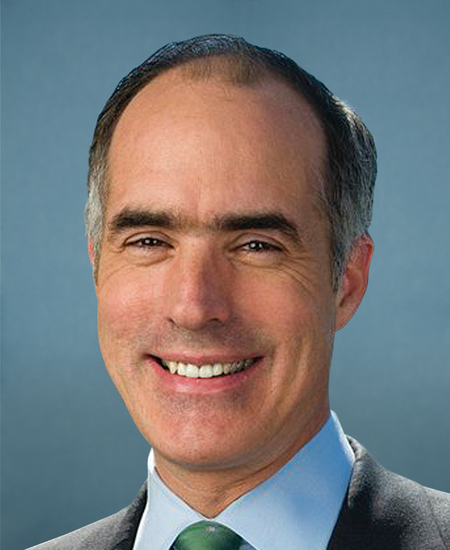
Sen. Robert P. Casey, Jr.
Sponsored bills
Fresh Start Act of 2021 This bill authorizes the Department of Justice to award grants for states to implement automatic expungement laws (i.e., laws that provide for the automatic expungement or sealing of an individual's criminal records).
Higher Education Mental Health Act of 2021 This bill requires the Department of Education to establish an Advisory Commission on Serving and Supporting Students with Mental Health Disabilities in Institutions of Higher Education. The commission must conduct a study and report on services available to students with mental health disabilities in institutions of higher education (IHEs) and the effectiveness of such services in supporting these students; the impact of policies and procedures, such as reasonable accommodation and disciplinary policies, that help or hinder the goal of providing equal opportunity to these students; the use of protected health information of these students by IHEs; the impact of providing mental health services on a student's academic performance, well-being, and ability to complete college; conclusions on the major challenges facing these students; and recommendations to improve the overall education, retention, and graduation of these students.
Improving Seniors' Timely Access to Care Act of 2021 This bill establishes several requirements and standards relating to prior authorization processes under Medicare Advantage (MA) plans. Specifically, MA plans must (1) establish an electronic prior authorization program that meets specified standards, including the ability to provide real-time decisions in response to requests for items and services that are routinely approved; (2) annually publish specified prior authorization information, including the percentage of requests approved and the average response time; and (3) meet other standards, as set by the Centers for Medicare & Medicaid Services, relating to the quality and timeliness of prior authorization determinations.
State, Local, Tribal, and Territorial Fiscal Recovery, Infrastructure, and Disaster Relief Flexibility Act This bill allows states, tribes, territories, and localities to use certain COVID-19 relief funds for new categories of spending, including for natural disasters and infrastructure projects. It also makes changes to expenditure deadlines and other aspects of this funding. Specifically, recipients may use funds for emergency relief from natural disasters and associated negative economic impacts of natural disasters. In addition, recipients may use a portion of their COVID-19 relief funds for designated infrastructure projects, such as nationally significant freight and highway projects. Furthermore, the bill allows recipients to expend COVID-19 relief funds on these types of infrastructure projects until September 30, 2026. Under current law, recipients must expend the funds by December 31, 2024. Other changes in the bill include (1) modifying eligibility and allocation requirements for funding set aside for counties and Indian tribes that are near public lands, (2) allowing Indian tribes an additional year to expend their COVID-19 relief funds, and (3) establishing a process for government entities to decline COVID-19 relief funds and requiring any declined funds to be used to reduce the federal deficit.
Freedom to Vote Act This bill addresses voter registration and voting access, election integrity and security, redistricting, and campaign finance. Specifically, the bill expands voter registration (e.g., automatic and same-day registration) and voting access (e.g., vote-by-mail and early voting). It also limits removing voters from voter rolls. Next, the bill establishes Election Day as a federal holiday. The bill declares that the right of a U.S. citizen to vote in any election for federal office shall not be denied or abridged because that individual has been convicted of a criminal offense unless, at the time of the election, such individual is serving a felony sentence. The bill establishes certain federal criminal offenses related to voting. In particular, the bill establishes a new criminal offense for conduct (or attempted conduct) to corruptly hinder, interfere with, or prevent another person from registering to vote or helping someone register to vote. Additionally, the bill sets forth provisions related to election security, including by requiring states to conduct post-election audits for federal elections. The bill outlines criteria for congressional redistricting and generally prohibits mid-decade redistricting. The bill addresses campaign finance, including by expanding the prohibition on campaign spending by foreign nationals, requiring additional disclosure of campaign-related fundraising and spending, requiring additional disclaimers regarding certain political advertising, and establishing an alternative campaign funding system for certain federal offices.
This resolution recognizes (1) the celebration of Hispanic Heritage Month from September 15 - October 15, 2021; and (2) the integral role of Latinos and their manifold heritage in the economy, culture, and identity of the United States.
Maddy summaryThis Senate resolution designates September 2021 as National Childhood Cancer Awareness Month. It requests federal, state, local governments, and nonprofit organizations to observe the month with public awareness programs focused on childhood cancer risks. The resolution also encourages ongoing medical and psychosocial care for childhood cancer survivors and recognizes childhood cancer as a public health priority. As a symbolic resolution, it does not create new laws or funding but aims to raise public awareness.
Maddy summarySRES 372 is a symbolic Senate resolution designating the week beginning September 13, 2021, as "National Hispanic-Serving Institutions Week." It recognizes Hispanic-Serving Institutions (HSIs) - colleges and universities with at least 25% Hispanic undergraduate enrollment - as vital providers of higher education to underserved students, particularly Hispanic learners. The resolution calls on the public and organizations to observe the week with events supporting these institutions, which serve 2.3 million Hispanic students nationwide. This is a non-binding commemorative measure with no policy changes or funding impacts.
Homes for Every Local Protector, Educator, and Responder Act of 2021 or the HELPER Act of 2021 This bill establishes a program administered by the Department of Housing and Urban Development to provide mortgage assistance to law enforcement officers, elementary and secondary school teachers, firefighters, or other first responders. Specifically, these individuals may be eligible for a one-time mortgage on a primary family residence with no down payment and no monthly mortgage insurance premium.