

Maddy summaryThis Senate resolution (SRES 464) expresses symbolic support for National Adoption Month (November) and National Adoption Day (November 20), encouraging public awareness of children awaiting adoption. It does not create new laws or allocate funding but urges U.S. citizens to consider adoption and support efforts to provide safety and permanency for children in foster care. The resolution highlights challenges like the pandemic's impact on foster care systems while affirming that every child deserves a permanent family. It directly affects no specific group through policy changes - it is a non-binding statement of support endorsed by 30+ senators.
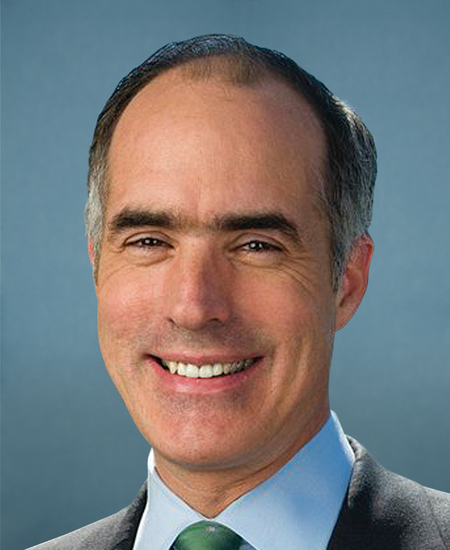
Sen. Robert P. Casey, Jr.
Sponsored bills
Food Donation Improvement Act of 2021 This bill expands liability protections for the donation of food and grocery products. Specifically, the bill expands the liability protections to include donations of an apparently fit grocery product or apparently wholesome food for which the recipient is charged a good Samaritan reduced price that is no greater than the cost of handling, administering, and distributing the food or product; or that is donated directly to a needy individual by a retail grocer, wholesaler, agricultural producer, restaurant, caterer, school food authority, or institution of higher education. The Department of Agriculture must issue regulations that clarify the quality and labeling standards that food products donated under the Bill Emerson Good Samaritan Food Donation Act must meet to be eligible for liability protection.
This bill redesignates the Geospatial Learning Center in the Next NGA West facility in St. Louis, Missouri, as the Senator Roy Blunt Geospatial Learning Center.
Providing Assistance for Transit Help to College Act or the PATH to College Act This bill authorizes grants for improving transit connections for students at institutions of higher education, such as by adding transit stops within walking distance of a campus or subsidizing transit costs for students. The Department of Transportation may award the grants to partnerships of public transit providers and one or more community colleges, historically Black colleges and universities, tribal colleges and universities, and other minority-serving institutions.
Healthy Maternity and Obstetric Medicine Act or the Healthy MOM Act This bill expands health insurance coverage availability for pregnant individuals. It requires health insurers, health insurance exchanges, and group health plans to offer a special enrollment period to pregnant individuals. The special enrollment period offered by an insurer or exchange must begin when the pregnancy is reported to the insurer or exchange. The special enrollment period offered by a group health plan must begin when the pregnancy is reported to the plan or is confirmed by a health care provider. The bill also makes pregnancy a qualifying life event for the purpose of enrolling in a federal employee health benefit plan. Additionally, a group health plan or health insurer that covers dependents must provide coverage for maternity care to all covered individuals. Any individual who is eligible for Medicaid and is, or becomes, pregnant maintains such eligibility for one year after the end of the pregnancy. The bill revises the range in which a state must establish a maximum level of family income for pregnant women and infants to be eligible for Medicaid. The upper limit of the range is eliminated and the lower limit is set to the level in place on January 1, 2014.
Transformation to Competitive Integrated Employment Act This bill addresses employment standards for people with disabilities. First, the Department of Labor must award grants to states and certain eligible entities to assist them in transforming their business and program models to support people with disabilities by providing competitive integrated employment, assisting them in finding and retaining work in such employment, providing them with integrated employment and integrated community participation and wraparound services, and ensuring that such services comply with federal regulations for individuals receiving home and community-based services. The bill also prohibits the issuance of new special certificates that allow payment of subminimum wages to people with disabilities and phases out existing certificates over a five-year period. Further, Labor's Office of Disability Employment must award grants for technical assistance and other strategic support to employers transitioning from special certificates to competitive integrated employment for people with disabilities. Labor must contract with a nonprofit entity to conduct an evaluation of the impact of these transitions.
Airline Passengers' Bill of Rights This bill expands protections for passengers in air transportation. Among other things, the bill requires the Department of Transportation to implement regulations relating to protections for airline passengers from being required to involuntarily relinquish their seats, unless necessary for safety or security; the elimination of the dollar limitations on compensation to passengers denied boarding due to overbooking; compensation to passengers for delayed or cancelled flights; interline agreements between air carriers and other transportation providers; training on the rights of passengers; unreasonable air carrier fees; unrestricted access of consumers to information on schedules, fares, fees, and taxes; accuracy in pricing of tickets and disclosure of lowest fares; and notifications to passengers of their rights and eligibility for refunds. The Federal Aviation Administration must (1) prohibit any air carrier from reducing seat size or leg room, and (2) report on the quality of food and potable water on passenger aircraft and the sufficiency of flight crews and aircraft. The bill provides a private right of action for passengers aggrieved by airline actions and increases civil penalties on air carriers for violations of passenger protections.
Bringing an End to Harassment by Enhancing Accountability and Rejecting Discrimination in the Workplace Act or the BE HEARD in the Workplace Act This bill expands protections against discrimination and harassment in the workplace and raises the minimum wage for tipped employees. Specifically, the bill (1) makes it an unlawful employment practice to discriminate against an individual in the workplace based on sexual orientation, gender identity, pregnancy, childbirth, a medical condition related to pregnancy or childbirth, or a sex stereotype; and (2) provides a statutory definition for what constitutes workplace harassment. Further, these protections apply to all workplaces, regardless of size, and to all workers, including independent contractors, interns, volunteers, and trainees. The bill prohibits employers from entering into contracts or agreements with workers that contain certain nondisparagement or nondisclosure clauses and prohibits certain predispute arbitration agreements and postdispute agreements. It also establishes grant programs to (1) prevent and respond to workplace discrimination and harassment, (2) provide legal assistance for low-income workers, and (3) establish a system of legal advocacy in states to protect the rights of workers. The bill further provides employees the right to retain their tips and it increases, in specified annual increments, the minimum wage for tipped employees to match the federal minimum wage for nontipped employees. Additionally, the bill requires the Equal Employment Opportunity Commission to provide specified training and resource materials, establish and convene a harassment prevention task force, and establish an Office of Education and Outreach with regard to prohibited discrimination and harassment in employment. The bill also requires specified studies, reports, and research on prohibited workplace harassment.
Creating Early Childhood Leaders Act This bill revises requirements for effective school leadership programs that are funded by Teacher Quality Partnership Grants. Specifically, the bill requires the leadership programs to train early education leaders on skills concerning early childhood development and instruction of children from birth through age eight.
Maddy summarySRES 451 is a commemorative Senate resolution honoring the late Senator Max Cleland (D-GA), who died November 9, 2021. The resolution recognizes his service as a Vietnam War veteran (losing both legs and an arm in combat), his 50+ years of public service including roles as Georgia State Senator, Secretary of State, U.S. Senator, and Administrator of the Veterans Administration, and his advocacy for veterans. It formally expresses the Senate’s "profound sorrow" and "deep regret" over his death, commemorates his legacy of service to Georgia and veterans, and requests the Secretary of the Senate transmit the resolution to his family. This is a ceremonial resolution with no policy changes or legal effect.