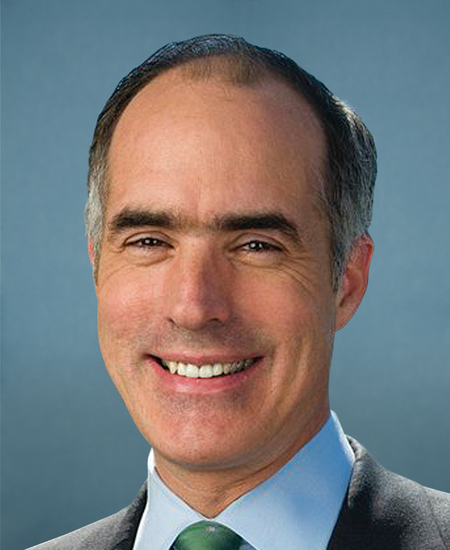
Photo of Robert P. Casey, Jr.
D United States Senate · Pennsylvania

Sen. Robert P. Casey, Jr.

Compare
Total votes
597
all sessions
Attendance
99%
5 missed
Near the chamber average
With party
97%
of cast votes
Higher than 76% of chamber peers
Bipartisan score
2%
crosses aisle rarely
Lower than 77% of chamber peers
Sponsored
1,299
bills & resolutions
Higher than 84% of chamber peers
Committees
0
assignments
1,299 bills and resolutions

Sponsored bills

Total
1,299
Primary
284
Co-sponsor
1,015
This page
1,299
matching current filters
Co-sponsor S 1146
Passed · United States Senate · Co-sponsor
Find and Protect Foster Youth Act

Maddy summaryThis bill requires the federal government to evaluate state and tribal protocols for handling children missing from foster care and provide technical assistance to improve these systems. It mandates the Secretary to assess how effectively states identify and respond to missing youth, identify obstacles, and share best practices for tracking and recovery. Additionally, it directs the Secretary to assist states in implementing mandatory screenings for sex trafficking risks when youth return to foster care after going missing, including documentation and appropriate service referrals. The bill directly affects states, tribes, and tribal organizations administering foster care programs under federal law.

Passed Sep 19, 2024 1 co-sponsor
Co-sponsor SRES 825
In committee · United States Senate · Co-sponsor
A resolution recognizing the significance of equal pay and the pay disparity between disabled women and both disabled and nondisabled men.

Maddy summaryS. RES. 825 is a Senate resolution recognizing the significant pay gap between disabled women and both disabled and nondisabled men. It cites data showing disabled women earn, on average, just 50 cents for every dollar paid to nondisabled men, with even wider disparities for disabled women of color (e.g., 44 cents for disabled Latinas). The resolution highlights systemic barriers like occupational segregation (overrepresentation in low-paid jobs), discrimination, inadequate support services, and public benefits work disincentives as key drivers of this gap. While not creating new laws, the resolution aims to formally acknowledge these inequities and reaffirm the Senate’s commitment to addressing wage disparities for disabled women.

In committee Sep 18, 2024 1 co-sponsor
Co-sponsor SRES 828
In committee · United States Senate · Co-sponsor
A resolution expressing the sense of the Senate that every person has the basic right to emergency health care, including abortion care.

Maddy summarySRES 828 is a non-binding Senate resolution expressing the chamber’s position that every person has the right to emergency health care, including abortion care, during medical emergencies. It highlights that abortion restrictions in emergencies force providers to choose between treating patients or risking criminal charges, disproportionately harming Black, Indigenous, people of color, immigrants, low-income individuals, and LGBTQI+ patients. The resolution specifically notes that such bans create dangerous uncertainty for life-threatening conditions like severe hemorrhage, sepsis, or placenta previa. As a symbolic statement, it does not create new law or alter existing policies.

In committee Sep 18, 2024 1 co-sponsor
Primary S 5094
In committee · United States Senate · Lead sponsor
Farm to Food Bank Reauthorization Act of 2024

Maddy summaryThis bill reauthorizes and updates a program allowing states to purchase agricultural products for food banks. It changes language from "donate" to include "sell" or "otherwise provide," enabling states to buy surplus farm goods instead of relying solely on donations. Key provisions include increasing annual funding from $4 million to $8 million (2024-2029) and adding a reimbursement mechanism for states to cover eligible costs when purchasing products from farmers or distributors. The bill directly affects state food assistance programs, farmers, and food banks by creating a more flexible system for sourcing and distributing agricultural products.

In committee Sep 18, 2024 0 co-sponsors
Primary S 5101
In committee · United States Senate · Lead sponsor
Farmer Driven Conservation Outcomes Act of 2024

Maddy summaryThe Farmer Driven Conservation Outcomes Act of 2024 requires the U.S. Department of Agriculture to measure the environmental and economic impacts of federal conservation programs, such as the agricultural conservation easement program and regional partnership programs. It mandates a new system to track progress toward conservation goals through voluntary on-farm data collection (with compensation for farmers), a national committee including farmers and experts, and biennial reports to Congress on program effectiveness. The Secretary must evaluate cost-effectiveness, provide quantitative outcome metrics, and recommend improvements for conservation practices. This law directly affects federal conservation program management and participating farmers who choose to engage in monitoring.

In committee Sep 18, 2024 0 co-sponsors
Co-sponsor SRES 822
In committee · United States Senate · Co-sponsor
A resolution designating September 2024 as "National Voting Rights Month".

Maddy summaryThis resolution designates September 2024 as "National Voting Rights Month" to highlight historical and ongoing voting rights issues in the U.S. It encourages all Americans to support voting access and urges Congress to pass specific voting rights legislation, including the Freedom to Vote Act and the Democracy Restoration Act. The resolution also recommends that schools teach about voting history, voter suppression, and current voting restrictions. As a symbolic measure, it does not create new laws but aims to raise awareness about voting rights challenges.

In committee Sep 17, 2024 1 co-sponsor
Co-sponsor SRES 823
Passed · United States Senate · Co-sponsor
A resolution recognizing Hispanic Heritage Month and celebrating the heritage and culture of Latinos in the United States and the immense contributions of Latinos to the United States.

Maddy summarySRES 823 is a symbolic Senate resolution recognizing Hispanic Heritage Month (September 15-October 15, 2024) and celebrating the cultural contributions and achievements of Latinos in the United States. It does not create new laws or affect specific groups; instead, it urges the public to observe the month through activities honoring Latino heritage. The resolution highlights Latinos' economic impact (e.g., $3.4 trillion purchasing power), demographic significance (19.5% of U.S. population), and historical military service, but these statistics serve as context, not policy changes. As a ceremonial resolution, it has no legal force and is intended to raise awareness, not alter government programs or funding.

Passed Sep 17, 2024 1 co-sponsor
Co-sponsor SRES 815
Passed · United States Senate · Co-sponsor
A resolution designating the week beginning on September 9, 2024, as "National Hispanic-Serving Institutions Week".

Maddy summarySRES 815 designates the week beginning September 9, 2024, as "National Hispanic-Serving Institutions Week" to recognize institutions that serve a significant Hispanic student population. It specifically refers to degree-granting colleges and universities with at least 25% Hispanic undergraduate enrollment, which collectively serve over 5 million students nationwide. The resolution calls for the public and organizations to observe this week with ceremonies and activities honoring these institutions' role in expanding access to higher education, particularly for low-income and underserved students. This is a ceremonial resolution with no funding or regulatory changes; it simply provides national recognition during Hispanic Heritage Month.

Passed Sep 17, 2024 1 co-sponsor
Primary S 5070
In committee · United States Senate · Lead sponsor
Ensuring Access to Medicaid Buy-in Programs Act of 2024

Maddy summaryThis bill removes a 65-year age limit from Medicaid eligibility rules for working adults with disabilities. Previously, individuals with disabilities who were working and over 64 were excluded from certain Medicaid coverage options. The bill amends two specific provisions of the Social Security Act (sections 1902(a)(10)(A)(ii)(XV) and 1905(v)(1)(A)) to eliminate this age restriction. It directly affects working adults with disabilities who were previously denied Medicaid access solely due to their age. The change updates existing Medicaid eligibility rules without creating new programs or altering benefit levels.

In committee Sep 17, 2024 0 co-sponsors
Co-sponsor S 4445
Introduced · United States Senate · Co-sponsor
Right to IVF Act

Right to IVF Act This bill provides a statutory right to access fertility treatments (e.g., in vitro fertilization). Specifically, under the bill, individuals have the right to access fertility treatments and to make decisions about the use of their reproductive genetic material (e.g., embryos) without limitation or interference. Health care providers and insurers have the right to provide and cover these services, respectively. Manufacturers of applicable drugs or devices also have the right to provide these drugs or devices. The bill supersedes state laws that limit or otherwise interfere with the provision of fertility treatments as set out under this bill, including laws that require medically unnecessary procedures or services in conjunction with fertility treatments or that restrict the ability of individuals to receive fertility treatments based on marital status or sex (including sexual orientation or gender identity). The bill does not affect state health and safety regulations for medical facilities or health care providers that are in accordance with widely accepted and evidence-based medical standards and for which the purpose cannot be achieved in another, nonrestrictive manner. The Department of Justice may bring civil actions against states, individuals, or entities that implement or enforce limitations or requirements that violate this bill. Individuals and health care providers may also bring civil actions.  In addition, the bill provides for coverage of fertility treatments under Medicare and Medicaid and for members of the uniformed services and veterans. It also requires private insurers that cover obstetrical services to also cover fertility treatments.


Introduced Sep 17, 2024 1 co-sponsor
Showing 51 to 60 of 1,299 bills
Previous 1 … 5 6 7 … 130 Next