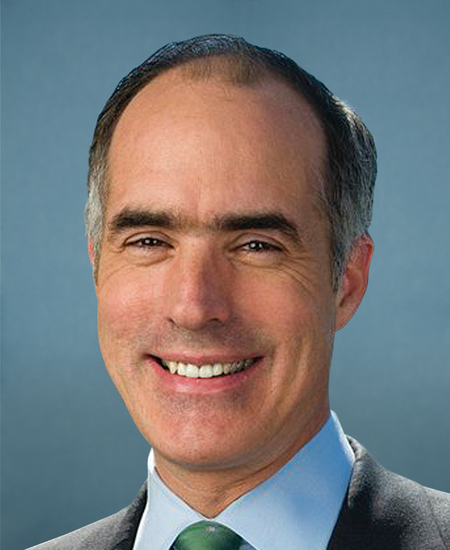
Photo of Robert P. Casey, Jr.
D United States Senate · Former member · Pennsylvania

Sen. Robert P. Casey, Jr.

Compare
Total votes
597
all sessions
Attendance
99%
5 missed
Near the chamber average
With party
97%
of cast votes
Higher than 76% of chamber peers
Bipartisan score
2%
crosses aisle rarely
Lower than 77% of chamber peers
Sponsored
1,299
bills & resolutions
Higher than 84% of chamber peers
Committees
0
assignments
1,299 bills and resolutions

Sponsored bills

Total
1,299
Primary
284
Co-sponsor
1,015
This page
1,299
matching current filters
Co-sponsor S 2427
In committee · United States Senate · Co-sponsor
A bill to amend title XXVII of the Public Health Service Act to require group health plans and health insurance issuers offering group or individual health insurance coverage to permit enrollees to obtain a 365-day supply of contraceptives.

Maddy summaryS 2427 requires group health plans and health insurance issuers (both group and individual plans) to cover a full year's supply (up to 365 days) of contraceptives that are already mandated to be covered under existing law. This means enrollees can obtain a one-time refill for a full year's supply without any additional cost-sharing (like copays or deductibles). The rule applies to all plans with coverage effective January 1, 2024, and requires federal agencies to inform providers and enrollees about the new requirement within 90 days of the law's enactment. The bill directly affects people with health insurance who use prescribed contraceptives, ensuring easier access without extra out-of-pocket costs for a full year's supply.

In committee Jul 20, 2023 1 co-sponsor
Co-sponsor S 2416
In committee · United States Senate · Co-sponsor
Relief for Survivors of Miners Act of 2023

Maddy summaryThe Relief for Survivors of Miners Act of 2023 simplifies benefits for survivors of miners who died from black lung disease (pneumoconiosis). It creates a rebuttable presumption that a miner's death was caused by the disease if they worked 10+ years in coal mines or were totally disabled by the disease at the time of death - this presumption can only be overturned by proving the disease didn’t contribute to the death. The bill also establishes a new program to cover up to $4,500 in attorneys’ fees and $3,000 in medical expenses for contested claims unresolved within a year, with coal operators later reimbursing the fund. Additionally, it requires a Government Accountability Office review of current benefit payments and interim payment practices to assess their financial and emotional impact on survivors.

In committee Jul 20, 2023 1 co-sponsor
Primary S 2440
In committee · United States Senate · Lead sponsor
Exploitative Workplace Surveillance and Technologies Task Force Act of 2023

Maddy summaryThe Exploitative Workplace Surveillance and Technologies Task Force Act of 2023 establishes a White House Task Force to study workplace surveillance practices and their impact on workers. The Task Force will examine how employers collect and use workplace data, including the effects on worker compensation, safety, health, and vulnerable populations such as workers with disabilities, low-wage workers, and workers of color. The Task Force will produce three reports over time, including an initial report within one year of enactment and a final report with recommendations for addressing workplace surveillance. This bill affects employers who employ 11 or more workers (called "covered employers") and federal agencies participating in the Task Force, though it does not directly regulate workplace surveillance.

In committee Jul 20, 2023 0 co-sponsors
Primary S 2419
In committee · United States Senate · Lead sponsor
No Robot Bosses Act

Maddy summaryThe No Robot Bosses Act (S 2419) prevents employers from using computer systems to make employment decisions without proper oversight. It prohibits employers from relying exclusively on automated decision systems for hiring, firing, or other employment decisions, and requires detailed disclosures to employees about how such systems were used. The bill creates a new Technology and Worker Protection Division within the Department of Labor to enforce these rules, and mandates that employers conduct annual tests for discrimination in these systems. The law applies to employers with 11 or more employees, including government contractors, and provides employees with the right to dispute automated decisions through human review.

In committee Jul 20, 2023 0 co-sponsors
Primary S 2456
In committee · United States Senate · Lead sponsor
Protecting Seniors from High Drug Costs Act

Protecting Seniors from High Drug Costs Act This bill limits cost-sharing for covered drugs under the Medicare prescription drug benefit to the negotiated price of the drug, net any manufacturer price concessions. Prescription drug plan sponsors are subject to civil penalties for violations.

In committee Jul 20, 2023 0 co-sponsors
Co-sponsor S 2372
In committee · United States Senate · Co-sponsor
Accelerating Kids’ Access to Care Act

Maddy summaryS 2372, the Accelerating Kids’ Access to Care Act, streamlines enrollment for out-of-state healthcare providers who treat Medicaid-eligible children under 21 with medically complex conditions. It requires states to adopt a process allowing these providers to join state Medicaid/CHIP programs without extra state-level screening, provided they already meet federal Medicare or home-state program requirements and pose low fraud risk. The bill establishes a 5-year enrollment period for eligible providers, directly affecting children needing specialized care across state lines and the providers serving them. Key provisions remove barriers to interstate care coordination while maintaining federal oversight standards.

In committee Jul 19, 2023 1 co-sponsor
Primary S 2360
In committee · United States Senate · Lead sponsor
TEAM Act

Maddy summaryThis bill creates the TEAM Act, establishing a federal pilot program under the Older Americans Act to address hunger among older adults and adults with disabilities. The program, run through the Center for the Aging Network, will implement best practices for healthy food access, seek federal agency collaboration recommendations, test innovative approaches to food insecurity, and evaluate results. It authorizes $5 million annually from 2024 through 2028 for demonstration projects, research, and evaluation related to these activities. The initiative directly affects vulnerable seniors and adults with disabilities by focusing on improving their access to affordable, healthy food through coordinated federal efforts.

In committee Jul 18, 2023 0 co-sponsors
Primary S 2361
In committee · United States Senate · Lead sponsor
Senior Nutrition Task Force Act of 2023

Maddy summaryS 2361, the Senior Nutrition Task Force Act of 2023, creates a federal task force to address hunger and improve nutrition access for older adults and adults with disabilities who receive federal nutrition benefits. The task force, led by the Agriculture Secretary and including representatives from 15+ federal agencies plus appointed community members, will coordinate existing programs, identify best practices, measure progress, and examine barriers to collaboration. It must report to Congress by September 2026 with recommendations for improving access to healthy, affordable food and reducing food insecurity for these groups. The bill directly affects older adults and adults with disabilities relying on federal nutrition programs by aiming to strengthen federal coordination around their needs.

In committee Jul 18, 2023 0 co-sponsors
Co-sponsor S 2344
In committee · United States Senate · Co-sponsor
Freedom to Vote Act

Maddy summary# Summary of Comprehensive Election Reform Bill This document is a comprehensive voting rights and election reform bill containing multiple titles with various provisions designed to: 1. **Restore voting rights** for citizens with criminal convictions (Democracy Restoration Act) - Restores voting rights for citizens not serving felony sentences in correctional institutions - Requires states to notify individuals of restored voting rights upon release or probation - Establishes enforcement mechanisms through civil actions 2. **Strengthen voter identification requirements** - Establishes a broad list of acceptable identification documents - Requires states to provide government-issued identification at no cost - Allows for provisional ballots with sworn statements for those without ID - Includes provisions for electronic documents and copies 3. **Prohibit voter caging and improper voter list maintenance** - Bans the use of "voter caging" documents or lists as evidence for challenging voter eligibility - Establishes strict conditions for removing voters from registration lists - Requires objective and reliable evidence for removals - Mandates notification procedures for voters removed from lists 4. **Enhance election integrity protections** - Prohibits interference with voter registration (including hindering, interfering with, or preventing registration) - Restricts removal of local election administrators to cases of inefficiency, neglect, or malfeasance - Protects election workers from intimidation and harassment - Bans deceptive practices regarding election information within 60 days of an election - Establishes criminal penalties for deceptive election practices 5. **Provides enforcement mechanisms** - Establishes private rights of action for violations - Includes civil and criminal penalties for violations - Requires reports to the Department of Justice for removals of election administrators - Sets specific timeframes for notification and corrective actions The bill aims to expand voting access while maintaining election integrity, with provisions designed to protect voting rights, prevent discrimination, and ensure fair administration of elections for Federal office.


In committee Jul 18, 2023 1 co-sponsor
Co-sponsor S 1664
In committee · United States Senate · Co-sponsor
Healthy Families Act

Maddy summaryThe Healthy Families Act requires most employers (with 15 or more employees) to provide workers with up to 56 hours of paid sick leave annually, earned at a rate of 1 hour for every 30 hours worked. Employees can use this leave for their own illness, medical care, caring for family members with health conditions, or addressing domestic violence, sexual assault, or stalking situations. The law prohibits employers from retaliating against workers who use this leave and mandates that employers post notices about the policy. Smaller employers (with fewer than 15 employees) may provide up to 56 hours of unpaid sick leave instead of paid leave. The Act includes enforcement mechanisms allowing employees to file complaints with the Department of Labor and seek damages for violations.

In committee Jul 18, 2023 1 co-sponsor
Showing 401 to 410 of 1,299 bills
Previous 1 … 40 41 42 … 130 Next