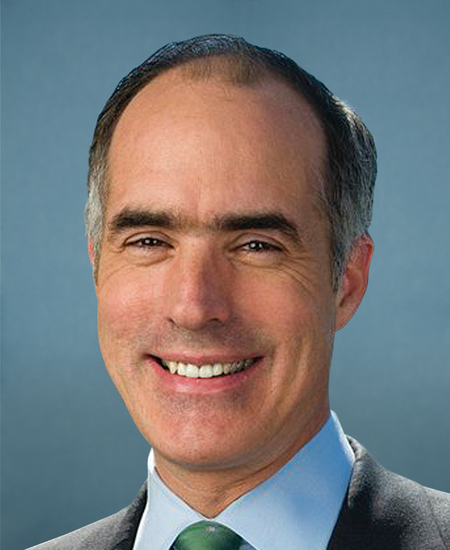
Photo of Robert P. Casey, Jr.
D United States Senate · Pennsylvania

Sen. Robert P. Casey, Jr.

Compare
Total votes
597
all sessions
Attendance
99%
5 missed
Near the chamber average
With party
97%
of cast votes
Higher than 76% of chamber peers
Bipartisan score
2%
crosses aisle rarely
Lower than 77% of chamber peers
Sponsored
1,299
bills & resolutions
Higher than 84% of chamber peers
Committees
0
assignments
1,299 bills and resolutions

Sponsored bills

Total
1,299
Primary
284
Co-sponsor
1,015
This page
1,299
matching current filters
Primary S 453
In committee · United States Senate · Lead sponsor
CHIPPER Act

Children's Health Insurance Program Pandemic Enhancement and Relief Act or the CHIPPER Act This bill extends through FY2022 the 11.5% increase to the enhanced federal matching rate, also known as the enhanced Federal Medical Assistance Percentage (FMAP), that is otherwise applicable under the Children's Health Insurance Program (CHIP), subject to specified conditions. For example, in order to receive the increased FMAP in FY2021 and FY2022, a state must cover, without cost-sharing, testing and treatment for COVID-19 (i.e., coronavirus disease 2019), including vaccines, specialized equipment, and therapies.

In committee Feb 25, 2021 0 co-sponsors
Co-sponsor SRES 75
Passed · United States Senate · Co-sponsor
A resolution celebrating Black History Month.

This resolution recognizes Black History Month as an opportunity to reflect on U.S. history and to commemorate the contributions of African Americans. It calls for the United States to (1) honor the contribution of pioneers who helped to ensure its legacy; and (2) move forward as a nation "indivisible, with liberty and justice for all."

Passed Feb 24, 2021 1 co-sponsor
Co-sponsor S 425
In committee · United States Senate · Co-sponsor
Complete Streets Act of 2021

Complete Streets Act of 2021 This bill directs each state to establish a competitive program to provide technical assistance and grants for the design and construction of complete streets to make transit routes safer and more accessible. Specifically, the bill directs the Department of Transportation (DOT) to establish benchmarks and guidance by which states can implement complete streets programs and eligible entities can carry out complete streets policies and principles; eligible entities seeking technical assistance or funds for a complete streets program to adopt policies using complete streets principles that are approved by the state or metropolitan planning organizations (MPOs) with jurisdiction over such entites; states and MPOs to certify that their complete street policies meet the minimum requirements set out by DOT; states to set aside 5% of their federal highway money to implement a complete streets program; and states and MPOs to adopt design standards for federal surface transportation projects that provide for the safe and adequate accommodation of all users of the surface transportation network, including motorized and non-motorized users, in all phases of project planning, development, and operation.

In committee Feb 24, 2021 1 co-sponsor
Co-sponsor S 424
In committee · United States Senate · Co-sponsor
International Human Rights Defense Act of 2021

International Human Rights Defense Act of 2021 This bill establishes in the Department of State a permanent Special Envoy for the Human Rights of LGBTQI (lesbian, gay, bisexual, transgender, queer, or intersex) Peoples who shall serve as the principal State Department advisor regarding human rights for LGBTQI people and represent the United States in diplomatic matters relevant to the human rights of LGBTQI people. The special envoy shall periodically provide Congress with a U.S. global strategy to prevent and respond to criminalization, discrimination, and violence against LGBTQI people. The State Department and the U.S. Agency for International Development may provide assistance to prevent and respond to such activities against LGBTQI people. The bill also requires that annual country reports on human rights practices include information on criminalization, discrimination, and violence based on sexual orientation and gender identity.

In committee Feb 24, 2021 1 co-sponsor
Co-sponsor S 377
In committee · United States Senate · Co-sponsor
Living Donor Protection Act of 2021

Living Donor Protection Act of 2021 This bill prohibits certain insurance carriers from discriminating against, and provides other protections for, living organ donors. Specifically, carriers may not deny, cancel, or otherwise impose conditions on policies for life insurance, disability insurance, or long-term care insurance based on an individual's status as a living organ donor. The bill also expressly specifies that recovery from organ-donation surgery constitutes a serious health condition that entitles eligible employees to job-protected medical leave. In addition, the Department of Health and Human Services must update educational materials on live organ donation to include information about the benefits of live organ donation and about access to insurance for living organ donors.

In committee Feb 23, 2021 1 co-sponsor
Co-sponsor S 394
In committee · United States Senate · Co-sponsor
Duty To Report Act

Duty To Report Act This bill requires political committees, candidates for federal office, and other individuals to report to the Federal Election Commission (FEC) and the Federal Bureau of Investigation (FBI) any offers of prohibited contributions, including offers of nonpublic information regarding other candidates, by foreign nationals. Specifically, political committees and candidates must report to the FEC within 24 hours any (1) offers of prohibited contributions from foreign nationals, and (2) meetings with foreign governments or their agents. In addition, the bill requires political committees, candidates, immediate family members of candidates, and individuals affiliated with a campaign (e.g., employees and independent contractors) to report to the FBI within 24 hours any offers of prohibited contributions from foreign nationals. Further, the bill establishes a new criminal offense for knowingly and willfully failing to comply with this reporting requirement. A violator is subject to criminal penalties—a fine, a prison term of up to two years, or both. Such reported information may not be used to enforce certain immigration provisions related to the removal of undocumented aliens.

In committee Feb 23, 2021 1 co-sponsor
Co-sponsor S 370
In committee · United States Senate · Co-sponsor
Strengthening Local Processing Act of 2021

Strengthening Local Processing Act of 2021 This bill revises provisions related to meat and poultry processing establishments, including smaller establishments (i.e., those with between 10 and 500 employees) and very small establishments (i.e., those with fewer than 10 employees or annual sales of less than $2.5 million). For example, the Department of Agriculture (USDA) must establish a searchable database of peer-reviewed validation studies for use in developing Hazard Analysis and Critical Control Points plans for smaller and very small establishments. The bill increases the maximum federal cost share from 50% to 65% that USDA may provide to assist states in creating meat and poultry inspection programs. Additionally, USDA must conduct outreach with states that have meat and poultry inspection programs, but that do not have Cooperative Interstate Shipment programs. The Cooperative Interstate Shipment program allows state-inspected facilities to operate as federally-inspected facilities and ship their products in interstate commerce and internationally. USDA must also award competitive grants for activities to adapt production, processing, distribution, and sales systems to respond to and recover from the effects of the COVID-19 pandemic, including activities that support (1) the health and safety of meat and poultry plant employees, suppliers, and customers; (2) increased processing capacity; and (3) the resilience of the small meat and poultry processing sector. Further, the bill establishes grant programs to (1) establish or expand career training programs at community colleges, vocational schools, and universities related to meat and poultry processing; and (2) support smaller and very small establishments by offsetting the cost of training new meat and poultry processors.

In committee Feb 23, 2021 1 co-sponsor
Co-sponsor S 393
In committee · United States Senate · Co-sponsor
Equality Act

Equality Act This bill prohibits discrimination based on sex, sexual orientation, and gender identity in areas including public accommodations and facilities, education, federal funding, employment, housing, credit, and the jury system. Specifically, the bill defines and includes sex, sexual orientation, and gender identity among the prohibited categories of discrimination or segregation. The bill expands the definition of public accommodations to include places or establishments that provide (1) exhibitions, recreation, exercise, amusement, gatherings, or displays; (2) goods, services, or programs; and (3) transportation services. The bill allows the Department of Justice to intervene in equal protection actions in federal court on account of sexual orientation or gender identity. The bill prohibits an individual from being denied access to a shared facility, including a restroom, a locker room, and a dressing room, that is in accordance with the individual's gender identity.

In committee Feb 23, 2021 1 co-sponsor
Co-sponsor S 385
In committee · United States Senate · Co-sponsor
Full-Service Community School Expansion Act of 2021

Full-Service Community School Expansion Act of 2021 This bill reauthorizes through FY2025 and expands the Full-Service Community Schools program. The program provides support for full-service community schools that serve children and their families, particularly for children who attend high-poverty elementary and secondary schools. Specifically, the bill directs the Department of Education (ED) to award grants to eligible entities to plan, implement, expand, and support full-service community schools. An eligible entity is a consortium of (1) one or more local educational agencies or the Bureau of Indian Education; and (2) one or more community-based organizations, nonprofit organizations, Indian tribes, tribal organizations, or other entities. A community school refers to a public elementary or secondary school that incorporates the four pillars of community schools. These four pillars are defined by the bill as (1) integrated student supports that address out-of-school barriers to learning (e.g., medical care and assistance with housing, transportation, or nutrition); (2) expanded and enriched learning time and opportunities (e.g., before- and after-school programs); (3) family and community engagement (e.g., adult education); and (4) collaborative leadership and practices, which must include a school-based leadership team, a community school coordinator, and a community-wide leadership team. Further, the bill directs ED to award grants to states to plan, implement, and expand community schools. A state educational agency that receives a grant must meet certain requirements, such as providing subgrants to local educational agencies, establishing a state-level steering committee, and establishing goals for the implementation and expansion of community schools throughout the state.


In committee Feb 23, 2021 1 co-sponsor
Showing 1,241 to 1,250 of 1,299 bills