

Assault Weapons Ban of 2021 This bill makes it a crime to knowingly import, sell, manufacture, transfer, or possess a semiautomatic assault weapon (SAW) or large capacity ammunition feeding device (LCAFD). The prohibition does not apply to a firearm that is (1) manually operated by bolt, pump, lever, or slide action; (2) permanently inoperable; (3) an antique; or (4) a rifle or shotgun specifically identified by make and model. The bill also exempts from the prohibition the following, with respect to a SAW or LCAFD: importation, sale, manufacture, transfer, or possession related to certain law enforcement efforts, or authorized tests or experiments; importation, sale, transfer, or possession related to securing nuclear materials; and possession by a retired law enforcement officer. The bill permits continued possession, sale, or transfer of a grandfathered SAW, which must be securely stored. A licensed gun dealer must conduct a background check prior to the sale or transfer of a grandfathered SAW between private parties. The bill permits continued possession of, but prohibits sale or transfer of, a grandfathered LCAFD. Newly manufactured LCAFDs must display serial number identification. Newly manufactured SAWs and LCAFDs must display the date of manufacture. The bill also allows a state or local government to use Edward Byrne Memorial Justice Assistance Grant Program funds to compensate individuals who surrender a SAW or LCAFD under a buy-back program.
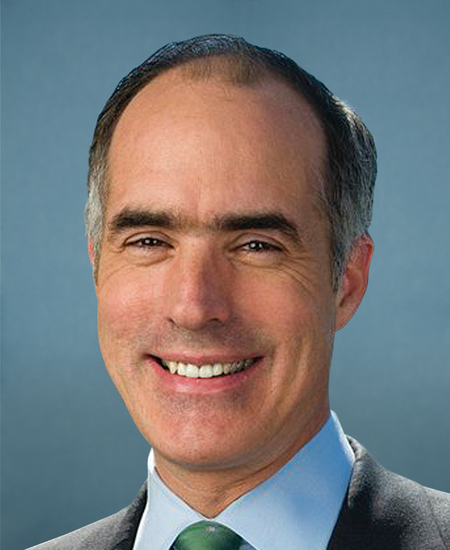
Sen. Robert P. Casey, Jr.
Sponsored bills
Work Opportunities and Resources to Keep Nonprofit Organizations Well Act or the WORK NOW Act This bill requires the Department of the Treasury to establish a grant program to provide emergency relief to certain nonprofit organizations, prioritizing organizations that provide services related to the COVID-19 (i.e., coronavirus disease 2019) pandemic. Organizations receiving funding must use not less than 60% of these funds to hire former and new employees.
Energizing American Shipbuilding Act of 2021 This bill directs (1) the Federal Energy Regulatory Commission (FERC) to require specified percentages of liquefied natural gas exports to be transported on vessels built or retrofitted in the United States and documented under its laws, and (2) the President to require specified percentages of crude oil exports to be transported on vessels built or retrofitted in the United States and documented under its laws. FERC and the President may waive these requirements under specified circumstances. The Energy Information Administration must collect and publish information on exports of natural gas and crude oil by vessels, including forecasts and data on those exports.
Safe Line Speeds During COVID-19 Act of 202 1 This bill directs the Food Safety and Inspection Service of the Department of Agriculture (USDA) to temporarily suspend any waivers and not issue new waivers related to line speeds in meat and poultry establishments and inspection staffing requirements for such establishments through 90 days after the date on which the COVID-19 (i.e., coronavirus disease 2019) emergency period is lifted. Additionally, the implementation of, and conversion to, the New Swine Slaughter Inspection System must be suspended. No funds made available to USDA during such emergency period shall be used to develop, propose, finalize, issue, amend, or implement any policy, regulation, directive, constituent update, or any other agency program that would increase line speeds at meat and poultry establishments. Not later than 90 days after the end of the emergency period, the Government Accountability Office shall conduct a review of actions taken by specific federal departments or agencies, including USDA, in response to the COVID-19 pandemic to determine the effectiveness of such actions in protecting animal, food, and worker safety.
This resolution recognizes the centennial of the Tulsa Race Massacre of 1921. The resolution acknowledges the historical significance of this event as one of the largest single instances of state-sanctioned violence against Black people in American history; honors the lives and legacies of the estimated 300 Black individuals who were killed during the massacre and the nearly 9,000 who were left homeless and penniless; condemns efforts to cover up the truth and shield the white community, especially government officials, from accountability; condemns the continued legacy of racism and white supremacy against Black people in the United States, particularly in the form of police brutality; encourages education about the massacre, the history of white supremacy that fueled the massacre, and subsequent attempts to deny or cover up the massacre, in all elementary and secondary education settings and in institutions of higher education; and recognizes the commitment of Congress to acknowledge and learn from the history of racism and racial violence to reverse the legacy of white supremacy and fight for racial justice.
Hello Girls Congressional Gold Medal Act of 2021 This bill provides for the award of a single Congressional Gold Medal in honor of the female telephone operators of the Army Signal Corps, commonly known as the Hello Girls , in recognition of their military service, devotion to duty, and 60-year struggle for veterans' benefits and recognition as soldiers.
Public Health Infrastructure Saves Lives Act This bill provides annual funding for the Centers for Disease Control and Prevention (CDC) to strengthen core public health infrastructure. Core public health infrastructure includes the elements and workforce capabilities that enable health departments to perform critical functions such as disease surveillance and emergency response. Specifically, the CDC must award grants to health departments for their core infrastructure needs. In addition, the CDC must support the development of accreditation standards for health departments that emphasize core public health infrastructure. Health departments must meet those (or similar) standards as a condition of receiving grants beginning in FY2025. The CDC must also take steps to expand and improve its own public health infrastructure.
Grandfamilies Technical Assistance Center Act This bill provides additional FY2021 funding for the Administration for Community Living to establish a National Technical Assistance Center on Grandfamilies and Kinship Families. The center must provide technical assistance to government agencies, nonprofits, and other community-based organizations that support kinship caregiver families. The focus must be on families in which the primary caregiver is 55 years or older or the child has one or more disabilities.
Air Carrier Access Amendments Act of 2021 This bill expands provisions prohibiting discrimination against disabled individuals by an air carrier. Specifically, it enumerates certain actions that an air carrier must take or may not take with respect to a disabled individual. It also requires the Department of Transportation (DOT) to ensure that disabled individuals traveling in air transportation are able to file complaints with DOT in response to disability-related discrimination and receive assistance from DOT through a hotline or comparable electronic means. The bill authorizes an aggrieved individual and the Department of Justice to bring a civil action for discrimination. The Architectural and Transportation Barriers Compliance Board shall prescribe regulations setting forth minimum standards for aircraft with new or existing type certificates to ensure the accessibility of individuals with disabilities, including those who use wheelchairs. The standards shall address, among other things, boarding and deplaning equipment, seating accommodations, lavatories, visually accessible announcements, and proper stowage of assistive devices in the cargo hold to prevent damage.
Disability Employment Incentive Act This bill expands tax credits and deductions that are available for employers who hire and retain employees with disabilities. The bill expands the work opportunity tax credit to include the hiring of employees who receive Social Security Disability Insurance (SSDI) benefits. For employers who hire vocational rehabilitation referrals, Supplemental Security Income recipients, or SSDI recipients, the bill also (1) increases the amount of wages that may be taken into account for the credit, and (2) allows an additional credit for second-year wages. With respect to the tax credit for expenditures by eligible small businesses to provide access to disabled individuals, the bill increases the limits that apply to (1) the amount of expenditures that are eligible for the credit, and (2) the gross receipts and full-time employees of eligible small businesses. The bill also expands the tax deduction for expenditures to remove architectural and transportation barriers to the handicapped and elderly. The bill modifies the deduction to (1) increase the limitation on the amount of the deduction, and (2) allow the deduction to be used for certain improvements in the accessibility of i nternet or telecommunications services to handicapped and elderly individuals.