

Educational Notification and Disclosure of Actions risking Loss of Life by Hazing Act or the END ALL Hazing Act This bill requires institutions of higher education (IHEs) that participate in federal student-aid programs to collect information and publicly report on hazing-related misconduct. Specifically, IHEs must prepare biannual reports and post the reports on their websites. The reports must include information on hazing-related misconduct committed by a student organization, including the name of the student organization that committed the violation, a description of the violation, and sanctions placed on the organization. Further, IHEs must report to campus police and law enforcement authorities within 72 hours of becoming aware of any allegation of hazing that involved serious bodily injury or a significant risk of serious bodily injury. The bill does not apply to foreign IHEs.
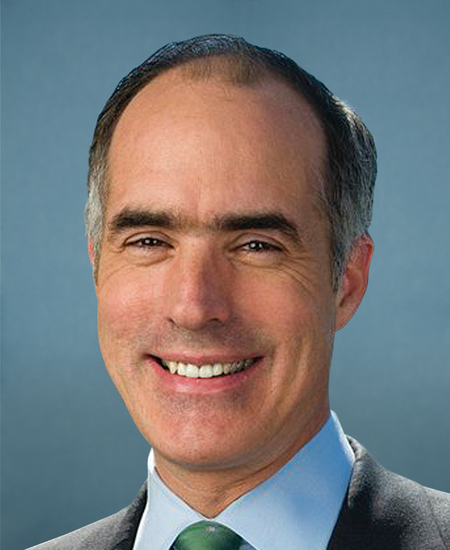
Sen. Robert P. Casey, Jr.
Sponsored bills
End Double Taxation of Successful Consumer Claims Act This bill allows a deduction from gross income (above-the-line deduction) for attorney fees and court costs in connection with a claim of a consumer protection violation.
Crisis Assistance Helping Out On The Streets Act or the CAHOOTS Act This bill allows state Medicaid programs to cover certain community-based mobile crisis intervention services for individuals experiencing a mental health or substance-use disorder crisis outside of a facility setting. Among other requirements, such services must be (1) provided by multidisciplinary teams composed of behavioral health professionals who are trained in trauma care and de-escalation techniques, (2) available 24-7, and (3) voluntary for the individual experiencing the mental health or substance-use disorder crisis. The bill provides an enhanced Federal Medical Assistance Percentage (i.e., federal matching rate) for such services, as well as specified funds for state planning and evaluation grants.
Lori Jackson Domestic Violence Survivor Protection Act This bill makes changes to the federal statutory framework that prohibits the shipment, transport, receipt, or possession of firearms or ammunition by an individual who is subject to a qualifying domestic violence court order. Under current law, a qualifying domestic violence court order must meet certain criteria, including to (1) be issued after a hearing of which the individual had notice and an opportunity to participate; and (2) restrain the individual from harassing, stalking, or threatening an intimate partner (i.e., a current or former spouse, a co-parent of a child, or a current or former cohabitant) or the child of an intimate partner. This bill expands the scope of qualifying domestic violence court orders to include an order that is issued after an ex parte hearing (i.e., a hearing with only one party present); restrains the individual from harassing, stalking, or threatening a dating partner or former dating partner; or restrains the individual from intimidating a witness. Current law also prohibits an individual who is convicted of a misdemeanor crime of domestic violence from shipping, transporting, receiving, or possessing firearms or ammunition. These restrictions generally only apply to spouses, co-parents, and cohabitants, and to offenses that involve physical force or deadly weapons. This bill expands the scope of these restrictions to include dating partners and offenses that involve stalking.
Protecting Americans with Pre-Existing Conditions Act of 2021 This bill nullifies specified guidance and final rule provisions pertaining to Section 1332 waivers (also known as State Innovation Waivers or State Relief and Empowerment Waivers) issued by the Department of the Treasury and the Department of Health and Human Services. The provisions allow states to forego certain requirements of the Patient Protection and Affordable Care Act in order to implement experimental plans for health care coverage, as long as the resulting coverage meets certain statutory criteria. The provisions, which supersede earlier guidance from 2015, alter agency interpretation of how states may satisfy the statutory criteria for waiver approval. For example, the provisions (1) redefine acceptable coverage under such waivers to include short-term, limited-duration insurance and association health plans; (2) allow the comprehensiveness and affordability of coverage under such waivers to be assessed based on projected availability, rather than enrollment; and (3) allow the level of coverage to be assessed based on the effects over the entire course of the waiver, rather than per year.
Medicare Sequester Relief Act This bill continues to exempt Medicare from sequestration until the end of the public health emergency relating to COVID-19 (i.e., coronavirus disease 2019). (Sequestration is a process of automatic, usually across-the-board spending reductions under which budgetary resources are permanently cancelled to enforce specific budget policy goals.)
Report and Educate About Campus Hazing Act or the REACH Act This bill requires institutions of higher education (IHEs) that participate in federal student-aid programs to report hazing incidents and implement hazing education programs. Specifically, the bill requires each IHE to disclose hazing incidents that were reported to campus officials in its annual security report. The bill defines the term hazing to mean any intentional, knowing, or reckless act committed by a student, or a former student, of an IHE against another student (regardless of that student's willingness to participate), that (1) is connected with an initiation into, an affiliation with, or the maintenance of membership in an organization that is affiliated with the IHE (e.g., an athletic team); and (2) contributes to a substantial risk of physical injury, mental harm, or degradation or causes physical injury, mental harm, or personal degradation. In addition, each IHE must implement a comprehensive program to prevent hazing, which must include information on hazing awareness, hazing prevention, and the IHE's policies on hazing.
This resolution condemns the February 1, 2021, military coup in Burma (Myanmar) and calls on Burmese authorities to allow journalists, human rights organizations, United Nations monitors, and humanitarian actors full and safe access to every part of the country. The resolution also asks neighboring countries to provide immediate and direct cross-border assistance to address the humanitarian needs of refugees.
Expanded Coverage for Former Foster Youth Act This bill modifies certain changes that are scheduled to take effect under the Substance Use-Disorder Prevention that Promotes Opioid Recovery and Treatment (SUPPORT) for Patients and Communities Act relating to the coverage of former foster youth under Medicaid. Under current law, a state Medicaid program must cover former foster youth until the age of 26 if the youth were in the state's foster care system at the age of 18 and were enrolled in the state's Medicaid program while in foster care; a state may choose to also cover former foster youth from other states. The SUPPORT for Patients and Communities Act altered these provisions to require a state Medicaid program to cover former foster youth from other states until the age of 26; such changes apply to former foster youth who reach the age of 18 on or after January 1, 2023. The bill requires state Medicaid programs to also cover former foster youth who were placed in a legal guardianship with a kinship caregiver or were emancipated from foster care before the age of 18. The bill also repeals the provision that requires former foster youth to have been enrolled in a state Medicaid program while in foster care in order to qualify for Medicaid coverage until the age of 26. States must also establish Medicaid outreach and enrollment programs for former foster youth.
Dosha Joi Immediate Coverage for Former Foster Youth Act This bill accelerates the application of certain changes that are scheduled to take effect under the Substance Use-Disorder Prevention that Promotes Opioid Recovery and Treatment (SUPPORT) for Patients and Communities Act relating to the coverage of former foster youth under Medicaid. Under current law, a state Medicaid program must cover former foster youth until the age of 26 if the youth were in the state's foster care system at the age of 18 and were enrolled in the state's Medicaid program while in foster care; a state may choose to also cover former foster youth from other states. The SUPPORT for Patients and Communities Act altered these provisions to require a state Medicaid program to cover former foster youth from other states until the age of 26; such changes apply to former foster youth who reach the age of 18 on or after January 1, 2023. The bill instead applies these changes to former foster youth who reach the age of 18 on or after the date of enactment of this bill. States must also establish Medicaid outreach and enrollment programs for former foster youth.