

Masih Alinejad Harassment and Unlawful Targeting Act of 2021 or the Masih Alinejad HUNT Act of 2021 This bill imposes sanctions on foreign persons (i.e., individuals or entities) that are acting on behalf of Iran's government and involved in the harassment of certain individuals, such as human rights activists. The Department of State must periodically report to Congress the identities of foreign persons acting on behalf of Iran's government that are knowingly responsible for or complicit in the surveillance, harassment, imprisonment, or killing of citizens of Iran or the United States who seek to (1) expose corruption or illegal activity by Iranian government officials; (2) obtain, defend, or promote internationally recognized human rights; or (3) obtain, defend, or promote the rights and well-being of women, religious and ethnic minorities, and the LGBTQ community in Iran. The report must include foreign persons involved in such actions that occur inside or outside Iran. The President must impose property-blocking sanctions on persons identified in the report, as well as visa-blocking sanctions on the identified individuals. The Department of the Treasury must submit to Congress a report identifying any foreign financial institution that knowingly conducts a significant transaction with a person sanctioned under this bill. Treasury may prohibit the opening, or prohibit or impose strict conditions on the maintaining of a U.S. correspondent account or a payable-through account by such a financial institution.
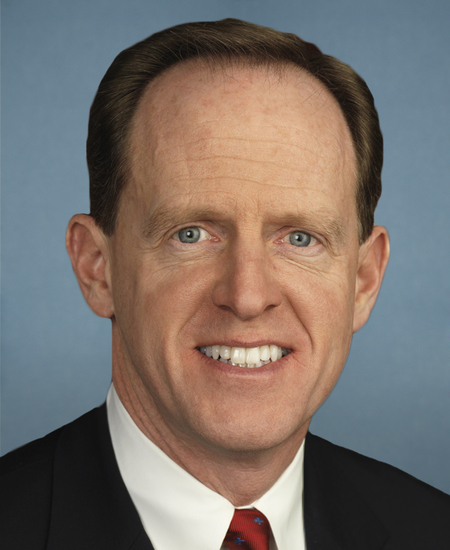
Sen. Patrick J. Toomey
Sponsored bills
Maddy summaryThis bill repeals a specific tax provision related to chemical manufacturers. It reverses a change made by section 80201 of the Infrastructure Investment and Jobs Act, which had modified an excise tax under the Superfund program. The repeal directly affects chemical manufacturers who were subject to this tax modification, restoring the previous tax treatment. The bill makes no new policy changes but specifically undoes this one tax-related amendment.
Food Donation Improvement Act of 2021 This bill expands liability protections for the donation of food and grocery products. Specifically, the bill expands the liability protections to include donations of an apparently fit grocery product or apparently wholesome food for which the recipient is charged a good Samaritan reduced price that is no greater than the cost of handling, administering, and distributing the food or product; or that is donated directly to a needy individual by a retail grocer, wholesaler, agricultural producer, restaurant, caterer, school food authority, or institution of higher education. The Department of Agriculture must issue regulations that clarify the quality and labeling standards that food products donated under the Bill Emerson Good Samaritan Food Donation Act must meet to be eligible for liability protection.
Maddy summarySRES 451 is a commemorative Senate resolution honoring the late Senator Max Cleland (D-GA), who died November 9, 2021. The resolution recognizes his service as a Vietnam War veteran (losing both legs and an arm in combat), his 50+ years of public service including roles as Georgia State Senator, Secretary of State, U.S. Senator, and Administrator of the Veterans Administration, and his advocacy for veterans. It formally expresses the Senate’s "profound sorrow" and "deep regret" over his death, commemorates his legacy of service to Georgia and veterans, and requests the Secretary of the Senate transmit the resolution to his family. This is a ceremonial resolution with no policy changes or legal effect.
Prohibiting Taxpayer Funded Settlements for Illegal Immigrants Act This bill prohibits using federal funds to make settlement payments to compensate any individuals for being separated from family members while detained by U.S. Customs and Border Protection if the detention was (1) a result of the individual improperly entering (or attempting to improperly enter) the United States, and (2) in accordance with a Department of Justice memorandum that adopted a zero-tolerance policy for such improper entry into the United States.
Capital Gains Inflation Relief Act of 2021 This bill allows the adjusted basis of certain assets (including any common stock in a C corporation, any digital asset, and tangible property used in a trade or business) to be indexed for inflation for the purpose of determining the gain or loss of a taxpayer (other than a corporation) who has held the asset for more than three years. The bill sets forth rules for applying the inflation adjustment to short sales; regulated investment companies; real estate investment trusts; other pass-through entities, including partnerships, S corporations, and common trust funds; dispositions between related persons; and improvements to property or contributions of capital. The Internal Revenue Service may disallow an adjustment if any person transfers cash, debt, or any other property to another person for the principal purpose of securing or increasing the adjustment allowed by this bill.
Investor Freedom Act of 2021 This bill prohibits banning the practice of payment for order flow (i.e., payment received by a stock brokerage firm for directing orders to another firm that buys and sells stock).
Upholding the 1995 Jerusalem Embassy Law Act of 2021 This bill prohibits using federal funds to establish any diplomatic facility in Jerusalem other than the U.S. Embassy to Israel.
No GSE Subsidies for Investor Properties Act This bill prohibits government-sponsored enterprises (i.e., Fannie Mae and Freddie Mac) from purchasing or acquiring a mortgage secured by an investor property loan (i.e., a property comprised of 1-to-4 family dwelling units that is not the principal residence or a second home of the borrower) 18 months after the date of enactment. Further, these enterprises must implement a plan to gradually reduce the purchase and acquisition of such loans.
Prohibiting IRS Financial Surveillance Act This bill prohibits the Department of the Treasury from requiring a financial institution to report the balances, transactions, or the transfers into and out of a financial account. This prohibition does not apply to laws or regulations in effect on the date of enactment.