

Stablecoin Transparency of Reserves and Uniform Safe Transactions Act of 2022 or the Stablecoin TRUST Act of 2022 This bill establishes a regulatory framework for payment stablecoins (digital assets which an issuer must directly convert to fiat currency). Specifically, the bill only allows the following entities to issue stablecoins a money transmitting business, a non-depository trust company, or any other person that is authorized by a state banking supervisor to issue payment stablecoins; a national limited payment stablecoin issuer; a depository institution; or a national trust bank.

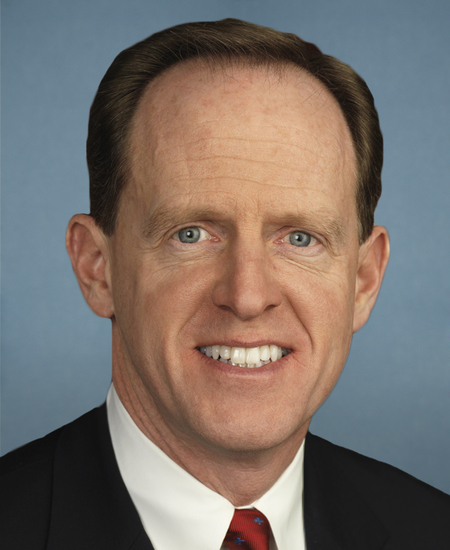
Sen. Patrick J. Toomey
Sponsored bills
Federal Reserve Accountability Act of 2022 This bill reduces the number of Federal Reserve districts from 12 to 5, requires Senate confirmation for Federal Reserve bank presidents, and makes other changes to the operation of the Federal Reserve Board and Federal Reserve banks.
Financial Regulators Transparency Act of 2022 This bill makes certain disclosure and ethics requirements applicable to the Federal Reserve banks and financial regulators. For example, the bill makes Federal Reserve banks subject to Freedom of Information Act requests and makes financial regulators subject to congressional ethics inquiries.
CFPB Stability Act of 2022 This bill restructures the leadership and funding of the Consumer Financial Protection Bureau. Specifically, the bill removes the bureau from the Federal Reserve System. Additionally, the bill eliminates the positions of director and deputy director and establishes a five-person panel appointed by the President and confirmed by the Senate, with not more than three members belonging to any one political party. Under the bill, the inspector general of the bureau must be appointed by the President and confirmed by the Senate. Under current law, the inspector general of the Federal Reserve Board also serves as the inspector general of the bureau. Further, the source of funding for the bureau is changed from Federal Reserve System transfers to annual appropriations. Under current law, the transfers from the Federal Reserve System permit the bureau to be funded outside of the annual appropriations process.
This joint resolution nullifies a Department of Education rule published on July 6, 2022, concerning final priorities, requirements, definitions, and selection criteria for the Charter Schools Program.
Pipeline Permitting for Energy Security Act of 2022 This bill modifies requirements under the Clean Water Act, the National Environmental Policy Act of 1969, and the Endangered Species Act of 1973 to expedite water quality certifications, environmental reviews, endangered species consultations, and make related changes. The bill also establishes requirements to expedite the approval of the Mountain Valley Pipeline, which is a natural gas pipeline located in Virginia and West Virginia.
IRS Funding Accountability Act This bill delays for a 60-day period funding for the Internal Revenue Service (IRS) enforcement activities enacted by the Inflation Reduction Act (except for eliminating return processing backlogs and reducing call wait times) until an annual spending plan for such activities is submitted to the congressional tax and appropriation committees. Congress may enact a joint resolution of disapproval of the spending plan before the end of the 60-day period requiring the IRS to submit a new spending plan. The IRS and the Department of the Treasury must make quarterly reports to the committees on expenditures for enforcement activities. The bill requires reductions in appropriations to the IRS for any failure to submit required reports.
Valley Forge Park Realignment Permit and Promise Act This bill authorizes the Department of the Interior to issue a right-of-way permit for portions of the main segment of the natural gas distribution pipeline within Valley Forge National Historical Park if the segment is relocated to a proposed realignment of Valley Forge Park Road and North Gulph Road within the park.
Electoral Count Reform and Presidential Transition Improvement Act of 2022 This bill revises the process of casting and counting electoral votes for presidential elections. The bill also revises provisions related to the presidential transition process. The bill specifies that the choice of electors must occur in accordance with the laws of the state enacted prior to election day. Additionally, the bill identifies each state's governor (unless otherwise identified in the laws or constitution of a state in effect on election day) as responsible for submitting the certificate of ascertainment identifying the state's electors. Further, the bill provides for expedited judicial review for any action brought by an aggrieved presidential or vice-presidential candidate arising under the U.S. Constitution or U.S. laws with respect to the issuance or transmission of such a certificate. The bill revises the framework for the joint session of Congress to count electoral votes and make a formal declaration of which candidates have been elected President and Vice President. Among other changes, the bill (1) specifies that the role of the Vice President during the joint session shall be ministerial in nature, and (2) raises the objection threshold in Congress to at least one-fifth of the duly chosen and sworn members of both the House of Representatives and the Senate. The bill also revises the presidential transition process, including to (1) allow more than one candidate to receive federal transition resources under certain circumstances, and (2) require additional reporting by the General Services Administration.
This bill extends until September 30, 2026, the use of Highway 209, a federally owned road within the boundaries of the Delaware Water Gap National Recreation Area, by certain commercial vehicles that serve local businesses.