

Working Families Flexibility Act of 2021 This bill revises requirements for the receipt of compensatory time off for private sector employees. Specifically, the bill authorizes private employers to provide compensatory time off to their employees at a rate of one and one-half hours for each hour of employment for which overtime compensation otherwise is required; employees may accrue a maximum of 160 hours of compensatory time. Employers are prohibited from interfering with an employee's right to or not request compensatory time off in lieu of payment of overtime compensation or from requiring an employee to use such compensatory time, and must give their employees 30-days notice before discontinuing a compensatory time policy. Employers are liable to employees for damages from violations of these requirements.
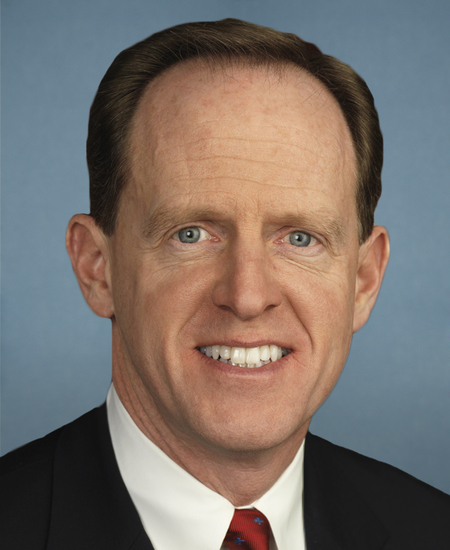
Sen. Patrick J. Toomey
Sponsored bills
Assuring that Robust, Thorough, and Informed Congressional Leadership is Exercised Over National Emergencies Act or the ARTICLE ONE Act This bill terminates a declaration of national emergency made by the President after 30 days unless Congress votes to extend the declaration. (Currently, Congress can cancel an emergency declaration only by passing a resolution that can withstand a presidential veto.) The bill establishes procedures for congressional review of declarations of national emergencies. The President shall (1) transmit specified information to Congress with any proclamation declaring or renewing a national emergency, including a description of the circumstances necessitating the declaration or renewal of a national emergency declaration and its estimated duration; and (2) report periodically on the status of the emergency.
This resolution designates January 24-January 30, 2021, as National School Choice Week.
Protecting Our Wealth of Energy Resources Act of 2021 or the POWER Act of 2021 This bill requires the President and federal agencies to obtain the approval of Congress before prohibiting or substantially delaying certain new energy or mineral leases or permits on federal lands, including oil and gas leases, coal leases, hard rock leases, or critical minerals leases. In addition, the President and agencies must obtain the approval of Congress before withdrawing certain federal lands from mineral and geothermal leasing activities.
Born-Alive Abortion Survivors Protection Act This bill establishes requirements for the degree of care a health care practitioner must provide in the case of a child born alive following an abortion or attempted abortion. Specifically, a health care practitioner who is present must (1) exercise the same degree of care as would reasonably be provided to any other child born alive at the same gestational age, and (2) ensure the child is immediately admitted to a hospital. Additionally, a health care practitioner or other employee who has knowledge of a failure to comply with the degree-of-care requirements must immediately report such failure to law enforcement. A health care practitioner who fails to provide the required degree of care, or a health care practitioner or other employee who fails to report such failure, is subject to criminal penalties—a fine, up to five years in prison, or both. An individual who intentionally kills or attempts to kill a child born alive is subject to prosecution for murder. The bill bars the criminal prosecution of a mother of a child born alive under this bill and allows her to bring a civil action against a health care practitioner or other employee for violations.
No Taxpayer Funding for Abortion and Abortion Insurance Full Disclosure Act of 2021 This bill modifies provisions relating to federal funding for, and health insurance coverage of, abortions. Specifically, the bill prohibits the use of federal funds for abortions or for health coverage that includes abortions. Such restrictions extend to the use of funds in the budget of the District of Columbia. Additionally, abortions may not be provided in a federal health care facility or by a federal employee. Historically, language has been included in annual appropriations bills for the Department of Health and Human Services (HHS) that prohibits the use of federal funds for abortions—such language is commonly referred to as the Hyde Amendment. Similar language is also frequently included in appropriations bills for other federal agencies and the District of Columbia. The bill makes these restrictions permanent and extends the restrictions to all federal funds (rather than specific agencies). The bill's restrictions regarding the use of federal funds do not apply in cases of rape, incest, or where a physical disorder, injury, or illness endangers a woman's life unless an abortion is performed. The Hyde Amendment provides the same exceptions. The bill also prohibits qualified health plans from including coverage for abortions. Currently, qualified health plans may cover abortion, but the portion of the premium attributable to abortion coverage is not eligible for subsidies.
Regulations from the Executive in Need of Scrutiny Act of 20 21 This bill revises provisions relating to congressional review of agency rulemaking. Specifically, the bill establishes a congressional approval process for a major rule. A major rule may only take effect if Congress approves of the rule. A major rule is a rule that results in (1) an annual effect on the economy of $100 million or more; (2) a major increase in costs or prices for consumers, individual industries, government agencies, or geographic regions; or (3) significant adverse effects on competition, employment, investment, productivity, innovation, or the ability of U.S.-based enterprises to compete with foreign-based enterprises. In addition, the bill establishes a congressional disapproval process for a nonmajor rule. A nonmajor rule may only take effect if Congress does not disapprove of the rule.
Pain-Capable Unborn Child Protection Act This bill establishes a new criminal offense for performing or attempting to perform an abortion if the probable post-fertilization age of the fetus is 20 weeks or more. A violator is subject to criminal penalties—a fine, a prison term of up to five years, or both. The bill provides exceptions for an abortion (1) that is necessary to save the life of the pregnant woman, or (2) when the pregnancy is the result of rape or incest. A physician who performs or attempts to perform an abortion under an exception must comply with specified requirements. A woman who undergoes a prohibited abortion may not be prosecuted for violating or conspiring to violate the provisions of this bill.
Stop Dangerous Sanctuary Cities Act This bill prohibits a sanctuary jurisdiction from receiving grants under certain Economic Development Assistance Programs and the Community Development Block Grant Program. Under the bill, a sanctuary jurisdiction is a state or local government that has in effect a statute, policy, or practice that prohibits or restricts (1) information sharing with another government entity about an individual's immigration status, or (2) compliance with a lawfully issued Department of Homeland Security (DHS) detainer request or notification of release request. When complying with a DHS-issued detainer, a state or local government shall be deemed to be acting as an agent of DHS with all authority available to DHS officers and employees. The bill also limits the legal liability of a state or local government for complying with a detainer.
Student Empowerment Act This bill allows tax-exempt distributions from qualified tuition programs (known as 529 plans) to be used for additional educational expenses in connection with enrollment or attendance at an elementary or secondary school. (Under current law, distributions in connection with an elementary or secondary school are limited to tuition for a public, private, or religious school.) The bill allows the distributions to be used for additional educational expenses, including curriculum and curricular materials, books or other instructional materials, online educational materials, tutoring or educational classes outside the home, testing fees, fees for dual enrollment in an institution of higher education, and educational therapies for students with disabilities. Distributions may also be used for tuition and the purposes above in connection with a homeschool (whether treated as a homeschool or a private school under state law).