

Maddy summaryThis bill reauthorizes the HOME Investment Partnerships Program with increased annual funding from $5 billion in 2024 to over $6 billion by 2028, providing states and local jurisdictions with resources to develop and preserve affordable housing. Key changes include eliminating a commitment deadline, modifying homeownership resale restrictions to better protect long-term affordability, requiring property inspections to ensure housing quality, and establishing a new home loan guarantee program with a $2 billion initial limit. The bill also adds specific protections for small-scale housing (with four or fewer units) and tenants, while strengthening enforcement mechanisms for compliance with program requirements. These reforms aim to improve the efficiency and effectiveness of the program in creating and maintaining affordable housing across participating jurisdictions.
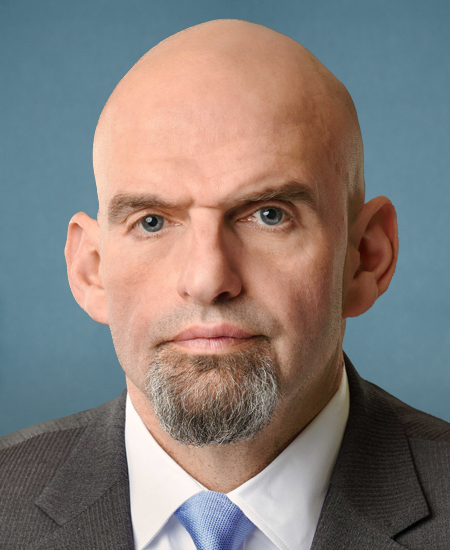
Sen. John Fetterman
Sponsored bills
Maddy summaryThe Stop Predatory Investing Act disallows tax deductions for interest and depreciation on single-family rental properties owned by individuals or entities that own 50 or more such properties (defined as residential units with four or fewer dwellings, including townhouses as separate buildings). It applies to properties without low-income housing credits and excludes properties constructed by the owner or acquired before first occupancy. Exceptions allow deductions if the property is sold to an individual for their primary residence (per Section 121) or to a qualified nonprofit organization focused on affordable housing, such as community land trusts, housing nonprofits, or community development corporations. The law defines "disqualified" owners and specifies qualifying nonprofits under Section 163(n)(2)(C), effective for taxable years after enactment.
Maddy summaryThis bill authorizes the U.S. Treasury to mint and sell commemorative coins honoring the 2026 FIFA World Cup, which will be hosted by the U.S., Mexico, and Canada. It specifies three coin types: $5 gold coins (max 100,000), $1 silver coins (max 500,000), and half-dollar coins (max 750,000), all with designs reflecting soccer and the World Cup. A surcharge is added to each coin sale ($35 for $5 coins, $10 for $1 coins, $5 for half-dollars), with all surcharge revenue going directly to FWC2026 US, Inc. to fund U.S. soccer programs, particularly youth initiatives and underserved communities. The coins may only be sold during 2026 and must cover all costs to avoid government expense.
Maddy summaryThis bill directs the Department of Education to consider the International Holocaust Remembrance Alliance (IHRA) definition of antisemitism when investigating potential violations of Title VI of the Civil Rights Act of 1964. It specifically applies to cases involving discrimination based on actual or perceived Jewish ancestry or ethnic characteristics in schools and federally funded programs. The bill clarifies that this guidance does not expand the Department's authority, alter existing discrimination standards, or affect First Amendment rights. It aims to ensure consistent enforcement against antisemitism under existing civil rights law, as previously adopted by the Department of Education.
Maddy summaryThe Whole-Home Repairs Act of 2024 establishes a $25 million pilot program to provide home repair assistance to eligible homeowners and landlords. It creates a system where local governments and qualified nonprofits will administer grants to homeowners with incomes at or below 80% of area median income, and forgivable loans to landlords who own fewer than 10 rental properties. The program requires repairs to address accessibility, habitability, energy efficiency, and safety concerns, with landlords agreeing to rent caps, lease extensions for current tenants, and compliance with housing codes. The pilot will run until October 1, 2029, and includes reporting requirements to track program impact and prevent waste. This legislation directly affects low-income homeowners and small-scale landlords in communities across the United States.
Maddy summaryThe Rural Housing Service Reform Act of 2023 establishes a permanent program to preserve and revitalize rural affordable housing projects financed under sections 514, 515, and 516 of the Housing Act of 1949, directly affecting low-income rural residents and housing owners. It creates mechanisms for loan restructuring to maintain safe, affordable housing, including options like reducing interest rates, deferring payments, and subordinating debt. The bill also creates a new Native CDFI relending program to increase homeownership opportunities for Native American communities and extends the maximum term of direct loans from 30 to 40 years. Additionally, it establishes procedures for renewing rental assistance contracts for up to 20 years and adjusts the process for updating housing voucher amounts based on changes in household income or composition.
Maddy summary# Summary of the Long-Term Care Workforce Support Act This comprehensive legislation establishes a framework to support and improve conditions for the direct care professional workforce (including home health aides, nursing assistants, and similar workers) through multiple key provisions: 1. **Workplace Violence Prevention** - Requires healthcare facilities to develop and implement written workplace violence prevention plans, including risk assessments, training, incident reporting procedures, and anti-retaliation policies. The plan must include specific measures to address different types of workplace violence (Type 1-4). 2. **Paid Sick Time** - Mandates that employers provide direct care professionals with paid sick time (1 hour for every 30 hours worked), with specific uses including: - Medical care for the employee - Caring for family members (children, parents, spouse, domestic partner) - Addressing domestic violence, sexual assault, or stalking - Public health emergencies (with additional paid sick time provided during declared emergencies) 3. **National Compensation Strategy** - Establishes a National Direct Care Professional Compensation Strategy to: - Identify ways to provide direct care professionals with livable wages - Guide State Medicaid agencies in compensating direct care professionals at full labor cost - Create a National Direct Care Professional Compensation Advisory Council with diverse representation - Address challenges including part-time work nature, workforce mobility, and inequities related to race, ethnicity, and immigration status 4. **Evaluation Framework** - Requires an evaluation of the Act's implementation and outcomes by an external evaluator with experience in home and community-based services, disability programs, and healthcare workforce programs. The evaluation will assess impacts on: - Workforce recruitment, retention, and advancement - Compensation and working conditions - Burnout and attrition rates - Access to long-term care services - Costs to Medicare and Medicaid programs The legislation aims to improve the quality of care for older individuals and people with disabilities by strengthening the direct care workforce through better compensation, safer working conditions, and improved benefits.
Maddy summaryS 4116, the Servicemember Healthcare Freedom Act of 2024, allows members of the Selected Reserve and National Guard who work civilian government jobs (and are eligible for Federal Employee Health Benefits) to enroll in TRICARE Reserve Select (TRS) healthcare plans starting January 1, 2025. This removes a current prohibition preventing these service members and their families from using TRS while working federal civilian roles. The bill modifies the expiration date in existing law from 2030 to 2025, providing continuity of care during military mobilization cycles. It directly affects reserve component members and National Guard members employed in civilian government positions who previously could not access TRS alongside their FEHB coverage.
Maddy summaryThis bill requires random assignment of certain civil cases challenging laws to a district court judge, rather than allowing parties to strategically choose courts. It directly affects individuals or groups filing lawsuits seeking nationwide challenges to federal laws or statewide challenges to state laws. The key provision mandates that cases asking courts to block, invalidate, or order enforcement of laws (including regulations or agency policies) must be randomly assigned to a judge in the filing district. This aims to prevent "judge shopping" by eliminating the ability to select a court based on perceived judicial bias. The rule applies to both federal and state law challenges filed in district courts.
Maddy summaryThe STAGE Act creates a new federal grant program providing funding to professional nonprofit theaters to support employment, economic recovery, and facility improvements. Eligible theaters must be 501(c)(3) nonprofits with a 3-year programming history, fair pay practices, no recent labor violations, and either revenue losses or focus on underserved communities. Grants cover payroll, facility maintenance, marketing, and workforce development, with limits of $16 million per grant or 20% of the theater's prior year expenses. The bill authorizes $1 billion annually (2024-2028) for this program and requires a federal study on sustaining the nonprofit arts sector.