

Maddy summaryThis bill, S 2526 (Fight for the American Dream Act), allows young immigrants protected by Deferred Action for Childhood Arrivals (DACA) to enlist in the U.S. military by amending eligibility rules to include those with valid employment authorization under DACA. It also updates naturalization rules for service members, clarifying that military service in the Selected Reserve or active duty qualifies for citizenship and adjusting geographic references to include American Samoa and certain Pacific territories. The bill directly affects DACA-eligible individuals seeking military service and service members pursuing citizenship, removing a key barrier to enlistment and streamlining the naturalization process. These changes are specific legal updates to Title 10 (military) and the Immigration and Nationality Act, without altering DACA status or broader immigration policy.
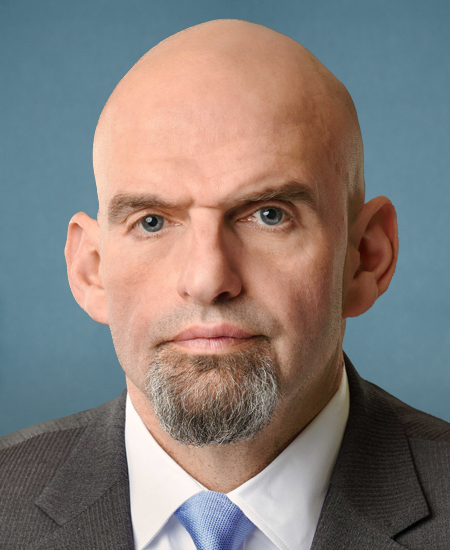
Sen. John Fetterman
Sponsored bills
Maddy summaryThis bill requires gas pipeline operators to immediately implement a federal safety rule mandating regular leak detection and prompt repair of gas leaks. The rule, finalized by the Pipeline and Hazardous Materials Safety Administration in January 2025, sets specific standards for identifying and fixing leaks in gas pipelines. By making this rule effective upon enactment, the bill removes any delays in its implementation. Pipeline companies operating under federal jurisdiction will be directly affected by these requirements.
Maddy summaryThe Medical Debt Relief Act of 2025 would prevent medical debt from appearing on credit reports and bar creditors from using medical debt to deny or limit credit. It defines medical debt as any balance from medical services, products, or devices and amends the Fair Credit Reporting Act to exclude such debt from adverse credit reporting. The bill also requires the Consumer Financial Protection Bureau to update regulations within one year to prohibit creditors from considering medical debt during credit decisions. This change would directly protect consumers - especially those with unexpected medical bills - from credit score damage unrelated to financial management.
Maddy summaryThe EATS Act of 2025 (S 2512) expands eligibility for the Supplemental Nutrition Assistance Program (SNAP) to include most college students. It directly affects full-time undergraduate students enrolled at least half-time in recognized higher education institutions by removing their current exclusion from SNAP benefits. The bill revises the definition of "household" under SNAP rules and eliminates the prior requirement that students meet separate conditions to qualify. This change, effective January 2026, would allow millions of students to access food assistance without additional barriers.
Maddy summaryThe John R. Lewis Voting Rights Advancement Act of 2025 strengthens voting rights protections by requiring preclearance for certain voting changes in jurisdictions with a history of discrimination. It establishes new preclearance requirements for changes to election methods, district boundaries, voter ID rules, and polling locations. The bill updates standards for determining when voting practices deny or abridge rights, particularly for racial, ethnic, and language minority groups. It also requires transparency about voting changes through public notices and strengthens enforcement mechanisms for voting rights violations. The bill directly affects states and localities with documented histories of voting discrimination, aiming to protect minority voters' rights.
Maddy summaryThis bill establishes that food products cannot use dairy product names like "yogurt," "milk," or "cheese" unless they meet specific U.S. Food and Drug Administration (FDA) standards for dairy. It directly affects food manufacturers who currently market non-dairy products (e.g., plant-based milks) using traditional dairy names. The bill amends federal law to require that any food using such names must be made primarily from mammal milk (lacteal secretion), not plant-based ingredients, and clarifies that the FDA will enforce this rule through new guidance. The FDA must issue enforcement guidance within 180 days and report on enforcement actions to Congress within two years.
Maddy summaryThis bill authorizes $50 million annually from 2026 through 2031 for the Centers for Disease Control and Prevention (CDC) to fund research on firearms safety and gun violence prevention. It directly affects the CDC and researchers by providing dedicated funding to study these topics under the Public Health Service Act. The key mechanism is a specific annual funding allocation, added to existing resources, to support new or ongoing research initiatives. The bill does not create new regulations or restrict gun ownership but focuses solely on enabling evidence-based research. This is a funding measure, not a policy change affecting the public directly.
Maddy summaryThe Restoring Essential Healthcare Act repeals a provision that blocked Medicaid payments to certain healthcare providers. Specifically, it removes a restriction from Public Law 119-21 that prevented Medicaid from paying "prohibited entities" for services provided between the law's enactment and this bill's effective date. Payments for those services will now be made retroactively, as if the restriction had never existed. This directly affects Medicaid programs and the healthcare providers previously excluded from receiving these payments.
Maddy summaryThe Buffalo Soldiers Congressional Gold Medal Act of 2025 authorizes Congress to award a gold medal to the Buffalo Soldier regiments - the 9th and 10th Cavalry, and the 24th and 25th Infantry regiments - for their service from 1866 until the Army's desegregation in 1951. The medal, designed by the Secretary of the Treasury, will be displayed at the National Museum of African American History and Culture in the Smithsonian Institution. Duplicate bronze medals may be sold to the public at cost to cover production expenses. This bill is a commemorative measure that formally recognizes the historical contributions of these military units without creating new government programs or altering existing laws.
Maddy summaryThe Pay Teachers Act requires states to ensure public school teachers earn a minimum starting salary of $60,000 that increases with experience, and paraprofessionals and education support staff earn at least $45,000 annually or $30 per hour. The bill provides mandatory federal funding to support these salary increases and requires states to develop implementation plans within 4 years (with possible extensions for states facing financial challenges). It also establishes career ladder programs that allow teachers to earn additional compensation for taking on leadership roles and responsibilities. This legislation directly affects all public school teachers, paraprofessionals, and education support staff nationwide, as well as state and local education agencies responsible for implementing the changes.