

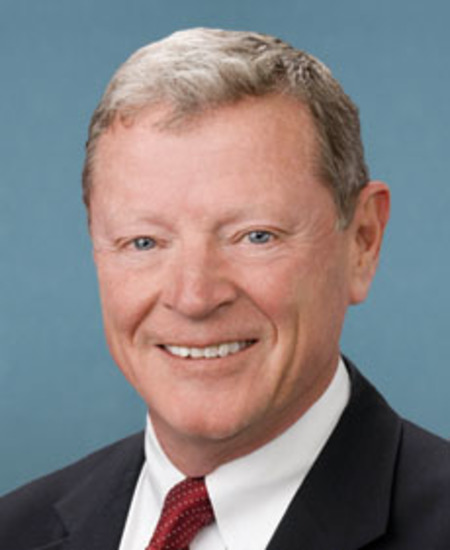
Photo of James M. Inhofe
R United States Senate · Oklahoma

Sen. James M. Inhofe

Compare
Total votes
380
all sessions
Attendance
89%
40 missed
Lower than 98% of chamber peers
With party
96%
of cast votes
Near the chamber average
Bipartisan score
2%
crosses aisle rarely
Near the chamber average
Sponsored
332
bills & resolutions
Near the chamber average
Committees
0
assignments
332 bills and resolutions

Sponsored bills

Total
332
Primary
32
Co-sponsor
300
This page
332
matching current filters
Co-sponsor S 126
In committee · United States Senate · Co-sponsor
A bill to amend the Internal Revenue Code of 1986 to make permanent the individual tax provisions of the tax reform law, and for other purposes.

This bill makes permanent several tax provisions for individual taxpayers that were enacted by the Tax Cuts and Jobs Act of 2017 and are scheduled to expire at the end of 2025. These provisions include reduction of individual income tax rates, increase in the child tax credit, limitations on the tax deduction for state and local taxes and the mortgage interest deduction, and increase in the exemption amount for estate and gift taxes.

In committee Jan 28, 2021 1 co-sponsor
Co-sponsor S 68
In committee · United States Senate · Co-sponsor
Regulations from the Executive in Need of Scrutiny Act of 2021

Regulations from the Executive in Need of Scrutiny Act of 20 21 This bill revises provisions relating to congressional review of agency rulemaking. Specifically, the bill establishes a congressional approval process for a major rule. A major rule may only take effect if Congress approves of the rule. A major rule is a rule that results in (1) an annual effect on the economy of $100 million or more; (2) a major increase in costs or prices for consumers, individual industries, government agencies, or geographic regions; or (3) significant adverse effects on competition, employment, investment, productivity, innovation, or the ability of U.S.-based enterprises to compete with foreign-based enterprises. In addition, the bill establishes a congressional disapproval process for a nonmajor rule. A nonmajor rule may only take effect if Congress does not disapprove of the rule.

In committee Jan 27, 2021 1 co-sponsor
Co-sponsor S 59
In committee · United States Senate · Co-sponsor
Justice for Victims of Sanctuary Cities Act of 2021

Justice for Victims of Sanctuary Cities Act of 2021 This bill provides a private right of action against state and local jurisdictions with certain policies that limit cooperation with federal immigration enforcement efforts, and contains additional provisions related to such jurisdictions. Currently, such cooperation is generally not required. An individual (or certain relatives of such an individual) who is the victim of any felony for which an alien has been arrested, convicted, or sentenced to a prison term of at least one year may sue a state or local jurisdiction if the jurisdiction failed to comply with (1) certain Department of Homeland Security (DHS) requests related to arresting and detaining aliens, and (2) a DHS request to detain the alien in question or provide a notification about the release of the alien. A jurisdiction that accepts certain federal grants may not assert immunity in such a civil action. A jurisdiction (or employee of a jurisdiction) that complies with certain DHS detainer requests shall be deemed to be acting as an agent of DHS. A complying jurisdiction or employee of the jurisdiction shall not be liable in any lawsuit relating to compliance with such requests. In a lawsuit against an employee of the jurisdiction, the United States shall be substituted in as the defendant, and remedies shall be limited to provisions for bringing tort claims against the federal government.

In committee Jan 27, 2021 1 co-sponsor
Co-sponsor S 61
In committee · United States Senate · Co-sponsor
Pain-Capable Unborn Child Protection Act

Pain-Capable Unborn Child Protection Act This bill establishes a new criminal offense for performing or attempting to perform an abortion if the probable post-fertilization age of the fetus is 20 weeks or more. A violator is subject to criminal penalties—a fine, a prison term of up to five years, or both. The bill provides exceptions for an abortion (1) that is necessary to save the life of the pregnant woman, or (2) when the pregnancy is the result of rape or incest. A physician who performs or attempts to perform an abortion under an exception must comply with specified requirements. A woman who undergoes a prohibited abortion may not be prosecuted for violating or conspiring to violate the provisions of this bill.

In committee Jan 27, 2021 1 co-sponsor
Co-sponsor S 71
In committee · United States Senate · Co-sponsor
Accountability Through Electronic Verification Act

Accountability Through Electronic Verification Act This bill expands the E-Verify program by requiring all employers to use it and permanently reauthorizes the program. Currently, E-Verify use is voluntary for most employers, although some states mandate its use. All employers shall use E-Verify to confirm the identity and employment eligibility of all recruited, referred, or hired individuals, including current employees who were never verified under the program. Failure to use E-Verify shall create a rebuttable presumption that the employer is violating immigration law. U.S. Citizenship and Immigration Services shall generate weekly reports about individuals who have received a final nonconfirmation of employment eligibility. The Department of Homeland Security (DHS) shall use the report to enforce immigration laws. DHS shall establish a program to help certain small businesses verify employee eligibility. DHS shall also update E-Verify's design to help prevent and detect fraud and identity theft. The bill increases civil and criminal penalties for hiring unauthorized aliens. DHS shall debar repeat offenders and those criminally convicted from holding federal contracts, grants, or cooperative agreements. The Social Security Administration, Internal Revenue Service, Department of the Treasury, and DHS shall jointly establish a program to share information to help identify unauthorized aliens. The bill establishes the Employer Compliance Inspection Center within Homeland Security Investigations of U.S. Immigration and Customs Enforcement. The center's duties include processing I-9 employment eligibility verification forms and ensuring compliance with employment eligibility laws. DHS shall report to Congress on ways to simplify procedures relating to I-9 forms and on whether the I-9 process should be eliminated.

In committee Jan 27, 2021 1 co-sponsor
Co-sponsor S 60
In committee · United States Senate · Co-sponsor
Immigration Detainer Enforcement Act of 2021

Immigration Detainer Enforcement Act of 2021 This bill expands statutory provisions to authorize the Department of Homeland Security (DHS) to request a law enforcement agency to detain an individual who has been arrested for violating any law (if the individual is believed to be an unlawfully present alien), where current provisions only explicitly authorize detainer requests for individuals arrested for violating controlled substances laws. The bill also modifies other related provisions. A law enforcement agency that has received a detainer request may hold the targeted individual for up to 48 hours. DHS may enter into agreements with law enforcement agencies to indemnify such agencies against claims for wrongful detention resulting from a detainer request. No provision of federal, state, or local law may restrict any government entity from (1) providing DHS with access to databases with information relating to issued detainers, or (2) holding an individual subject to a detainer. DHS shall periodically certify to Congress as to which state or local entities have not complied with a detainer request. Such entities shall be ineligible for compensation for costs related to honoring detainer requests. State and local entities that comply with DHS detainer requests shall have prioritized access to (1) certain law enforcement-related grants, and (2) certain excess federal property.

In committee Jan 27, 2021 1 co-sponsor
Co-sponsor S 42
In committee · United States Senate · Co-sponsor
Stop Dangerous Sanctuary Cities Act

Stop Dangerous Sanctuary Cities Act This bill prohibits a sanctuary jurisdiction from receiving grants under certain Economic Development Assistance Programs and the Community Development Block Grant Program. Under the bill, a sanctuary jurisdiction is a state or local government that has in effect a statute, policy, or practice that prohibits or restricts (1) information sharing with another government entity about an individual's immigration status, or (2) compliance with a lawfully issued Department of Homeland Security (DHS) detainer request or notification of release request. When complying with a DHS-issued detainer, a state or local government shall be deemed to be acting as an agent of DHS with all authority available to DHS officers and employees. The bill also limits the legal liability of a state or local government for complying with a detainer.

In committee Jan 26, 2021 1 co-sponsor
Primary S 39
In committee · United States Senate · Lead sponsor
Protecting American Innovation and Development Act of 2021

Protecting American Innovation and Development Act of 2021 This bill authorizes import controls against certain foreign persons that infringe patents belonging to a U.S. person that are essential to a wireless communications standard. Specifically, the Department of Commerce must create a list of foreign entities that are citizens or nationals of a country of concern and that engage in the unlicensed use (i.e., infringement) of such essential wireless communications patents. A country of concern is a country wherein the persistent infringement of these patents poses a threat to (1) U.S. wireless communications research and development infrastructure, and (2) U.S. national security. Any foreign entity on this list, as well as specified persons that raise a national security concern with respect to wireless communications technology, may be subject to import controls (for example, a foreign entity may be required to post a bond before importing into the United States any goods that potentially infringe the wireless patent in question). Commerce must also establish a watch list of foreign entities from a country of concern that (1) are selling in the United States a product claiming to comply with a wireless standard, and (2) have not obtained a license (or taken certain actions to obtain that license) for patents essential to that wireless standard. An entity on either list may petition Commerce to be removed from that list on the basis that the conditions that led to its inclusion no longer exist.

In committee Jan 25, 2021 0 co-sponsors
Co-sponsor SRES 13
In committee · United States Senate · Co-sponsor
A resolution expressing the sense of the Senate that the International Olympic Committee should rebid the 2022 Winter Olympic Games to be hosted by a country that recognizes and respects human rights.

This resolution calls for the International Olympic Committee to rebid the 2022 Winter Olympics if China fails to demonstrate significant progress in securing fundamental human rights. The resolution also expresses support for the well-being of Olympic athletes and the integrity of sport.

In committee Jan 22, 2021 1 co-sponsor
Showing 321 to 330 of 332 bills