

Maddy summaryThis bill, the Richard L. Trumka Protecting the Right to Organize Act of 2025, aims to strengthen workers' rights to organize and bargain collectively. It would make it harder for employers to classify workers as independent contractors by changing the definition of "employee," restricts employers from threatening to permanently replace workers who strike, and prohibits them from requiring employees to give up their right to pursue class or collective claims. The bill also changes election procedures to make it easier for workers to form unions, requires employers to post notices about workers' rights in conspicuous locations, and increases penalties for unfair labor practices. It directly affects employers and workers across various industries by altering the landscape of labor organizing and collective bargaining.
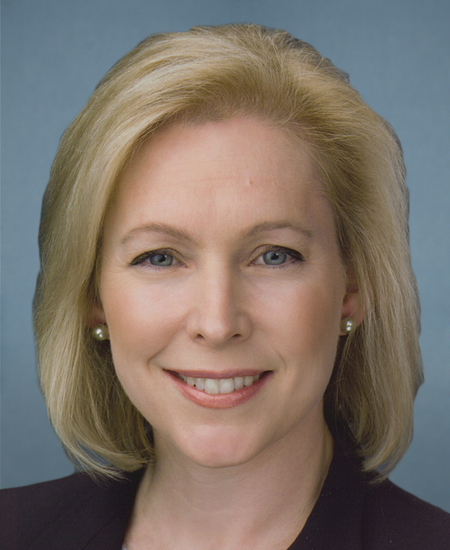
Sen. Kirsten E. Gillibrand
Sponsored bills
Maddy summaryThe Faster Labor Contracts Act requires employers and newly certified unions to begin negotiating an initial collective bargaining agreement within 10 days of a written request. If no agreement is reached within 90 days, the parties may request mediation from the Federal Mediation and Conciliation Service, which must act within 30 days. If mediation fails, the dispute moves to a binding arbitration panel whose decision - based on factors like employer finances, business type, and industry wages - remains enforceable for two years. This law directly affects employees represented by newly certified unions and their employers by reducing delays in securing first contracts, which historically averaged 465 days.
Maddy summaryThis bill increases tax benefits for working families by expanding child care tax credits. It raises the employer-provided child care credit from 25% to 50% of qualified expenses (with the maximum credit increasing from $150,000 to $500,000), and adds a new refundable household care credit allowing up to 50% of eligible expenses (capped at $5,000 for one child or $8,000 for two+ children). Small businesses receive enhanced benefits, with a 60% credit rate and higher maximum ($600,000) for qualifying employers. The changes directly affect working parents, caregivers, and small businesses that provide or support child care.
Maddy summaryThe Social Security Expansion Act (S 770) increases benefits for Social Security recipients by raising the first bend point percentage from 90% to 95% and adding an 18% increase for those eligible after 2025. It establishes a new Consumer Price Index for Elderly Consumers (CPI-E) to calculate cost-of-living adjustments and increases minimum benefits for lifetime low earners based on years worked, with benefits ranging from 16.25% to 125% of poverty guidelines. The bill also extends benefit eligibility for children who are full-time students until age 22 (instead of 19) and introduces new taxes on high earners, including a payroll tax on income between the contribution base and $250,000, a tax on self-employment income above $250,000, and raises the investment gains tax from 3.8% to 16.2%. The legislation consolidates Social Security's trust funds into a single Social Security Trust Fund.
Maddy summaryThis bill reauthorizes existing federal grant programs focused on restoring and stewarding the Long Island Sound through 2029. It extends the funding period for two key programs: the Long Island Sound Grants (under the Federal Water Pollution Control Act) and the Long Island Sound Stewardship Grants (under the 2006 Stewardship Act), changing their authorization from 2019-2023 to 2025-2029. These grants directly support states (Connecticut and New York), local governments, and non-profits working on water quality, habitat restoration, and public education projects in the Sound. The bill makes no new policy changes but continues current funding mechanisms for these established environmental programs.
Maddy summaryS 797, the Family Building FEHB Fairness Act, adds fertility treatment benefits to the Federal Employees Health Benefits (FEHB) program. This bill directly affects federal employees and their families enrolled in FEHB plans by requiring these plans to cover specified fertility treatments, including in vitro fertilization, embryo preservation, genetic testing, and related medications. Key provisions define "fertility treatment" to include procedures like artificial insemination, assisted reproductive technology, and gamete donation, as determined by the Office of Personnel Management and Health and Human Services. The change takes effect one year after the bill is enacted, making these services a standard covered benefit under FEHB.
This resolution recognizes Black History Month as an opportunity to reflect on U.S. history and to commemorate the contributions of African Americans. It calls for the United States to (1) honor the contribution of pioneers who helped to ensure its legacy; and (2) move forward as a nation "indivisible, with liberty and justice for all."
Maddy summaryThis bill adjusts the World Trade Center (WTC) Health Program to expand access to mental health evaluations and correct funding mechanisms. It allows licensed mental health providers (not just physicians) to certify mental health conditions for WTC responders and survivors, and extends the timeframe to add new health conditions from 90 to 180 days. The bill also modifies how annual funding is calculated - using a 7% annual increase plus a population-based adjustment - to ensure long-term program sustainability through 2090. Additionally, it removes deceased individuals from enrollment counts to improve program accuracy and clarifies provider credentialing rules for the nationwide health network. These changes directly affect WTC responders and survivors seeking health coverage under the program.
Maddy summaryS 726, titled "Ethan's Law," requires gun owners to store firearms securely in homes where minors (under 18) or individuals ineligible to own guns (per federal/state law) reside. It makes unsecured storage unlawful if a person "knows or reasonably should know" access is possible, with exceptions for gun safes, secure locations, or carrying firearms on one's person. Violations incur $500 fines per offense, and enhanced penalties apply if injury or death occurs. The bill also creates a federal grant program to support states with similar secure-storage laws and states that non-compliance constitutes negligence. This law directly affects households with minors or prohibited individuals, aiming to reduce accidental shootings, youth access, and firearm thefts.
Maddy summaryThis bill would establish the African Burial Ground International Memorial Museum and Educational Center at the African Burial Ground National Historic Landmark in Lower Manhattan, New York City. The museum would serve as a permanent memorial honoring enslaved Africans buried at the site, examining their cultural traditions and the history of slavery in the United States. The National Park Service would operate the museum, which would be associated with the National Museum of African American History and Culture, and would include provisions for site acquisition, development, and public programming. The bill creates an Advisory Council with representation from federal, state, and local governments, as well as community stakeholders, to guide the museum's planning and operation. It authorizes $15 million for fiscal year 2025 and ongoing funding for the museum's development and operation.