

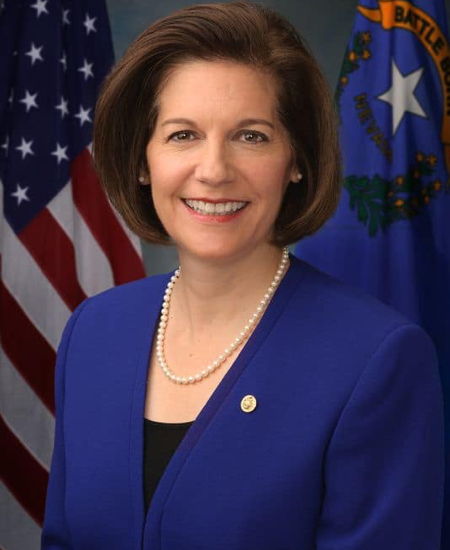
Photo of Catherine Cortez Masto
D United States Senate · Nevada

Sen. Catherine Cortez Masto

Compare
Total votes
1,054
all sessions
Attendance
98%
23 missed
Near the chamber average
With party
93%
of cast votes
Lower than 97% of chamber peers
Bipartisan score
4%
crosses aisle rarely
Higher than 95% of chamber peers
Sponsored
1,624
bills & resolutions
Higher than 77% of chamber peers
Committees
13
assignments
1,624 bills and resolutions

Sponsored bills

Total
1,624
Primary
337
Co-sponsor
1,287
This page
1,624
matching current filters
Primary S 1372
In committee · United States Senate · Lead sponsor
Tax Cut for Workers Act of 2025

Maddy summaryThis bill, the Tax Cut for Workers Act of 2025, expands the Earned Income Credit (EIC) to make it more accessible and generous for low-income workers without children. It lowers the minimum age for the credit from 25 to 19 (with exceptions for students, former foster youth, and homeless youth), removes the maximum age limit, and increases the credit amount and income thresholds. The bill also adjusts these amounts for inflation and allows taxpayers to use their prior year’s earned income if it was higher, applying to taxable years starting after 2025. These changes extend the credit to U.S. territories like Puerto Rico and American Samoa without prior time limits.

In committee Apr 9, 2025 0 co-sponsors
Co-sponsor S 1379
In committee · United States Senate · Co-sponsor
REPAIR Act

Maddy summaryThe REPAIR Act requires motor vehicle manufacturers to provide consumers and repair facilities with access to vehicle data, repair information, tools, and parts necessary for maintenance and repairs. It prohibits manufacturers from using technological or contractual barriers that restrict consumers' ability to choose repair facilities or use alternative parts, including aftermarket, recycled, or remanufactured components. The law mandates that manufacturers make critical repair information available to repair shops and alternative parts manufacturers at fair, reasonable costs, and ensures owners can access vehicle data without restrictions. The Federal Trade Commission will enforce these requirements, with penalties for violations, and an advisory committee will monitor implementation and identify barriers to competition. This legislation directly affects car owners, independent repair shops, parts manufacturers, and vehicle manufacturers by promoting competition and consumer choice in vehicle repair.

In committee Apr 9, 2025 1 co-sponsor
Primary S 1364
In committee · United States Senate · Lead sponsor
Supporting American Allies Act

Maddy summaryS 1364, the Supporting American Allies Act, exempts goods imported from Israel and Ukraine from tariffs imposed under a specific executive order. This directly affects importers of products from these two countries by removing a financial burden related to trade deficits. The key provision is a targeted tariff exemption for articles imported from Israel or Ukraine, as specified in Section 2 of the bill. The bill makes a concrete policy change by altering the application of existing trade duties without creating new requirements.

In committee Apr 9, 2025 0 co-sponsors
Co-sponsor S 1381
In committee · United States Senate · Co-sponsor
Protecting Employees and Retirees in Business Bankruptcies Act of 2025

Protecting Employees and Retirees in Business Bankruptcies Act of 2025 This bill establishes limits on executive compensation and provides protections for employee wages and benefits if an employer files for Chapter 11 (reorganization) bankruptcy. First, the bill increases the limit on claims for wages, salaries, other employee benefits, and commissions from $10,000 to $20,000 and eliminates the requirement that such claims must have been earned within 180 days before the filing of the bankruptcy petition. The bill grants certain claims higher priority in the bankruptcy process, including specific types of severance pay; contributions to an employee benefit plan; back pay, civil penalties, or damages arising from certain labor law violations; and certain pension plan withdrawal liabilities. The bill also limits executive compensation under a reorganization plan. For example, insiders (parties with close relationships to the debtor), senior executives, and others as specified by the bill may only receive payments or other distributions that are generally applicable to all full-time employees, subject to certain limits. The bill further restricts the compensation of any insider who continues to be employed by the debtor. A reorganization plan may only be approved if it provides for the recovery of claims relating to retiree benefits or for other financial returns paid under the plan. The bill also provides protections for collective bargaining agreements (CBAs) during bankruptcy proceedings. If a proceeding resulting from a CBA was or could have been commenced before the bankruptcy, the bankruptcy does not act as a stay in such a proceeding.

In committee Apr 9, 2025 1 co-sponsor
Co-sponsor S 1393
In committee · United States Senate · Co-sponsor
American Family Act

Maddy summaryThe American Family Act creates a new monthly child tax credit that would provide $300 per month for each child under age 6 and $300 per month for each child age 6 and older, with income-based eligibility limits. The credit would be refundable, meaning it could be paid even if a family owes no income tax, and would replace the current annual child tax credit. The bill establishes income thresholds ($150,000 for joint filers) above which the credit begins to phase out, with full phase-out at $400,000 for joint filers. It also includes provisions for "presumptive eligibility" to allow for advance payments based on previous tax returns or government program data. The bill would terminate the existing annual child tax credit after 2024, replacing it with this monthly payment system.

In committee Apr 9, 2025 1 co-sponsor
Co-sponsor S 1335
In committee · United States Senate · Co-sponsor
Secure Family Futures Act of 2025

Maddy summaryThis bill, titled misleadingly as the "Secure Family Futures Act of 2025," actually modifies tax rules for specific insurance companies, not family-related policies. It directly affects "applicable insurance companies" (defined as most domestic insurers not using special tax elections or foreign entities) by: (1) excluding their debt holdings (like bonds) from being counted as capital assets for tax purposes, and (2) allowing capital losses incurred by these companies to be carried forward over 10 years instead of the standard period. These changes apply to debt acquired and losses arising after December 31, 2025. The bill contains no provisions related to families, child welfare, or social programs.

In committee Apr 8, 2025 1 co-sponsor
Co-sponsor SRES 159
Passed · United States Senate · Co-sponsor
A resolution honoring the life of the Honorable John Bennett Johnston, Jr., former Senator for the State of Louisiana.

Maddy summaryThis resolution (SRES 159) is a ceremonial Senate measure honoring the late Senator John Bennett Johnston, Jr. (1932-2024), who represented Louisiana in the U.S. Senate from 1972 to 1997. It commemorates his career, including his work on energy policy, flood control, and Louisiana conservation efforts, and requests the Senate adjourn in his memory while sending condolences to his family. As a non-binding resolution, it has no policy impact or direct effect on any individuals or laws.

Passed Apr 7, 2025 1 co-sponsor
Co-sponsor SRES 156
Passed · United States Senate · Co-sponsor
A resolution commemorating the 50th anniversary of the Indian Self-Determination and Education Assistance Act.

Maddy summarySRES 156 is a Senate resolution commemorating the 50th anniversary of the Indian Self-Determination and Education Assistance Act (ISDEAA), signed into law on January 4, 1975. It recognizes how ISDEAA has enabled federally recognized tribes to administer federal programs - including healthcare, education, and public safety - for their communities, with 92% of tribes using its authorities as of 2024. The resolution is purely ceremonial and does not create new policy or alter existing law, instead affirming congressional support for tribal self-governance.

Passed Apr 5, 2025 1 co-sponsor
Co-sponsor S 1310
In committee · United States Senate · Co-sponsor
No Tax Breaks for Union Busting (NTBUB) Act

Maddy summaryS 1310, the No Tax Breaks for Union Busting (NTBUB) Act, denies tax deductions for employer spending aimed at influencing workers' decisions about union organizing or collective bargaining. It amends the tax code to block deductions for expenses like anti-union consultant fees, captive audience meetings, and other tactics that interfere with labor rights under the National Labor Relations Act. Employers must report such spending on tax returns with specific details, including dates, amounts, and whether activities relate to unfair labor practice charges. This directly affects businesses that engage in anti-union organizing tactics, removing a tax incentive for these activities while preserving deductions for standard union negotiations.

In committee Apr 4, 2025 1 co-sponsor
Primary S 1273
In committee · United States Senate · Lead sponsor
Combatting Money Laundering in Cyber Crime Act of 2025

Combatting Money Laundering in Cyber Crime Act of 2025 This bill expands the investigative authority of the U.S. Secret Service, extends reporting requirements related to public-private information sharing, and requires the Government Accountability Office (GAO) to evaluate existing requirements to combat money laundering and related crimes. Specifically, the bill authorizes the Secret Service to investigate money laundering and structured transactions (i.e., structuring currency transactions to evade currency reporting requirements). Additionally, the bill extends the requirement for the Financial Crimes Enforcement Network (FinCEN) to report on the efforts of the FinCEN Exchange. The FinCEN Exchange is a voluntary public-private information sharing partnership among law enforcement agencies, national security agencies, financial institutions, and FinCEN to combat money laundering and related crimes, including the financing of terrorism. The bill also extends the requirement for the U.S. executive director at the International Monetary Fund to support the increased use of the fund's administrative budget to help members prevent money laundering and the financing of terrorism. The requirement expires on December 20, 2025. Finally, the bill directs the GAO to report on implementation of provisions of the Anti-Money Laundering Act of 2020 that expanded information sharing with tribal authorities and expanded reporting requirements related to money laundering and terrorist financing. The GAO must focus on evaluating the ability of law enforcement to identify and deter money laundering in cybercrimes.

In committee Apr 3, 2025 0 co-sponsors
Showing 421 to 430 of 1,624 bills
Previous 1 … 42 43 44 … 163 Next