

Ban Russian Energy Imports Act This bill declares that a national emergency exists with respect to the aggression of Russia against Ukraine. During this emergency, the President must prohibit the importation of crude oil, petroleum, petroleum products, liquefied natural gas, and coal in which Russia or a Russian national has any interest. The bill exempts products that are already loaded or in transit at the time of this bill's enactment.
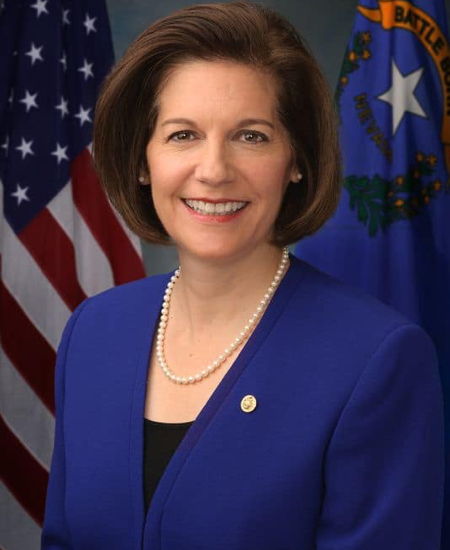
Sen. Catherine Cortez Masto
Sponsored bills
Arbitration Fairness for Consumers Act This bill deems as invalid or unenforceable a predispute arbitration agreement or joint-action waiver related to a consumer financial product or service.
Resolving Extended Limbo for Immigrant Employees and Families Act or the RELIEF Act This bill revises provisions related to family- and employment-based visas. The bill (1) increases the per-country cap on family-based immigrant visas from 7% of the total number of such visas available that year to 15%, (2) eliminates the 7% cap for employment-based immigrant visas, and (3) removes an offset that reduced the number of visas for individuals from China. The annual cap for visas for the unmarried children of citizens is increased, and the formula for calculating the cap for the unmarried children of residents is revised. The bill also establishes transition rules for employment-based visas from FY2022-FY2024, by reserving a percentage of EB-2 (workers with advanced degrees or exceptional ability), EB-3 (skilled and other workers), and EB-5 (investors) visas for individuals not from the two countries with the largest number of recipients of such visas. Of the unreserved visas, not more than 85% shall be allotted to immigrants from any single country. The Department of State shall increase allocations of family- and employment-based visas by the number of beneficiaries of such applications filed before this bill's enactment, to be allocated FY2022-FY2026 to beneficiaries of applications filed before this bill's enactment who have not yet received a visa. The minor children and spouses of permanent residents and those accompanying a qualified alien shall be treated as an immediate relative for immigration purposes. Whether an alien qualifies as a minor shall be determined according to the alien's age at the time a relevant petition is filed.
Lake Tahoe Restoration Reauthorization Act This bill reauthorizes through September 30, 2034, activities to restore Lake Tahoe and its surrounding basin. Lake Tahoe is a large freshwater lake on the border of California and Nevada.
Health Care for Burn Pit Veterans Act This bill updates policies and procedures related to Department of Veterans Affairs (VA) health care and benefits for veterans who have been exposed to toxic substances. Specifically, the bill extends the eligibility period for VA hospital care, medical services, and nursing home care for combat veterans who served after September 11, 2001, and were exposed to toxic substances, radiation, or other conditions, including those who did not enroll to receive VA care during the eligibility period. The VA must incorporate into its existing health care screening a screening to help determine potential exposures to toxic substances during military service. Among other requirements, the VA must also provide annual training to health care and benefits personnel with respect to veterans who were exposed to toxic substances; analyze total and respiratory disease mortality in veterans who served in specified locations on specified dates; conduct an epidemiological study on the health trends of veterans who served in the Armed Forces after September 11, 2001; conduct a study to determine trends in the rates of the incidence of cancer in veterans; publish a list of VA resources for veterans who were exposed to toxic substances, families and caregivers of such veterans, and survivors of such veterans who are receiving death benefits; and report on the data quality of the Individual Longitudinal Exposure Record and its usefulness in supporting veterans in receiving VA health care and benefits.
Harriet Tubman Bicentennial Commemorative Coin Act This bill directs the Department of the Treasury to mint and issue 50,000 $5 gold coins, 400,000 $1 silver coins, and 750,000 half-dollar clad coins emblematic of the legacy of Harriet Tubman as an abolitionist. The Secretary may issue coins under this bill only during the period of January 1, 2024, through December 31, 2024. All surcharges received by Treasury from the sale of such coins must be paid equally to the National Underground Railroad Freedom Center in Cincinnati, Ohio, and The Harriet Tubman Home, Inc. in Auburn, New York, for the purpose of accomplishing and advancing their missions.
This resolution supports the designation of February 19-February 26, 2022, as National FFA Week. It also (1) recognizes the important role of the National FFA Organization (Future Farmers of America) in developing the next generation of leaders who will change the world, and (2) celebrates 70 years of the National FFA Organization's membership magazine.
Maddy summaryThis Senate resolution (SRES 526) formally condemns the antisemitic terrorist attack at Congregation Beth Israel Synagogue in Colleyville, Texas, on January 15, 2022, where hostages were held at gunpoint. It expresses gratitude that no lives were lost, applauds law enforcement and emergency responders for their actions, and condemns antisemitism in the United States. The resolution does not create new policies or allocate funds; it is a symbolic expression of support for the Jewish community and law enforcement. It directly affects the congregation and local community by affirming their safety and the importance of religious freedom.
This resolution recognizes Black History Month as an opportunity to reflect on U.S. history and to commemorate the contributions of African Americans. It calls for the United States to (1) honor the contribution of pioneers who helped to ensure its legacy; and (2) move forward as a nation "indivisible, with liberty and justice for all."
Affordable Insulin Now Act This bill limits cost-sharing for insulin under private health insurance and the Medicare prescription drug benefit. Specifically, the bill caps cost-sharing under private health insurance for a month's supply of selected insulin products at $35 or 25% of a plan's negotiated price (after any price concessions), whichever is less, beginning in 2023. The bill caps cost-sharing under the Medicare prescription drug benefit for a month's supply of covered insulin products at (1) $35 between October 1, 2022, and January 1, 2024; and (2) $35 or 25% of a plan's negotiated price, whichever is less, beginning in 2024. The bill provides funds for FY2022 for the Centers for Medicare & Medicaid Services (CMS) to implement the bill. Currently, the CMS is testing a voluntary model under the Medicare prescription drug benefit (the Part D Senior Savings Model) in which the copayment for a month's supply of insulin is capped at $35 through participating plans. The model is set to expire on December 31, 2025.