

Maddy summarySRES 643 is a Senate resolution designating the week of May 15-21, 2022, as "National Police Week" to honor law enforcement officers who serve and sacrifice in their communities. The resolution recognizes the service of law enforcement officers, particularly those killed or injured in the line of duty, and acknowledges their sacrifices during the COVID-19 pandemic. It expresses support for officers' needs for proper equipment, training, and resources, and encourages the public to observe the week by honoring law enforcement personnel. This designation serves as a formal recognition of law enforcement service without creating new legal requirements or policy changes.
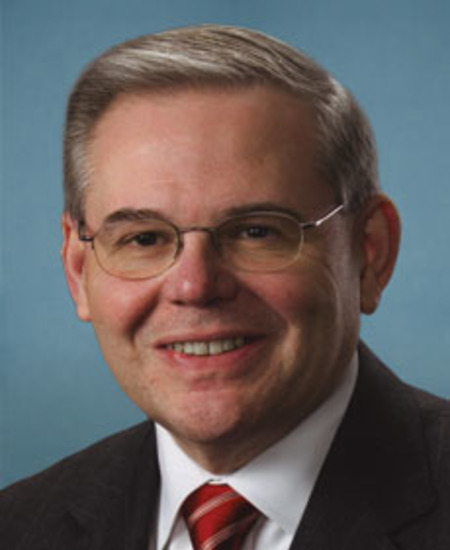
Sen. Robert Menendez
Sponsored bills
Access to Baby Formula Act of 2022 This bill authorizes the Department of Agriculture (USDA) to take certain actions to address emergencies, disasters, and supply chain disruptions (particularly the shortage of infant formula in the United States) affecting participants of the Special Supplemental Nutrition Program for Women, Infants, and Children (WIC). For example, the bill directs USDA to require each infant formula cost containment contract to include remedies in the event of an infant formula recall, including how an infant formula manufacturer would protect against disruption to WIC participants in the state.
University Centers for Growth, Development, and Prosperity Act of 2022 This bill requires the Economic Development Administration (EDA) to establish in each state a university center at an institution of higher education that must, to the extent possible, collaborate with economic development districts, provide technical assistance and business development services to area businesses, and conduct research and analysis relating to economic development. In selecting such centers, the EDA must prioritize Historically Black Colleges and Universities, Tribal Colleges and Universities, Hispanic-Serving Institutions, and other minority-serving institutions.
Domestic Terrorism Prevention Act of 2022 This bill establishes new requirements to expand the availability of information on domestic terrorism, as well as the relationship between domestic terrorism and hate crimes. It authorizes domestic terrorism components within the Department of Homeland Security (DHS), the Department of Justice (DOJ), and the Federal Bureau of Investigation (FBI) to monitor, analyze, investigate, and prosecute domestic terrorism. The domestic terrorism components of DHS, DOJ, and the FBI must jointly report on domestic terrorism, including white-supremacist-related incidents or attempted incidents. DHS, DOJ, and the FBI must review the anti-terrorism training and resource programs of their agencies that are provided to federal, state, local, and tribal law enforcement agencies. Additionally, DOJ must make training on prosecuting domestic terrorism available to its prosecutors and to assistant U.S. attorneys. It creates an interagency task force to analyze and combat white supremacist and neo-Nazi infiltration of the uniformed services and federal law enforcement agencies. Finally, it directs the FBI to assign a special agent or hate crimes liaison to each field office to investigate hate crimes incidents with a nexus to domestic terrorism.
Greatest Generation Commemorative Coin Act This bill directs the Department of the Treasury to mint and issue up to 50,000 $5 coins, 400,000 $1 silver coins, and 750,000 half-dollar clad coins in commemoration of the National World War II Memorial in the District of Columbia. The design of the coins shall be emblematic of the memorial and the service and sacrifice of American soldiers and civilians during World War II. All surcharges received from the sale of such coins shall be paid to the Friends of the National World War II Memorial to support the National Park Service in maintaining and repairing the memorial, and for educational and commemorative programs.
This bill directs the Department of State to include additional information in its annual reports concerning Taiwan's participation at the World Health Organization's World Health Assembly (WHA) as an observer. The report shall describe changes and improvements to the State Department's plan to support Taiwan's observer status at the WHA, following any meetings at which Taiwan did not participate under such status. (China has opposed Taiwan's participation in the WHA.)
Maddy summaryThis concurrent resolution (SCONRES 39) is a symbolic congressional gesture commemorating the 1,000,000 Americans who died from COVID-19 in the United States. It formally recognizes and mourns this death toll, which was reached on May 12, 2022, and honors the memory of the deceased while offering condolences to their families. The resolution has no binding legal effect or policy changes - it serves solely as a formal expression of remembrance by Congress. It directly affects no individuals or groups through new requirements, but acknowledges the pandemic's profound human impact on U.S. communities.
This concurrent resolution condemns the October 25, 2021, coup in Sudan. It recognizes the Prime Minister and his cabinet as the constitutional leaders of Sudan's transitional government and calls for Sudan's military junta, among other things, to immediately release all civilian government officials, civil society members, and other individuals detained in connection with the coup; return to constitutional rule under the transitional constitution; and lift the state of emergency, including complete restoration of all means of communication. Finally, the concurrent resolution calls on international partners to join U.S. efforts to impose targeted sanctions on the junta and other accomplices to the coup; and suspend Sudan's participation in all regional multilateral organizations until Sudan is returned to constitutional rule under the transitional constitution.
Autism Family Caregivers Act of 2022 This bill establishes a pilot program to provide training for caregivers on improving health and other outcomes for children with autism spectrum disorder and other developmental disabilities or delays. To carry out the program, the Health Resources and Services Administration (HRSA) must award grants to, among other eligible entities, health systems and nonprofits to provide the training. HRSA must also provide technical assistance to grant recipients and evaluate the program.
Alzheimer's Accountability and Investment Act This bill requires the National Institutes of Health to annually submit, beginning in FY2024, an estimate of its budget and personnel needs for carrying out initiatives pursuant to the National Alzheimer's Project. This project supports coordination of federal planning, research, and other efforts to address Alzheimer's disease and related dementias.