

Maddy summaryThis bill creates a federal grant program to help states and tribal governments improve their systems for licensing firearms dealers. To qualify, a state must already have a law requiring dealers to be licensed (with licenses valid up to 3 years, regular inspections, and penalties for violations like suspension or fines). Grants, capped at $2.5 million per year, can fund developing, implementing, or evaluating these licensing programs. Recipients must report annually on inspections, violations, and license statuses, and the federal government will publish annual reports to Congress on all grant activities.
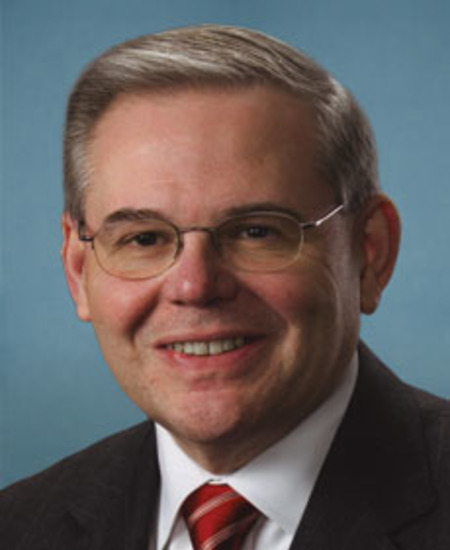
Sen. Robert Menendez
Sponsored bills
Maddy summaryThis is a ceremonial Senate resolution (SRES 110) honoring the late James George Abourezk, the first Arab American to serve in the U.S. Senate (1973-1979) from South Dakota. It commemorates his legacy, including his work re-establishing the Senate Committee on Indian Affairs and co-authoring key Native American rights legislation like the Indian Child Welfare Act. The resolution directs the Senate to adjourn in his memory and send a copy to his family, acknowledging his service as a representative and advocate for Native American communities. As a procedural resolution, it has no legislative effect beyond commemoration.
Maddy summaryS 817, the SVB Act, repeals Title IV of the 2018 Economic Growth, Regulatory Relief, and Consumer Protection Act (Public Law 115-174). This bill restores the banking regulations that existed before Title IV was enacted, effectively undoing the 2018 changes to financial oversight. It directly affects banking regulations governing financial institutions by reverting to the prior regulatory framework. The key mechanism is the explicit repeal of Title IV and the restoration of pre-2018 provisions as if the 2018 law had never applied.
Maddy summaryThis bill authorizes the minting of commemorative coins to mark the 100th anniversary of the U.S. Foreign Service. It specifies three coin types: up to 50,000 $5 gold coins (90% gold), 400,000 $1 silver coins (90% silver), and 750,000 half-dollar clad coins, all to be issued in 2025. A surcharge ($35 for gold, $10 for silver, $5 for half-dollars) will be added to each coin's sale price, with all funds going directly to the Association for Diplomatic Studies and Training to support its diplomatic history preservation work. The bill ensures no net cost to the government by requiring all design, production, and marketing expenses to be recovered through coin sales.
Maddy summarySRES 104 is a symbolic Senate resolution recognizing the heritage, culture, and contributions of Latinas in the United States. It highlights that nearly 30 million Latinas live in the U.S. (1 in 6 women), emphasizing their roles across diverse fields like business (over 2 million Latina-owned businesses), military service (45,710 active-duty Latinas), arts (Selena, Rita Moreno), and essential work during the pandemic. The resolution notes ongoing challenges, including Latinas earning only 57 cents for every dollar earned by White, non-Hispanic men. It formally celebrates Latinas' achievements while acknowledging the need for further progress toward equality. As a non-binding resolution, it does not create new laws or allocate funds.
Maddy summaryThis bill amends a 1999 appropriations law to prevent U.S. government entities from honoring trademarks tied to confiscated foreign assets. It directly affects businesses or individuals claiming trademark rights over marks previously used in connection with assets seized by foreign governments, unless the original owner or their legal successor consented. The key change requires that anyone asserting trademark rights must have known or had reason to know the mark was linked to confiscated assets. The bill also adds a new requirement that such rights can only be enforced if the claimant had actual knowledge of the confiscation at the time of acquisition.
Maddy summaryS 737, the No Tax Breaks for Union Busting (NTBUB) Act, denies tax deductions for employers who spend money to influence employees about union activities or collective bargaining. It amends the tax code to make non-deductible expenses related to swaying union elections, labor disputes, or collective actions - such as anti-union consulting fees, captive audience meetings, or legal settlements over unfair labor practices. Employers must report such spending on tax returns (using new Form 6720D) and face penalties for non-compliance, including fines up to $100,000. The bill directly affects businesses that engage in union-avoidance tactics, aiming to remove tax incentives for undermining workers’ rights under labor laws.
Maddy summaryS 753, the "Good Jobs for Good Airports Act," requires airports receiving federal funding to pay covered airport service workers a minimum wage of $15 per hour or higher (based on local standards, the Service Contract Act, or state/local laws), plus minimum fringe benefits. It directly affects workers in roles like baggage handling, security, concessions, cleaning, and ticketing at airports classified as "small," "medium," or "large hub" airports. Key mechanisms include annual certification by airport operators that all covered workers meet these standards, with compliance tied to eligibility for federal airport grants. The law does not override stricter state or local wage laws but sets a baseline for federally funded airport projects.
Maddy summaryThe Tax Fairness for Workers Act (S 738) allows employees to deduct certain work-related expenses from their taxable income. It creates an above-the-line deduction for union dues and adds a new exception permitting miscellaneous itemized deductions for other employee expenses, such as uniforms or tools, that were previously limited. This directly affects wage-earning workers who pay union dues or have unreimbursed job costs. The changes apply to taxable years beginning after December 31, 2022, and remove prior restrictions on these deductions.
Maddy summaryS 701, the Women’s Health Protection Act of 2023, prohibits states from imposing restrictions on abortion that are more burdensome than those for comparable medical procedures. It protects access to abortion before fetal viability (when a fetus could survive outside the womb) by banning requirements like unnecessary in-person visits, medically inaccurate counseling, or facility restrictions not applied to similar care. Post-viability abortions remain protected when medically necessary to safeguard a patient’s life or health. The bill preempts conflicting state laws and ensures enforcement through federal courts to uphold these access protections for patients and health care providers.