

Women's Health Protection Act of 2021 This bill prohibits governmental restrictions on the provision of, and access to, abortion services. Specifically, governments may not limit a provider's ability to prescribe certain drugs, offer abortion services via telemedicine, or immediately provide abortion services when the provider determines a delay risks the patient's health. Furthermore, governments may not require a provider to perform unnecessary medical procedures, provide medically inaccurate information, comply with credentialing or other conditions that do not apply to providers whose services are medically comparable to abortions, or carry out all services connected to an abortion. In addition, governments may not (1) require patients to make medically unnecessary in-person visits before receiving abortion services or disclose their reasons for obtaining such services, or (2) prohibit abortion services before fetal viability or after fetal viability when a provider determines the pregnancy risks the patient's life or health. The bill also prohibits other governmental measures that are similar to the bill's specified restrictions or that otherwise single out and impede access to abortion services, unless a government demonstrates that the measure significantly advances the safety of abortion services or health of patients and cannot be achieved through less restrictive means. The Department of Justice, individuals, or providers may bring a lawsuit to enforce this bill, and states are not immune from suits for violations. The bill applies to restrictions imposed both prior and subsequent to the bill's enactment.
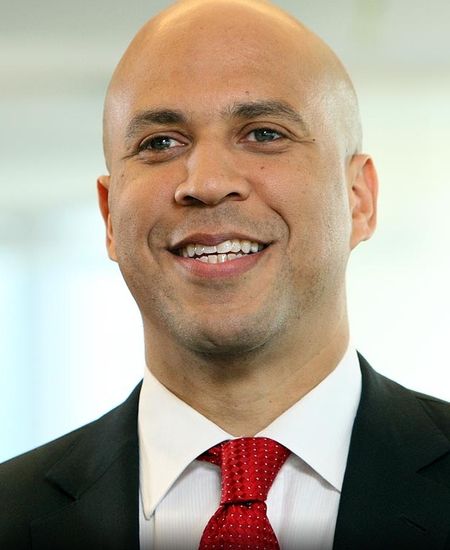
Sen. Cory A. Booker
Sponsored bills
Filthy Fifty Act This bill requires the Department of Defense (DOD) to complete testing for perfluoroalkyl and polyfluoroalkyl substances (PFAS) at all military installations, formerly used defense sites, and state-owned facilities of the National Guard in the United States. PFAS are man-made and may have adverse human health effects. Not later than 60 days following the detection of PFAS at a military installation, formerly used defense site, or state-owned facility of the National Guard, DOD must take removal actions to ensure that all individuals served by a drinking water source contaminated by PFAS have access to drinking water that meets the applicable standard, regardless of whether DOD is the drinking water purveyor. Additionally, DOD must complete all physical construction required for the remediation of PFAS at such sites not later than 10 years after the enactment of this bill. DOD must report to Congress identifying the status of remediation efforts at 50 specified sites, such as England Air Force Base, Louisiana. DOD must complete all physical construction required for the remediation of PFAS at the 50 specified sites not later than five years after the enactment of this bill.
Maternal Health Quality Improvement Act This bill requires the Department of Health and Human Services (HHS) to establish specified grant programs to support positive maternal health care outcomes for pregnant and postpartum women and their infants. Specifically, HHS must award grants to (1) develop best practices to reduce preventable maternal mortality, and (2) train health care professionals to reduce and prevent discrimination when providing maternal health services. In addition, HHS may award grants to establish evidence-informed, integrated health care services to pregnant and postpartum women and their infants. The bill also provides statutory authority for a grant program that supports perinatal quality collaboratives. These are networks of perinatal care providers and public health professionals that work to improve pregnancy outcomes through continuous quality improvement. HHS also must (1) contract with an independent research organization to study and make recommendations on trainings for health professional schools and education programs on reducing and preventing discrimination in the provision of maternal health services, and (2) address pregnant and postpartum women and their infants in public awareness initiatives related to vaccinations.
COVID-19 Safer Detention Act of 2021 This bill expands statutory authority for federal prisoners to be released before completing their sentences or to be placed in the community to serve the final portion of their sentences. First, the bill makes changes to the early release pilot program which authorizes the Bureau of Prisons to release early and place on home confinement elderly offenders and terminally ill offenders who meet eligibility criteria. This bill expands eligibility to offenders serving time for an offense under the laws of the District of Columbia, reduces the amount of time an offender must serve by the good time credits earned by the offender, and creates a judicial review process for prisoners. Second, the bill modifies the compassionate release process which authorizes federal courts to reduce a prisoner's sentence and impose a term of probation or supervised released in certain circumstances. This bill expands eligibility to prisoners sentenced before November 1, 1987; and specifies that vulnerability to COVID-19 is a basis for compassionate release. Regarding the judicial review of these release authorities, the bill also (1) authorizes federal courts to appoint counsel to assist defendants, (2) applies statutory rights for crime victims to these proceedings, and (3) shortens the waiting period during the COVID-19 pandemic. Additionally, the bill requires the Government Accountability Office to study postrelease, probation, and pretrial services, including recent changes. Finally, the bill directs the Administrative Office of the U.S. Courts to request resources to address staffing needs in each judicial district, including resources that may be necessary as a result of this bill.
This resolution expresses the Senate's condolences to the people of Afghanistan and the Hazara, an ethnic minority community in Afghanistan. The resolution also condemns all forms of violence against women and girls in Afghanistan and supports U.S. and international efforts to ensure that girls in Afghanistan can safely attend school. (On May 8, 2021, a bomb attack at the Sayed Ul-Shuhada High School in Kabul killed more than 85 people.)
This resolution offers the condolences of the Senate regarding the death of Senator John William Warner and expresses deep appreciation for his outstanding and important service to his country.
This resolution recognizes the significance of Asian/Pacific American Heritage Month as an important time to celebrate the contributions of Asian Americans and Pacific Islanders to the history of the United States. The resolution also recognizes that the Asian American and Pacific Islander communities enhance the rich diversity of the United States.
Algorithmic Justice and Online Platform Transparency Act This bill establishes requirements for certain commercial online platforms (e.g., social media sites) that withhold or promote content through algorithms and related computational processes that use personal information. The platforms must make disclosures about their collection and use of personal information and their content moderation practices; retain specified records that describe how the algorithms use personal information and assess whether the algorithms produce disparate outcomes based on race and other demographic factors in terms of access to housing, employment, financial services, and related matters; employ algorithms safely and effectively; and allow users to access and transfer their personal information. If a platform uses algorithms to publish or sell advertising, it must maintain a library of the advertisements. The Federal Trade Commission must also adopt rules concerning deceptive advertising. A platform's chief executive officer or other senior officer must certify compliance with disclosure requirements. Additionally, platforms may not (1) employ algorithms or other design features that result in discrimination or similar harms based on demographic or biometric factors, or (2) process information such that it impairs voting rights. Further, users of a platform may not violate civil rights laws using the platform's algorithms. The bill prohibits waivers or other methods that limit rights under the bill; provides whistleblower protections for individuals who report violations; and authorizes enforcement by specified federal agencies, states, and private individuals. The bill also provides funding for an interagency task force to study the discriminatory use of personal information by platforms' algorithms.
Veteran Readiness and Employment National Emergency Extended Deadline Act of 2021 or the VR&E NEED Act of 2021 This bill extends a veteran's eligibility for the Veteran Readiness and Employment program when educational institutions are temporarily or permanently closed due to an emergency situation, or there is another reason that prevents a veteran from participating. Specifically, the period of eligibility must not run during the period the veteran is prevented from participating in the program. The period must resume on a date, determined by the Department of Veterans Affairs, that is not earlier than the first day after the veteran is able to resume participation and not later than 90 days after that day.
National Origin-Based Antidiscrimination for Nonimmigrants Act or the NO BAN Act This bill imposes limitations on the President's authority to suspend or restrict aliens from entering the United States. It also prohibits religious discrimination in various immigration-related decisions, such as whether to issue an immigrant or nonimmigrant visa, unless there is a statutory basis for such discrimination. The President may temporarily restrict the entry of any aliens or class of aliens after the Department of State determines that the restriction would address specific and credible facts that threaten U.S. interests such as security or public safety. The bill also imposes limitations on such restrictions, such as requiring the President, State Department, and the Department of Homeland Security (DHS) to (1) only issue a restriction when required to address a compelling government interest, and (2) narrowly tailor the suspension to use the least restrictive means to achieve such an interest. Before imposing a restriction, the State Department and DHS shall consult with Congress. The State Department and DHS shall report to Congress about the restriction within 48 hours of the restriction's imposition. If such a report is not made, the restriction shall immediately terminate. Individuals or entities present in the United States and unlawfully harmed by such a restriction may sue in federal court. DHS may suspend the entry of aliens traveling to the United States on a commercial airline that failed to comply with regulations related to detecting fraudulent travel documents.