

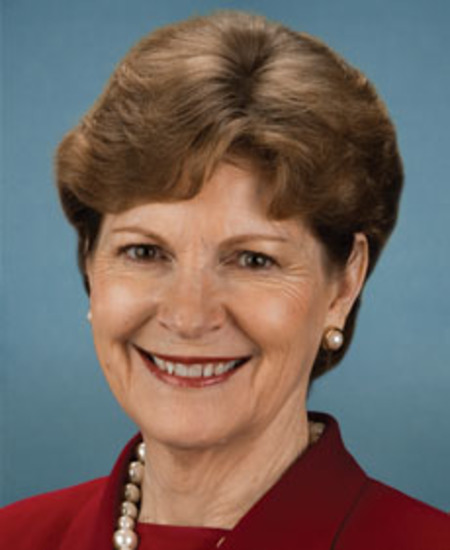
Photo of Jeanne Shaheen
D United States Senate · New Hampshire

Sen. Jeanne Shaheen

Compare
Total votes
1,054
all sessions
Attendance
98%
18 missed
Near the chamber average
With party
97%
of cast votes
Near the chamber average
Bipartisan score
2%
crosses aisle rarely
Near the chamber average
Sponsored
1,732
bills & resolutions
Higher than 85% of chamber peers
Committees
22
assignments
1,732 bills and resolutions

Sponsored bills

Total
1,732
Primary
279
Co-sponsor
1,453
This page
1,732
matching current filters
Co-sponsor S 522
In committee · United States Senate · Co-sponsor
Credit Union Board Modernization Act

Credit Union Board Modernization Act This bill revises the required frequency of meetings held by a credit union's board of directors. Specifically, new credit unions and credit unions with a low soundness rating must meet monthly. All other credit unions must hold at least six meetings annually, with at least one meeting held during each fiscal quarter. Currently, all credit union boards must meet at least once a month.

In committee Feb 11, 2025 1 co-sponsor
Co-sponsor S 526
In committee · United States Senate · Co-sponsor
Pharmacy Benefit Manager Transparency Act of 2025

Maddy summaryS 526, the Pharmacy Benefit Manager Transparency Act of 2025, requires pharmacy benefit managers (PBMs) - the middlemen managing drug coverage for health plans - to disclose financial details and stop unfair practices. It prohibits PBMs from keeping price differences between what they charge health plans and pay pharmacies, arbitrarily clawing back payments, or inflating fees to offset government-mandated changes. PBMs must annually report to the FTC and HHS on rebate sharing, fee structures, formulary changes, and reimbursement differences, including whether drug tier shifts were influenced by manufacturers. This directly affects PBMs, pharmacies, health plans, and patients by increasing transparency in drug pricing and reimbursement.

In committee Feb 11, 2025 1 co-sponsor
Co-sponsor S 455
In committee · United States Senate · Co-sponsor
Protecting Sensitive Locations Act

Protecting Sensitive Locations Act This bill prohibits immigration enforcement actions within 1,000 feet of a sensitive location except in exigent circumstances, such as the imminent risk of death, violence, or physical harm to any person. Sensitive locations include  health care facilities; schools and school bus stops; places that provide assistance for people such as children, pregnant women, and abuse victims; child care facilities; places that provide disaster or emergency services; places of worship; courthouses and lawyers’ offices; facilities used as polling places; certain labor union facilities; and public assistance offices. The prohibition shall apply to Department of Homeland Security officers and agents, as well as state employees pursuing immigration enforcement actions. If an enforcement action is carried out in violation of this prohibition (1) no information resulting from the action may be entered into the record in a resulting removal proceeding, and (2) the affected individual may move to immediately terminate such a proceeding. U.S. Immigration and Customs Enforcement and U.S. Customs and Border Protection shall annually report to Congress about enforcement actions taken at sensitive locations in the preceding year.

In committee Feb 6, 2025 1 co-sponsor
Co-sponsor S 463
In committee · United States Senate · Co-sponsor
Protect Our Letter Carriers Act of 2025

Maddy summaryThis bill directs $1.4 billion annually (2025-2029) to upgrade U.S. Postal Service mailboxes with high-security models and replace physical "arrow keys" with electronic locks, directly affecting postal carriers and mail collection points. It requires the Attorney General to appoint dedicated prosecutors in each judicial district to coordinate investigations and prosecutions of crimes against postal employees, including assaults or robberies. The bill also mandates the U.S. Sentencing Commission to amend guidelines so that assaults or robberies against postal employees are treated with the same severity as assaults against law enforcement officers. These changes aim to enhance physical security, improve legal responses to violence, and increase penalties for attacks on postal workers.

In committee Feb 6, 2025 1 co-sponsor
Co-sponsor S 467
In committee · United States Senate · Co-sponsor
End Double Taxation of Successful Consumer Claims Act

Maddy summaryThis bill creates a tax deduction for attorney fees paid in consumer protection lawsuits where a defendant is found liable for violating specific federal or state consumer laws. It directly affects consumers who win such cases and their attorneys, by allowing them to deduct these fees from taxable income instead of paying tax on them. The key provision amends the tax code to add an "above-the-line" deduction for fees related to violations of laws like the Truth in Lending Act, Fair Debt Collection Practices Act, and Fair Credit Reporting Act. This change removes a tax burden on the portion of settlement awards covering legal costs, ensuring consumers keep more of their recovery.

In committee Feb 6, 2025 1 co-sponsor
Co-sponsor S 479
In committee · United States Senate · Co-sponsor
New Markets Tax Credit Extension Act of 2025

Maddy summaryThis bill permanently extends the New Markets Tax Credit (NMTC) program, which incentivizes private investment in low-income communities. It modifies the tax code to keep the credit available beyond 2025 (replacing "2020 through 2025" with "2020 and each calendar year thereafter") and adds automatic annual inflation adjustments to the credit amount starting in 2026. The bill also provides tax relief by allowing NMTC credits to offset the alternative minimum tax, specifically for investments made after December 2024. This directly affects community development financial institutions (CDFIs) and investors who fund projects in designated low-income areas.

In committee Feb 6, 2025 1 co-sponsor
Co-sponsor S 475
In committee · United States Senate · Co-sponsor
Alternatives to PAIN Act

Maddy summaryS 475, the Alternatives to PAIN Act, changes Medicare Part D coverage to make non-opioid pain management drugs more accessible and affordable for beneficiaries. It requires Medicare plans to cover qualifying non-opioid pain drugs without deductibles and place them on the lowest cost-sharing tier (meaning patients pay the least out-of-pocket) starting in 2026. The bill also prohibits plans from requiring step therapy (forcing patients to try opioids first) or prior authorization for these specific drugs. Qualifying drugs must treat acute pain (like post-surgery), not work on opioid receptors, have no equivalent alternatives, and meet cost thresholds. This directly affects Medicare Part D beneficiaries needing pain management and the plans that cover them.

In committee Feb 6, 2025 1 co-sponsor
Co-sponsor S 489
In committee · United States Senate · Co-sponsor
Air Guard STATUS Act of 2025

Maddy summaryThis bill creates a permanent program to cover tuition and educational expenses for Air National Guard members who meet their training requirements. It requires the Air Force Secretary to use existing authority under federal law (10 U.S.C. §2007) to pay for these costs, replacing temporary or inconsistent approaches. The program directly affects active-duty Air National Guard members who comply with their training obligations under 32 U.S.C. §502(a). This is a concrete policy change to standardize and ensure ongoing tuition assistance, not a new funding source or eligibility expansion.

In committee Feb 6, 2025 1 co-sponsor
Co-sponsor S 491
In committee · United States Senate · Co-sponsor
Foreign Assistance Accountability and Oversight Act

Maddy summaryThis bill creates a new "Director of Foreign Assistance" position within the U.S. Department of State, requiring Senate confirmation and mandating that the Director report directly to the Deputy Secretary of State. The Director's duties include coordinating all U.S. foreign aid programs across agencies (like USAID and the Treasury), aligning aid with national security goals, tracking results through data analysis, and improving transparency in spending. The bill also requires all foreign aid funds to be obligated (committed for spending) within 90 days of congressional appropriations. This position directly affects how the State Department and other federal agencies manage and report on foreign assistance programs.

In committee Feb 6, 2025 1 co-sponsor
Showing 601 to 610 of 1,732 bills
Previous 1 … 60 61 62 … 174 Next