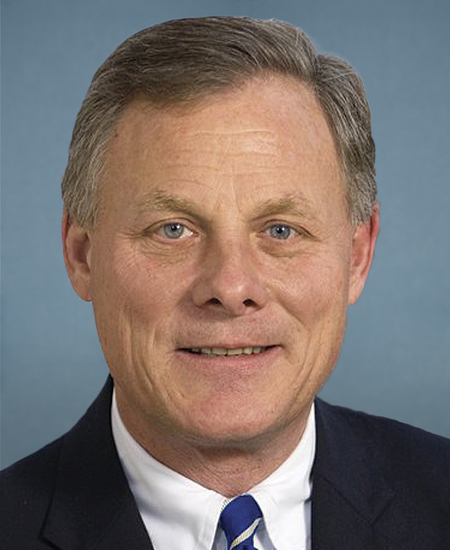
This resolution remembers former Prime Minister of Japan Shinzo Abe and his work to strengthen the alliance between the United States and Japan. It also extends condolences to his family and the people of Japan.
Sen. Richard Burr
Sponsored bills
Renewable Natural Gas Incentive Act of 2022 This bill allows a tax credit through 2032 equal to $1 times the number of gallons of renewable natural gas or gasoline gallon equivalent of nonliquid renewable natural gas for use as a fuel in a motor vehicle or motorboat or for use as a fuel in aviation.
Food and Drug Administration Simple Reauthorization Act of 2022 or the FDASRA Act of 2022 This bill reauthorizes the authority of the Food and Drug Administration to collect certain fees related to drugs, medical devices, and biosimilar biological products and modifies such fees, including the base fee amounts.
Food and Drug Administration Safety and Landmark Advancements Act of 2022 or the FDASLA Act of 2022 This bill modifies Food and Drug Administration (FDA) authority to collect certain fees. It also expands FDA authority to regulate certain products, including cosmetics. Among other provisions, the bill reauthorizes FDA authority to collect certain fees related to drugs, medical devices, and biosimilar biological products and modifies such fees, including the base fee amounts; establishes that certain requirements related to obtaining market approval for a new drug or a biosimilar may be satisfied using alternatives to animal testing, such as in vitro tests; authorizes the FDA to require that certain drugs be dispensed with a safe disposal system even if the system does not render a drug nonretrievable (current law requires such a system to render the drug nonretrievable); establishes time lines for the FDA to respond to requests to determine whether a drug is a therapeutic equivalent to an approved drug; modifies the accelerated process for approving products for a serious or life-threatening disease or condition and establishes an intra-agency coordinating council to ensure consistent and appropriate use of the process; requires additional regulation of cosmetics, including by requiring manufacturers to register manufacturing facilities and each cosmetic product with the FDA; requires dietary supplement manufacturers to provide to the FDA certain information, including a list of all ingredients, about each dietary supplement that it markets; requires an in vitro clinical test to receive FDA premarket approval or a technology certification (or be otherwise exempted) before being introduced into interstate commerce; and requires the FDA to temporarily relax certain premarket requirements for a manufacturer that intends to market a new infant formula.

This resolution celebrates the 50th anniversary of the Federal Pell Grant program and expresses support for the designation of June 23 as National Pell Grant Day.
This resolution (1) supports the designation of July 8, 2022, as Collector Car Appreciation Day, (2) recognizes the collection and restoration of historic and classic cars as an important part of preserving the technological achievements and cultural heritage of the United States, and (3) encourages engagement in Collector Car Appreciation Day events.
Saving Access to Laboratory Services Act This bill modifies provisions relating to Medicare payment rates for clinical diagnostic laboratory services, including by requiring payment rates for certain widely available clinical diagnostic laboratory tests to be based on a statistical sampling of private sector rates.
Pregnant Workers Fairness Act This bill prohibits employment practices that discriminate against making reasonable accommodations for qualified employees affected by pregnancy, childbirth, or related medical conditions. A qualified employee is an employee or applicant who, with or without reasonable accommodation, can perform the essential functions of the position, with specified exceptions. Specifically, the bill declares that it is an unlawful employment practice to fail to make reasonable accommodations to known limitations of such employees unless the accommodation would impose an undue hardship on an entity's business operation; require a qualified employee affected by such condition to accept an accommodation other than any reasonable accommodation arrived at through an interactive process; deny employment opportunities based on the need of the entity to make such reasonable accommodations to a qualified employee; require such employees to take paid or unpaid leave if another reasonable accommodation can be provided; or take adverse action in terms, conditions, or privileges of employment against a qualified employee requesting or using such reasonable accommodations. The bill sets forth enforcement procedures and remedies that cover different types of employees in relation to such unlawful employment practices. The Equal Employment Opportunity Commission must provide examples of reasonable accommodations that shall be provided to affected employees unless the employer can demonstrate that doing so would impose an undue hardship. The bill prohibits state immunity under the Eleventh Amendment to the Constitution from an action for a violation of this bill.
Retirement Improvement and Savings Enhancement to Supplement Healthy Investments for the Nest Egg Act or the RISE & SHINE Act This bill makes various changes with respect to employer-sponsored retirement plans. For example, the bill allows plans sponsored by charities, educational institutions, and nonprofit organizations (i.e., 403(b) retirement plans) to participate in multiple employer plans and pooled employer plans. The bill also revises the notice and disclosure requirements for certain retirement plans, and it permits plan sponsors to make emergency savings accounts available to participants of defined contribution plans.
Educational Choice for Children Act This bill allows individuals and corporations a new tax credit after 2022 for charitable contributions to tax-exempt organizations that provide scholarships to elementary and secondary school students. Such students must be members of a household with incomes not greater 300% of the area median gross income and be eligible to enroll in a public elementary or secondary school. The bill excludes from the gross income of taxpayer dependents any scholarship amount for the elementary or secondary education expenses of eligible students. It also prohibits governmental control over scholarship granting organizations.