

This resolution designates March 10, 2022, as National Slam the Scam Day to raise awareness about scams involving individuals impersonating government employees, encourage policies to prevent such scams, recognize those who work to prevent such scams, and encourage the public to report and share information about such scams.
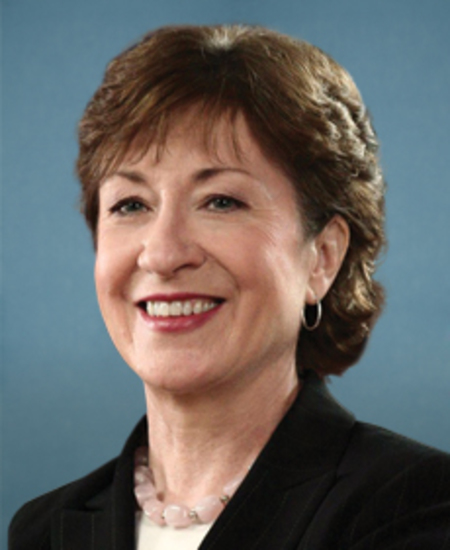
Sen. Susan M. Collins
Sponsored bills
This resolution designates March 2022 as National Women's History Month. The resolution also recognizes the celebration of such month as a time to reflect on the contributions that women have made to the United States.
Stewarding Atlantic Fisheries Ecosystems by Supporting Economic Assistance and Sustainability Act of 2022 or the SAFE SEAS Act of 2022 This bill establishes grants for states to assist lobster and Jonah crab harvesters with the costs of gear modifications in accordance with the Atlantic Large Whale Take Reduction Plan.
Stop Russian Government and Oligarchs from Limiting Democracy Act of 2022 or the Stop Russian GOLD Act of 2022 This bill prohibits a U.S. person from engaging in a transaction with a foreign person who purchases, transacts in, or transports Russian gold.
Ban Russian Energy Imports Act This bill declares that a national emergency exists with respect to the aggression of Russia against Ukraine. During this emergency, the President must prohibit the importation of crude oil, petroleum, petroleum products, liquefied natural gas, and coal in which Russia or a Russian national has any interest. The bill exempts products that are already loaded or in transit at the time of this bill's enactment.
This resolution strongly condemns the ongoing violence, war crimes, crimes against humanity, and systematic human rights abuses being carried out by Russia's military and its proxies at the direction of Russian President Vladimir Putin. It also encourages the U.S. government and partner nations to use their influence and vote in international organizations to hold those responsible for such crimes and abuses accountable.
Strengthening American Cybersecurity Act of 2022 This bill addresses cybersecurity threats against critical infrastructure and the federal government. The Cybersecurity and Infrastructure Security Agency (CISA) must perform ongoing and continuous assessments of federal risk posture. An agency, within a specified time frame, must (1) determine whether notice to any individual potentially affected by a breach is appropriate based on a risk assessment; and (2) as appropriate, provide written notice to each individual potentially affected. Each agency must (1) provide information relating to a major incident to specified parties, and (2) develop specified training for individuals with access to federal information or information systems. The bill requires reporting and other actions to address cybersecurity incidents. Entities that own or operate critical infrastructure must report cyber incidents and ransom payments within specified time frames. The bill limits the use and disclosure of reported information. The bill establishes (1) an interagency council to standardize federal reporting of cybersecurity threats, (2) a task force on ransomware attacks, and (3) a pilot program to identify information systems vulnerable to such attacks. The bill provides statutory authority for the Federal Risk and Authorization Management Program (FedRAMP) within the General Services Administration (GSA). FedRAMP is a government-wide program that provides a standardized approach to security assessment, authorization, and continuous monitoring for cloud computing products and services. The bill establishes a FedRAMP Board to examine the operations of FedRAMP and the Federal Secure Cloud Advisory Committee.
Reproductive Choice Act This bill provides statutory authority for certain Supreme Court holdings on abortion rights and restrictions in the cases of Roe v. Wade and Planned Parenthood of Southeastern Pennsylvania v. Casey . In Roe , the Court held that the Constitution protects a woman's decision to terminate her pregnancy. In Casey , the Court reaffirmed this holding and additionally held that state abortion regulations may not place a substantial obstacle in the path of a woman seeking an abortion before fetal viability (i.e., an undue burden). However, a state may (1) restrict abortions after viability, except when a pregnancy endangers the life or health of the woman; and (2) enact regulations to further the health or safety of a woman seeking an abortion, except for unnecessary health regulations that present a substantial obstacle to a woman seeking an abortion. The bill provides statutory authority for these holdings. It also specifies that the bill does not affect laws regarding conscience protection.
Emmett Till Antilynching Act This bill makes lynching a federal hate crime offense. Specifically, the bill imposes criminal penalties—a fine, a prison term of up to 30 years, or both—on an individual who conspires to commit a hate crime offense that results in death or serious bodily injury or that includes kidnapping or an attempt to kidnap, aggravated sexual abuse or an attempt to commit aggravated sexual abuse, or an attempt to kill.
This bill exempts until June 30, 2025, certain contractors that receive federal highway or public transportation funding from having to adjust costs associated with their contracts to account for loan forgiveness through the Paycheck Protection Program (PPP). (The PPP provided small businesses with loans for payroll and other costs to respond to the COVID-19 emergency with loan forgiveness under certain conditions.) Under current law, a contractor with a cost-reimbursable contract must reduce costs or provide cash refunds to the Department of Transportation (or a state department of transportation) if the contractor receives or accrues any income, rebate, allowance, or other credit relating to an allowable contract cost, which includes PPP loan forgiveness.