

Maddy summaryThe All Aboard Act of 2025 provides $83.5 billion over five years to accelerate rail electrification and transition to zero-emission rail systems. It establishes new funding programs for states, Amtrak, and rail carriers to electrify rail corridors, improve rail infrastructure, and support workforce transition plans. The bill sets specific targets including achieving zero emissions for 50% of trains by 2030 and all locomotives by 2047, with priority for projects in environmental justice communities. It requires applicants for rail electrification funding to include community engagement plans, environmental protection measures, and detailed workforce transition plans. The legislation aims to modernize rail infrastructure while addressing environmental justice concerns and supporting rail workers through training and job transition programs.
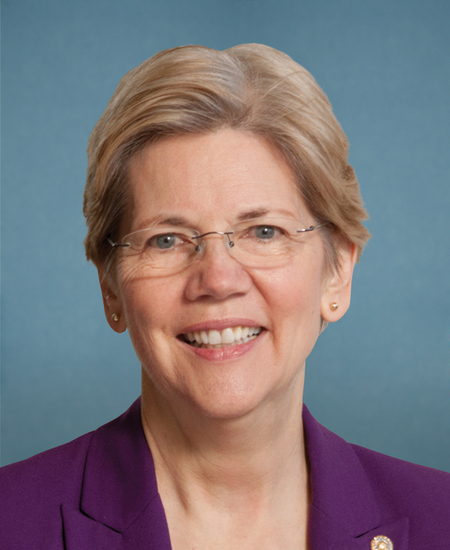
Sen. Elizabeth Warren
Sponsored bills
Maddy summaryThis bill amends the Federal Election Campaign Act to restrict corporate political fundraising. It limits the ability of corporations to establish political action committees (PACs) by requiring such funds to be operated only by nonprofit corporations (like 501(c)(3) organizations), not for-profit businesses. Key changes include banning solicitation of contributions from stockholders and restricting donations to only executive or administrative staff. Existing corporate PACs must dissolve and distribute funds within one year of the bill's enactment. The bill directly affects corporations seeking to fund political activities through PACs, shifting the model to nonprofit structures.
Maddy summaryThe John R. Lewis Voting Rights Advancement Act of 2025 strengthens voting rights protections by requiring preclearance for certain voting changes in jurisdictions with a history of discrimination. It establishes new preclearance requirements for changes to election methods, district boundaries, voter ID rules, and polling locations. The bill updates standards for determining when voting practices deny or abridge rights, particularly for racial, ethnic, and language minority groups. It also requires transparency about voting changes through public notices and strengthens enforcement mechanisms for voting rights violations. The bill directly affects states and localities with documented histories of voting discrimination, aiming to protect minority voters' rights.
Maddy summaryThis bill authorizes $50 million annually from 2026 through 2031 for the Centers for Disease Control and Prevention (CDC) to fund research on firearms safety and gun violence prevention. It directly affects the CDC and researchers by providing dedicated funding to study these topics under the Public Health Service Act. The key mechanism is a specific annual funding allocation, added to existing resources, to support new or ongoing research initiatives. The bill does not create new regulations or restrict gun ownership but focuses solely on enabling evidence-based research. This is a funding measure, not a policy change affecting the public directly.
Maddy summaryThe Restoring Essential Healthcare Act repeals a provision that blocked Medicaid payments to certain healthcare providers. Specifically, it removes a restriction from Public Law 119-21 that prevented Medicaid from paying "prohibited entities" for services provided between the law's enactment and this bill's effective date. Payments for those services will now be made retroactively, as if the restriction had never existed. This directly affects Medicaid programs and the healthcare providers previously excluded from receiving these payments.
Maddy summaryThe Modular Housing Production Act requires the Secretary of Housing and Urban Development to review Federal Housing Administration (FHA) construction financing programs and identify barriers preventing modular home developers from using these programs, such as restrictive payment schedules for construction. Within one year, the Secretary must publish a report with recommendations to remove these barriers, followed by a rulemaking process to establish an alternative payment schedule for modular home financing, including public input. The bill also authorizes a grant to study a standardized code for modular homes to improve design coordination and financing alignment. This legislation aims to streamline access to FHA financing for modular home developers without changing existing housing standards.
Maddy summaryBill S 2468 updates a provision in the Immigration and Nationality Act that allows certain long-term residents to apply for a form of legal status (registry). Currently, this provision only applies to people who entered the U.S. before July 1, 1924, or January 1, 1972. The bill changes the requirement to mandate that applicants entered the U.S. at least seven years before submitting their application. This adjustment would expand eligibility to include more individuals who have lived in the U.S. continuously for seven years or longer. The changes take effect 60 days after the bill is enacted.
Maddy summaryThe Pay Teachers Act requires states to ensure public school teachers earn a minimum starting salary of $60,000 that increases with experience, and paraprofessionals and education support staff earn at least $45,000 annually or $30 per hour. The bill provides mandatory federal funding to support these salary increases and requires states to develop implementation plans within 4 years (with possible extensions for states facing financial challenges). It also establishes career ladder programs that allow teachers to earn additional compensation for taking on leadership roles and responsibilities. This legislation directly affects all public school teachers, paraprofessionals, and education support staff nationwide, as well as state and local education agencies responsible for implementing the changes.
Maddy summaryThe Freedom to Move Act (S 2478) creates a federal grant program to help state and local governments cover costs of implementing fare-free public transportation and improve transit systems, primarily benefiting low-income individuals, foster care youth, and residents of underserved communities (defined as low-income communities of color with inadequate bus service). Eligible entities, including cities, transit agencies, and rural nonprofits, can apply for competitive 5-year grants requiring detailed plans to address transit equity gaps, expand service in underserved areas, and eliminate fare evasion enforcement policies that criminalize low-income riders. Funds can be used for operational costs, safer bus stops, pedestrian infrastructure, and network redesigns prioritizing reliable service for historically marginalized groups. The program is funded with $5 billion annually from 2026-2030, mandating annual reports tracking demographic progress and equity outcomes. It directly affects public transit systems in communities lacking frequent service, aiming to make transportation more accessible and reduce disparities.
Maddy summaryThis bill prohibits federal courts from excluding potential jurors based on disability or age. It amends jury selection rules to replace the term "infirmity" with "disability that cannot be reasonably accommodated" and explicitly states that people cannot be disqualified from serving on federal juries due to disability if reasonable accommodations would allow them to serve. The law requires courts to consider reasonable accommodations for qualified jurors with disabilities or age-related needs. This directly affects individuals with disabilities and older adults who may have been excluded from federal jury service under previous rules.