

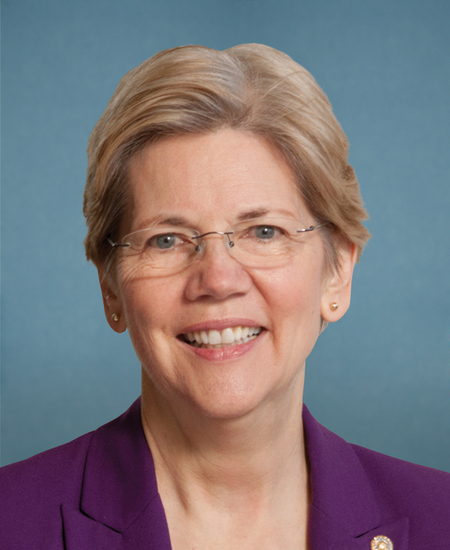
Photo of Elizabeth Warren
D United States Senate · Massachusetts

Sen. Elizabeth Warren

Compare
Total votes
1,044
all sessions
Attendance
100%
2 missed
Higher than 82% of chamber peers
With party
92%
of cast votes
Lower than 94% of chamber peers
Bipartisan score
5%
crosses aisle rarely
Higher than 92% of chamber peers
Sponsored
2,061
bills & resolutions
Higher than 83% of chamber peers
Committees
16
assignments
2,061 bills and resolutions

Sponsored bills

Total
2,061
Primary
272
Co-sponsor
1,789
This page
2,061
matching current filters
Co-sponsor SJRES 82
Failed · United States Senate · Co-sponsor
A joint resolution providing for congressional disapproval under chapter 8 of title 5, United States Code, of the rule submitted by the Office of the Secretary of the Department of Health and Human Services relating to "Policy on Adhering to the Text of the Administrative Procedure Act".

Maddy summarySJRES 82 is a joint resolution seeking to block a rule issued by the Department of Health and Human Services (HHS) regarding how the agency should follow the text of the Administrative Procedure Act (APA), a federal law governing how agencies create regulations. The rule, published in March 2025, was identified by the Government Accountability Office as a "rule" subject to the Congressional Review Act. If enacted, this resolution would void the HHS policy, preventing it from taking effect and requiring HHS to disregard this specific internal guideline. The bill directly affects HHS's rulemaking procedures by invalidating the policy statement on APA adherence.

Failed Dec 18, 2025 1 co-sponsor
Co-sponsor S 3570
In committee · United States Senate · Co-sponsor
Data Care Act of 2025

Maddy summaryThe Data Care Act of 2025 requires online service providers (like social media platforms or apps that collect user data) to securely handle "individual identifying data," especially sensitive information like health details, biometrics, financial data, or precise location. It imposes three key duties: (1) reasonably securing data from breaches, (2) not misusing data to harm users or benefit themselves, and (3) restricting data sharing to third parties only with strict confidentiality contracts. The Federal Trade Commission and state attorneys general can enforce these rules through penalties for violations, with civil fines calculated based on the number of affected users or days of noncompliance. The law directly affects major digital platforms collecting user data and takes effect 180 days after enactment.

In committee Dec 18, 2025 1 co-sponsor
Co-sponsor S 3561
In committee · United States Senate · Co-sponsor
Buy Now, Pay Later Protection Act of 2025

Maddy summaryThis bill defines "buy now, pay later" (BNPL) loans under federal law as short-term payment plans for retail purchases repaid in four or fewer interest-free installments with no fees. It extends existing consumer protections from the Truth in Lending Act to BNPL loans, requiring lenders to follow the same rules as credit card issuers regarding dispute resolution, account protections, and customer rights. The bill directly affects BNPL lenders (who must now comply with these rules) and consumers using BNPL services for retail purchases. The Consumer Financial Protection Bureau must issue implementing rules within one year of the law’s enactment.

In committee Dec 18, 2025 1 co-sponsor
Co-sponsor S 3545
In committee · United States Senate · Co-sponsor
Lowering American Energy Costs Act of 2025

Maddy summaryThis bill would require the President to restrict natural gas exports to lower domestic energy prices. It amends federal law to prohibit most natural gas exports, with limited exemptions for national security or strategic alliances (like exports to allied nations), but these exemptions would need Congressional approval. The bill cites studies showing that increased natural gas exports raise domestic prices, costing households and businesses billions annually. This policy change would directly affect natural gas producers and exporters, while aiming to reduce energy costs for American consumers.

In committee Dec 17, 2025 1 co-sponsor
Co-sponsor S 3548
In committee · United States Senate · Co-sponsor
Fair Competition for Small Business Act of 2025

Maddy summaryThis bill amends the Clayton Act to add a reference to itself within existing antitrust enforcement language. Specifically, it modifies Section 4C(a)(1) to include the phrase "or section 2 of this Act" after "any violation of the Sherman Act." The change directly affects how antitrust enforcement actions under the Clayton Act are referenced in legal proceedings. The bill does not introduce new substantive policy requirements but alters the statutory citation structure for consistency with its own provisions. (1 sentence summary: This procedural bill updates the Clayton Act's reference to itself in antitrust enforcement language.)

In committee Dec 17, 2025 1 co-sponsor
Co-sponsor S 3544
In committee · United States Senate · Co-sponsor
Federal Firearm Licensing Act

Maddy summaryS 3544, the Federal Firearm Licensing Act, would require most individuals to obtain a federal license to purchase, receive, or possess a firearm, with exceptions for states that have comparable state licensing systems. To qualify, applicants must complete firearms safety training (including a written test and hands-on shooting demonstration), pass a background check, and provide personal details, firearm specifics, and seller information. Licenses would be valid for one firearm within 30 days and expire after five years, with renewal requiring the same safety training and background check. The bill also mandates point-of-sale background checks through licensed dealers and requires sellers to report all firearm transactions to the federal government within three business days.

In committee Dec 17, 2025 1 co-sponsor
Co-sponsor S 3535
In committee · United States Senate · Co-sponsor
GRACE Act

Maddy summaryThe GRACE Act (S 3535) sets a minimum annual refugee admission target of 125,000 for the U.S., requiring the President to determine this number based on humanitarian needs and national interest. It introduces community/private sponsorship for refugees, allowing groups to provide initial resettlement services instead of traditional agency support. The bill mandates quarterly public reports to Congress on admissions numbers, regional allocations aligned with UN resettlement needs, processing times, security checks, and any shortfall in meeting targets. This directly affects refugees seeking admission, the Department of Homeland Security (which administers processing), and Congress (through transparency requirements).

In committee Dec 17, 2025 1 co-sponsor
Co-sponsor S 3555
In committee · United States Senate · Co-sponsor
Comprehensive Outbound Investment National Security Act of 2025

Maddy summaryThe Comprehensive Outbound Investment National Security Act of 2025 restricts U.S. investments in certain technologies in countries of concern, primarily China, by prohibiting investments in "covered national security transactions" involving specific technologies. It targets technologies including advanced semiconductors, artificial intelligence systems, quantum information technologies, high-performance computing, and hypersonic systems that could enhance military or surveillance capabilities. The bill requires U.S. persons to notify the government about certain transactions involving "notifiable technologies" and establishes civil penalties for violations, including potential divestment requirements. The law would expire seven years after enactment and mandates annual reports to Congress about implementation and enforcement.

In committee Dec 17, 2025 1 co-sponsor
Primary S 3547
In committee · United States Senate · Lead sponsor
Part-Time Worker Bill of Rights Act

Maddy summaryThe Part-Time Worker Bill of Rights Act would expand benefits for part-time workers by reducing the eligibility requirement for family and medical leave from 12 months of employment to just 90 days. It prohibits discrimination against part-time employees based on their work hours and requires employers to offer preferred work schedules to existing part-time employees before hiring new staff or using contractors. The bill mandates that employers compensate part-time workers for hours they could not schedule due to new hires, and establishes enforcement mechanisms through the Department of Labor. This legislation directly affects part-time workers and employers with more than 15 employees across various sectors, including government agencies.

In committee Dec 17, 2025 0 co-sponsors
Primary S 3550
In committee · United States Senate · Lead sponsor
Schedules That Work Act

Maddy summaryThe Schedules That Work Act would require employers in retail, food service, cleaning, hospitality, and warehouse sectors to provide workers with at least 14 days' advance notice of their schedules and pay predictability pay for last-minute changes. It gives employees the right to request schedule changes for reasons including health conditions, caregiving responsibilities, or enrollment in career training programs. Employers must engage in a good-faith process to address these requests unless they have a legitimate business reason to deny them. The bill aims to address widespread problems with unpredictable schedules that make it difficult for low-wage workers to manage family responsibilities, access healthcare, and secure stable housing and child care.

In committee Dec 17, 2025 0 co-sponsors
Showing 241 to 250 of 2,061 bills
Previous 1 … 24 25 26 … 207 Next