

Maddy summaryThe Educational Equity Challenge Grant Act of 2024 establishes a federal grant program to fund evidence-based and educator-designed initiatives addressing academic, social-emotional, mental, behavioral, and physical health inequities in schools, particularly those exacerbated by the COVID-19 pandemic. Grants target eligible entities like school districts, nonprofits, and tribal agencies to implement proven strategies (e.g., trauma-informed practices, culturally responsive curricula, extended learning time) or evaluate new approaches, with 75% of funds reserved for evidence-based proposals and 25% for field-initiated projects. The bill mandates that at least 50% of funds serve schools where 20%+ of students live in poverty and 25% support rural communities, requiring detailed reporting on outcomes by student group. It authorizes $15 billion annually for fiscal years 2025-2027 to support these efforts, with funds distributed through competitive applications requiring community input and outcome measurement.
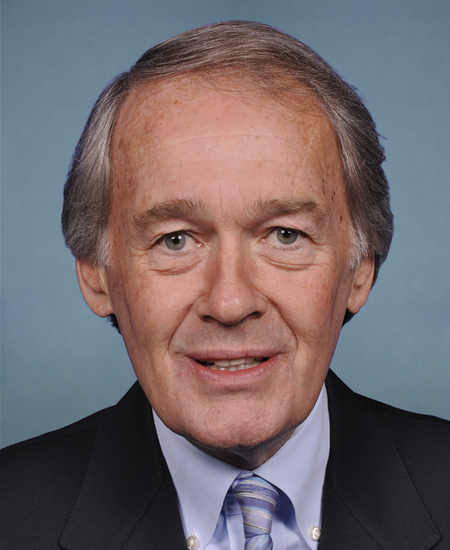
Sen. Edward J. Markey
Sponsored bills
Maddy summaryThis bill requires federal law enforcement officers, Bureau of Prisons staff, and U.S. Marshals to immediately provide medical care to individuals in federal custody showing signs of medical distress (like breathing difficulties). It makes it a crime for these officials to negligently fail to act, punishable by fines or up to one year in prison. The bill also mandates Inspector General investigations into such failures and requires agencies to train staff on medical assistance, while allowing state attorneys general to pursue civil cases for affected residents.
Maddy summarySRES 901 is a non-binding Senate resolution supporting Transgender Day of Remembrance by recognizing the epidemic of violence against transgender people in the U.S. It memorializes 38 transgender individuals, including transgender women of color, who were killed between October 2023 and September 2024. The resolution affirms the need for solutions to this violence while upholding the dignity of all transgender people. As a symbolic measure, it does not enact new policies or laws.
Maddy summaryThis bill expands disaster assistance eligibility under FEMA for individuals without documented property ownership but who have occupied land or housing in declared disaster areas (e.g., Hurricane Maria victims). It allows FEMA to use funds for title acquisition costs (like surveys and taxes) and creates a self-certification form using common documents (utility bills, pay stubs, school records) to prove occupancy - without requiring notarization. The bill amends the Stafford Act to replace "uninhabitable" with "damaged" in eligibility criteria and prioritizes habitable housing recovery over temporary solutions. It also mandates multilingual forms, 30-day implementation timelines for FEMA, and retroactive access for cases since 2017.
Maddy summaryThis bill creates a new federal grant program to address toxic substances in schools and early childhood facilities. It would provide $5.2 billion annually to states and tribes to identify and remove environmental hazards like lead, asbestos, and PCBs from schools, child care centers, and facilities for incarcerated youth. The funds can be used for inspections, remediation work, and training school staff on environmental health practices. The bill requires at least 40% of funds to go to high-poverty schools, 10% to early childhood settings serving vulnerable populations, and 5% to tribal schools. It also includes requirements for workforce development, using American-made materials, and real-time monitoring of indoor air quality.
Maddy summarySRES 897 is a Senate resolution designating November 2024 as National Native American Heritage Month and recognizing the Friday after Thanksgiving as Native American Heritage Day, as established by the 2009 Native American Heritage Day Act. It formally acknowledges the contributions of Native Americans to U.S. history, culture, and society, including their roles in agriculture, environmental stewardship, military service, and the influence of Indigenous governance concepts on the U.S. Constitution. The resolution encourages the public to observe these designations through educational programs and activities. As a ceremonial resolution, it does not create new laws or directly affect any individuals or communities.
Maddy summaryThe Stop Wall Street Looting Act imposes new restrictions on private equity firms and their acquisitions. It establishes joint and several liability for private equity funds and their managers for the debts and liabilities of acquired companies (target firms), limits post-acquisition dividends and distributions for four years, and imposes a surtax on certain payments received by investment firms from controlled target firms. The bill also increases priority for workers' wages and severance pay in bankruptcy proceedings, requires detailed disclosures about fund investments and fees, and includes provisions to protect workers during corporate bankruptcies. These changes directly affect private equity firms, their acquired companies, employees, and creditors, aiming to address perceived abuses in the private equity industry.
Maddy summaryThis bill authorizes U.S. sanctions against foreign individuals and entities that engage in activities worsening climate change or harming environmental defenders. It targets actions like building new subcritical coal plants that undermine global climate goals, causing illegal deforestation, misrepresenting environmental impacts, or threatening activists. Sanctions could include visa bans, asset freezes, or other penalties under existing Global Magnitsky authorities. The bill specifically affects foreign actors (not U.S. persons) whose activities significantly contribute to greenhouse gas emissions, deforestation, or human rights violations linked to environmental harm.
Maddy summaryThis bill requires the Federal Aviation Administration to partner with the National Academies to form an expert committee within 30 days of enactment. The committee must study the health impacts of air traffic noise and pollution and produce a scientific consensus report. The report will be sent to the FAA, Health and Human Services, EPA, and relevant congressional committees. This directly affects federal agencies responsible for aviation safety, environmental health, and transportation policy.
Maddy summaryThis bill requires the National Institutes of Health (NIH) Director to submit an annual budget estimate for Alzheimer's research initiatives to the President for transmission to Congress, starting in fiscal year 2024. It specifically mandates including estimates of personnel needs alongside funding projections, based on recommendations from the National Alzheimer's Project Act. The law directly affects NIH operations by establishing a formal, recurring reporting requirement for Alzheimer's-related funding. This is not a new funding measure but a procedural change to improve transparency and accountability in budget planning for these initiatives. The bill amends Section 2 of the National Alzheimer's Project Act to add this annual reporting obligation.