

Maddy summaryS 173 increases taxes on aviation fuel used by private jets and non-commercial aircraft, imposing a rate of 35.9 cents plus $1.641 per gallon (compared to 4.3 cents for commercial aviation), with annual inflation adjustments starting in 2026. It creates exceptions for emergency uses like medical evacuations or disaster response, and eliminates an existing exemption for certain agricultural aviation. The additional tax revenue funds a new "Clean Communities Trust Fund" to support air quality monitoring, expand public transit infrastructure near airports, and improve transportation in disadvantaged communities - requiring at least 50% of funds to target areas disproportionately impacted by air pollution. This bill directly affects private jet operators and aviation fuel suppliers while directing resources to environmental and transit projects in low-income communities.
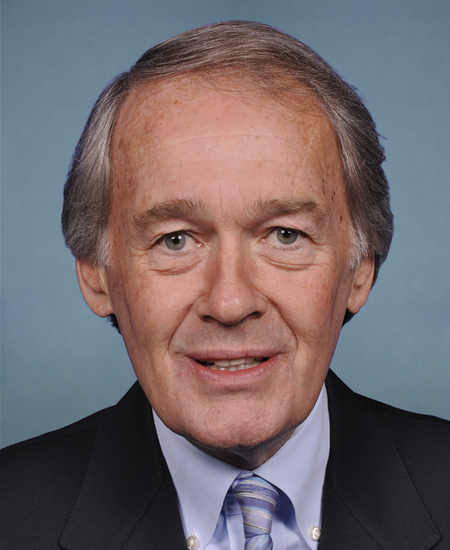
Sen. Edward J. Markey
Sponsored bills
Maddy summaryS 118, the Inaugural Committee Transparency Act of 2025, requires the Presidential Inaugural Committee to publicly disclose all spending of $200 or more, including the recipient's name, address, date, and purpose of each payment. It prohibits foreign national donations, bans using donor names for anonymous contributions, and prevents converting donated funds for personal expenses unrelated to the inauguration. The bill also mandates that any remaining donated funds be distributed to a qualified 501(c)(3) charity within 90 days after the inauguration, with possible extensions requiring supplemental reporting. This directly affects the Inaugural Committee and its donors by increasing financial transparency and restricting certain funding sources.
Federal Adjustment of Income Rates Act or the FAIR Act This bill modifies pay rates for federal employees in 2026. Specifically, the bill increases rates under the statutory pay systems and for prevailing rate employees by 3.3% and increases locality pay by 1%.
Maddy summaryThis bill would strengthen antitrust enforcement by revising the standard for evaluating mergers to consider more than just price increases, including quality, choice, innovation, and entry barriers. It establishes a new Office of Competition Advocate within the Federal Trade Commission to monitor competition and recommend enforcement actions, and it allows the Department of Justice and Federal Trade Commission to seek civil monetary penalties for antitrust violations. The bill also creates stronger whistleblower protections for employees reporting anticompetitive conduct and requires companies to report on the competitive effects of acquisitions. These changes aim to address growing market concentration and anticompetitive practices by large corporations.
Saving the Civil Service Act This bill generally prohibits changes to the classification of positions in the competitive service and excepted service unless certain conditions are met. (Competitive service positions are subject to competitive examination while excepted service positions are appointed under one of five schedules. Competitive service positions have notice and appeal requirements for adverse actions that are not applicable to most excepted positions, including those of a confidential, policy-determining, policy-making, or policy-advocating character under Schedule C.) On October 21, 2020, President Donald Trump issued an executive order that placed executive agency positions that are of a confidential, policy-determining, policy-making, or policy-advocating character, and that are not normally subject to change as a result of a presidential transition, under a new Schedule F in the excepted service. The order was subsequently revoked by President Joe Biden. The bill prohibits executive agency positions in the competitive service from being placed in the excepted service, unless such positions are placed in a schedule in the excepted service as in effect on September 30, 2020. The bill also prohibits positions in the excepted service from being placed in any schedule other than the aforementioned schedules. Additionally, agencies may not (1) transfer occupied positions from the competitive or excepted service into Schedule C without the consent of the Office of Personnel Management, or (2) transfer employees in the excepted service to another schedule or transfer employees in the competitive service to the excepted service without employee consent.
Maddy summaryS 103, the "Extend the TikTok Deadline Act," extends the deadline for TikTok to address national security concerns under existing law. It amends the Protecting Americans from Foreign Adversary Controlled Applications Act by changing the required timeframe from 270 days to 540 days. This directly affects TikTok, giving the company an additional six months to comply with the law’s requirements. The bill makes no new policy changes but only delays the implementation timeline for an existing provision.
Maddy summarySRES 19 is a Senate resolution honoring former President Jimmy Carter's life and legacy, commending his decades of public service, humanitarian work, and diplomatic achievements including the Camp David Accords and founding The Carter Center. The resolution specifically recognizes his Nobel Peace Prize, efforts to combat diseases like Guinea worm, and 30+ years of Habitat for Humanity homebuilding. It formally mourns his passing and extends condolences to his family, while highlighting his role in establishing U.S.-China diplomatic relations and creating the Departments of Education and Energy. As a symbolic resolution with no policy impact, it directly affects no individuals or entities but serves as a formal Senate tribute to Carter's historical contributions.
Maddy summaryThis bill adjusts tax credit rules for health insurance under the Affordable Care Act to make coverage more affordable for lower-income households. It replaces a flat income threshold with a sliding scale, reducing the percentage of income people pay for premiums based on their household income relative to the poverty line (e.g., 0% for incomes up to 150% of poverty, rising to 8.5% at 400%+). The change directly affects individuals buying insurance through health insurance marketplaces who qualify for tax credits. It takes effect for tax years beginning after 2025, modifying how the IRS calculates subsidy eligibility.
Maddy summaryThis bill establishes a 13-member Commission to study the historical and ongoing impacts of slavery and discrimination on African Americans, and to develop reparation proposals. The Commission will examine the institution of slavery from 1619-1865, discriminatory practices like redlining and Jim Crow, and current disparities in wealth, incarceration, and employment. It will identify evidence of these harms, study their lingering effects, and recommend educational approaches and potential remedies, including compensation calculations and eligibility. The Commission must submit its findings and recommendations to Congress within one year of its first meeting. The bill authorizes $12 million for the Commission's work and requires it to terminate 90 days after submitting its report.
Maddy summaryThe Washington, D.C. Admission Act would admit Washington, D.C. as a new state called "Washington, Douglass Commonwealth," granting it full representation with two U.S. Senators and one U.S. Representative. The bill would establish the new state's boundaries, with the area serving as the seat of government (the "Capital") remaining under federal jurisdiction for specific purposes. It would repeal the District of Columbia's congressional delegate position and its participation in presidential elections, while providing for a transition period overseen by a Statehood Transition Commission to handle the shift from district to state governance.