

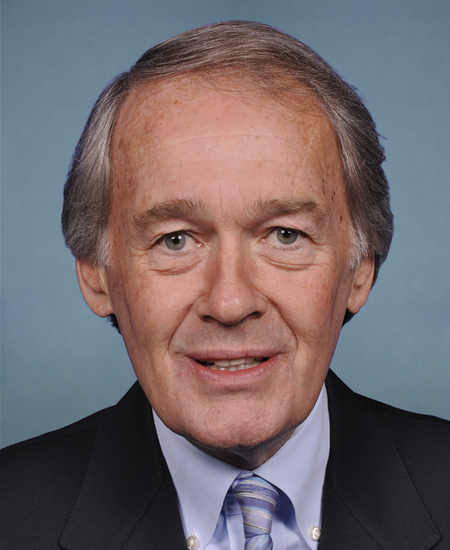
Photo of Edward J. Markey
D United States Senate · Massachusetts On the 2026 ballot

Sen. Edward J. Markey

Compare
Total votes
1,054
all sessions
Attendance
99%
7 missed
Higher than 75% of chamber peers
With party
91%
of cast votes
Lower than 93% of chamber peers
Bipartisan score
5%
crosses aisle rarely
Higher than 91% of chamber peers
Sponsored
2,057
bills & resolutions
Higher than 90% of chamber peers
Committees
12
assignments
2,057 bills and resolutions

Sponsored bills

Total
2,057
Primary
436
Co-sponsor
1,621
This page
2,057
matching current filters
Co-sponsor SRES 214
Passed · United States Senate · Co-sponsor
A resolution recognizing the significance of Asian American, Native Hawaiian, and Pacific Islander Heritage Month as an important time to celebrate the significant contributions of Asian Americans, Native Hawaiians, and Pacific Islanders to the history of the United States.

Maddy summarySRES 214 is a non-binding Senate resolution recognizing May as Asian American, Native Hawaiian, and Pacific Islander Heritage Month. It celebrates the historical contributions of these communities to U.S. history and acknowledges their diverse populations, which together represent over 10% of the U.S. population. The resolution references key milestones like the 1965 Immigration Act and the 60th anniversary of the Space Shuttle Discovery mission, while noting ongoing challenges such as hate crimes. As a ceremonial resolution, it does not create new laws or policies but formally honors these communities' achievements and cultural significance.

Passed May 22, 2025 1 co-sponsor
Co-sponsor S 1879
In committee · United States Senate · Co-sponsor
Ban Congressional Stock Trading Act

Maddy summaryThe Ban Congressional Stock Trading Act (S 1879) requires current and new Members of Congress, along with their spouses and dependent children, to divest or place certain investments in qualified blind trusts. It defines "covered investments" broadly to include stocks, bonds, commodities, and derivatives, while excluding diversified mutual funds, Treasury securities, and retirement plan investments. Members must complete this process within 120 days of enacting the law (with possible 180-day extensions), and new members have 120 days after taking office to comply. The law mandates public reporting of assets placed in blind trusts and imposes civil penalties for non-compliance, equal to a monthly portion of the member's salary. This legislation directly affects congressional staff members and their immediate families who hold financial interests that could create conflicts of interest.

In committee May 22, 2025 1 co-sponsor
Primary S 1881
In committee · United States Senate · Lead sponsor
Public Service Worker Protection Act

Maddy summaryThis bill expands workplace safety protections under the Occupational Safety and Health Act to cover public employees, including those working for federal, state, or local government agencies. It amends the law to explicitly include "the United States, a State, or a political subdivision of a State" in the definition of covered workers, removing previous exclusions. The key provision requires all public workplaces to follow OSHA safety standards, with a 36-month transition period for states or localities without their own OSHA-approved plans. This directly affects government workers like teachers, police, and sanitation staff who were previously excluded from federal OSHA coverage.

In committee May 22, 2025 0 co-sponsors
Primary S 1913
In committee · United States Senate · Lead sponsor
Ending Qualified Immunity Act

Maddy summaryS 1913, the "Ending Qualified Immunity Act," amends Section 1983 of federal law (42 U.S.C. 1983) to remove qualified immunity as a defense in civil rights lawsuits. It directly affects government officials (like police or local officials) sued for violating constitutional rights and the plaintiffs who have been denied redress due to this defense. The bill's key provision explicitly states that a defendant cannot claim as a defense that they acted in good faith, reasonably believed their conduct was lawful, the right wasn't clearly established, or the law was unclear at the time of the violation. This change aims to restore the original intent of Section 1983, which allows lawsuits against officials acting under color of law without immunity defenses based on subjective good faith or unclear legal standards.

In committee May 22, 2025 0 co-sponsors
Co-sponsor S 1910
In committee · United States Senate · Co-sponsor
Real Education and Access for Healthy Youth Act of 2025

Maddy summaryThis bill would establish federal grants to support comprehensive sex education and sexual health services for young people ages 10-29, with specific emphasis on making these programs evidence-informed, medically accurate, culturally responsive, trauma-informed, and inclusive of diverse identities. The bill authorizes $100 million annually for five years to fund programs in schools, colleges, and youth organizations that provide age-appropriate education on topics like anatomy, contraception, consent, healthy relationships, and STI prevention. It specifically requires programs to address racial and gender equity, serve underserved youth (including Black, Indigenous, Latine, LGBTQ+, and low-income youth), and avoid harmful practices like abstinence-only education. The bill repeals the "abstinence-only-until-marriage" program and redirects those funds to support the new comprehensive approach, requiring grantees to report on program impact including how many young people were served and how programs address racial and gender equity.

In committee May 22, 2025 1 co-sponsor
Co-sponsor S 1914
In committee · United States Senate · Co-sponsor
Andrew Kearse Accountability for Denial of Medical Care Act of 2025

Maddy summaryThis bill requires federal law enforcement officers, Bureau of Prisons staff, and U.S. Marshals to immediately obtain or provide medical care when someone in federal custody shows medical distress (like breathing difficulties). It makes it a federal offense for covered officials to negligently fail to act, punishable by fines, up to one year in prison, or both. The bill mandates Inspector General investigations into such failures that cause harm and establishes confidential complaint processes. It also requires agencies to train covered officials on responding to medical distress in custody. The law directly affects individuals in federal custody and the specific federal officials responsible for their care.

In committee May 22, 2025 1 co-sponsor
Co-sponsor S 1887
In committee · United States Senate · Co-sponsor
Vote at Home Act of 2025

Maddy summaryThe Vote at Home Act of 2025 would require all states to mail ballots to registered voters at least two weeks before federal elections, making voting by mail the default option for all eligible voters. It eliminates unnecessary barriers like notary requirements and excuse documentation for mail-in voting while ensuring ballots are accessible for people with disabilities. The bill also mandates free postage for election mail and expands automatic voter registration through motor vehicle departments. These changes would directly affect all voters participating in federal elections across the United States, aiming to increase accessibility and participation.

In committee May 22, 2025 1 co-sponsor
Co-sponsor S 1903
In committee · United States Senate · Co-sponsor
A bill to prohibit changes to Medicare and Medicaid in reconciliation.

Maddy summaryThis bill amends the Congressional Budget Act to explicitly prohibit changes to Medicare and Medicaid through the budget reconciliation process. It modifies Section 310(g) to add specific references to Medicare (Title XVIII) and Medicaid (Title XIX) of the Social Security Act, ensuring these programs are excluded from reconciliation considerations. The key mechanism prevents Congress from using the fast-track budget reconciliation procedure to alter Medicare or Medicaid funding, benefits, or structure. This directly affects congressional budget procedures, not the programs themselves, by restricting how lawmakers can make changes to these healthcare programs.

In committee May 22, 2025 1 co-sponsor
Co-sponsor SRES 240
In committee · United States Senate · Co-sponsor
A resolution affirming that diversity, equity, inclusion, and accessibility are fundamental values of the United States and emphasizing the ongoing need to address discrimination and inequality in the workplace, pre-K through 12th grade and higher education systems, government programs, the military, and our society.

Maddy summaryThis resolution (SRES 240) affirms that diversity, equity, inclusion, and accessibility are core U.S. values and emphasizes the need to address ongoing discrimination across multiple sectors. It directly affects workplaces, K-12 and higher education systems, healthcare, housing, government programs, and the military by citing data on persistent inequities - such as racial disparities in housing discrimination, wage gaps, and underrepresentation in leadership. The resolution does not create new laws but encourages federal, state, and local entities to adopt inclusive policies and remove barriers to opportunity. It references evidence from agencies like the Department of Housing and Urban Development and the Equal Employment Opportunity Commission to support its focus on systemic discrimination. The Senate calls for promoting environments where all individuals can achieve their full potential.

In committee May 21, 2025 1 co-sponsor
Co-sponsor S 1832
In committee · United States Senate · Co-sponsor
College for All Act of 2025

College for All Act of 2025 This bill establishes measures to expand access to higher education, including by eliminating tuition and required fees for eligible students, revising the Federal Pell Grant program, and reauthorizing certain programs to assist students from disadvantaged backgrounds. Specifically, the bill provides funding to enable states and tribal colleges and universities, through a federal-state partnership, to eliminate tuition and required fees for (1) all students at community colleges and two-year tribal colleges and universities, and (2) working- and middle-class students at four-year public institutions of higher education and tribal colleges and universities. The bill provides funding to enable private, nonprofit historically Black colleges and universities and minority-serving institutions to eliminate tuition and required fees for eligible students. The bill permanently reauthorizes and otherwise revises the Federal Pell Grant program by providing funding to increase the maximum award for each eligible student, increasing the duration limit for the use of Pell Grants, allowing students to use their awards to cover living and nontuition expenses, and expanding eligibility to Dreamer students (i.e., students who have been granted Deferred Action for Childhood Arrivals status and who entered the United States before the age of 16) and students with other immigration statuses. Further, the bill requires the Department of Education to award grants to eligible states and tribal colleges and universities for improving student outcomes. The bill reauthorizes through FY2035 the Federal TRIO Programs and reauthorizes through FY2029 the Gaining Early Awareness and Readiness for Undergraduate Programs.

In committee May 21, 2025 1 co-sponsor
Showing 491 to 500 of 2,057 bills
Previous 1 … 49 50 51 … 206 Next