

Part-Time Worker Bill of Rights Act This bill modifies various employment, leave, and pension rules with respect to part-time workers. Specifically, the bill removes the requirement that employees work a minimum number of hours during the preceding 12-month period before becoming eligible for family and medical leave. The bill also sets the maximum length of service on which employers may condition the eligibility of part-time employees for a qualified pension plan (e.g., 401(k) retirement plan). Except as required by an applicable collective bargaining agreement, such service requirement may be no longer than two consecutive 12-month periods of at least 500 hours of service for part-time employees who have reached the age of 21 by the end of such period. The bill further prohibits employers of more than 15 employees from setting disparate terms of employment or working conditions for part-time employees, including with respect to compensation, notice of work hours, and promotion opportunities. Additionally, the bill requires such employers to offer available, qualified part-time employees additional work hours before hiring new employees for such hours. Among other enforcement methods, employers must maintain three years of records for offers of additional hours and employee responses to such offers. The bill also provides a private right of action for employees to enforce the nondiscrimination requirements of this bill.
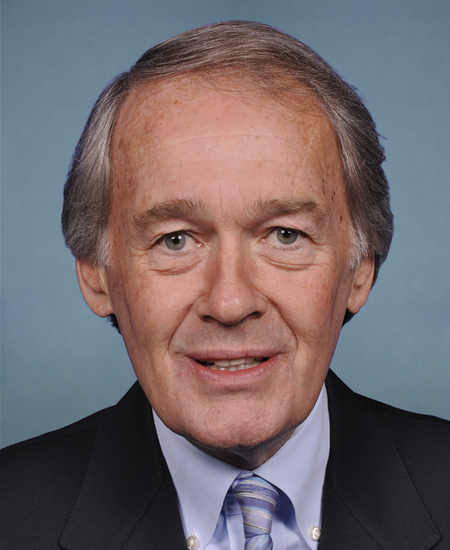
Sen. Edward J. Markey
Sponsored bills
Maddy summarySRES 510 is a Senate resolution designating January 25, 2022, as "National Poll Worker Recruitment Day." It recognizes the vital role of poll workers in elections and encourages eligible citizens to volunteer for the 2022 elections. The resolution does not create new laws or requirements but serves as a symbolic call to action to address poll worker shortages. It directly aims to engage the public in supporting election infrastructure through voluntary service.
This resolution acknowledges the collapse of the radio telescope at the Arecibo Observatory in Puerto Rico and encourages federal agencies to study means of replacing the observatory's lost scientific capabilities.
Jumpstart on College Act This bill directs the Department of Education (ED) to award grants to support early-college high schools and dual- or concurrent-enrollment programs. Specifically, ED must award grants to (1) institutions of higher education in partnership with one or more local educational agencies to assist them in establishing or supporting early-college high schools or dual- or concurrent-enrollment programs, and (2) states to assist them in supporting or establishing these schools or programs.
Opioid Treatment Access Act of 2022 This bill expands access to substance use disorder treatment by modifying the regulation of opioid treatment programs and narcotic drugs used for treatment, including with respect to a patient's unsupervised use of such drugs. Specifically, the Department of Health and Human Services (HHS) must issue regulations to further increase patients' access to unsupervised use or handling of drugs for treatment. The Substance Abuse and Mental Health Services Administration (SAMHSA) must study the effects of these revisions, and HHS must, as appropriate, promulgate additional regulations based on the study's findings. SAMHSA must also study the impact of certain exemptions from certification requirements for opioid treatment programs that were granted as part of COVID-19 response efforts, including any additional costs or savings that resulted from the exemptions. The bill also (1) allows specified types of health care providers to prescribe (subject to certain requirements) methadone that is dispensed through pharmacies for a patient's unsupervised use, and (2) provides statutory authority for a regulation that allows registered opioid treatment programs to operate mobile medication units without separately registering the unit.
Violence Against Women Act Reauthorization Act of 2022 This bill modifies and reauthorizes through FY2027 programs and activities under the Violence Against Women Act that seek to prevent and respond to domestic violence, sexual assault, dating violence, and stalking. The bill also authorizes new programs, makes changes to federal criminal laws, and establishes new protections to promote housing stability and economic security for victims of domestic violence, sexual assault, dating violence, and stalking.
Cape Cod National Seashore Advisory Commission Reauthorization Act This bill extends the Cape Cod National Seashore Advisory Commission until September 26, 2029. The bill also repeals the prohibition barring the Department of the Interior from, without the advice of the commission, issuing a permit for commercial or industrial use of property located within the seashore or establishing a public use area for recreational activity within the seashore.
Maddy summarySRES 509 is a non-binding Senate resolution honoring NFL quarterback Tom Brady for his 22-season professional career, primarily with the New England Patriots (20 seasons) and briefly with the Tampa Bay Buccaneers (2 seasons). The resolution recognizes his seven Super Bowl championships, NFL records (including most career passing yards and touchdowns), and iconic moments like the 2007 perfect regular season and Super Bowl LI comeback. It does not create new laws or affect any policies - it is a ceremonial tribute to Brady’s athletic achievements and legacy. The resolution was introduced by Senators Hassan, Collins, Whitehouse, and others in February 2022.
American Housing and Economic Mobility Act of 2021 This bill addresses housing affordability and availability, makes certain changes to the estate and gift taxes, and contains other related provisions. The Department of Housing and Urban Development shall provide grants to (1) state and local governments that remove unnecessary barriers to building affordable units, (2) states to assist borrowers who have negative equity in their homes, (3) state housing finance agencies to construct or acquire affordable rental housing and prevent tenant displacement and harassment, and (4) eligible individuals (generally, lower income individuals who resided in low-income or historically racially segregated areas) to help them purchase their first homes. The bill provides funding through FY2031 for the first-time homeowner grant program established by the bill, through FY2022 for the affordable rental housing construction program established by the bill, and through FY2022 for specified existing rural housing programs. The bill also expands fair housing protections to prohibit discrimination based on sexual orientation, gender identity, marital status, source of income, veteran status, or an individual's perceived membership in a protected class (e.g., an individual's perceived race or sex). Additionally, the bill modifies the estate tax in various ways, including by reducing the number of brackets to three, increasing the tax rates, and reducing the basic exemption amount. The bill also modifies provisions related to gift taxes and transfer taxes.
Sensible, Timely Relief for America's Nuclear Districts' Economic Development Act of 2021 or the STRANDED Act of 2021 This bill provides resources to communities that are challenged by stranded nuclear waste. The bill requires the Department of Energy (DOE) to establish a competitive prize competition for affected communities to carry out alternatives to nuclear facilities, generating sites, and waste sites. DOE must also (1) establish the Stranded Nuclear Waste Task Force to study existing public and private resources and funding for affected communities, and (2) establish a grant program to assist localities near nuclear power plants to offset the impacts of stranded nuclear waste in affected communities.