

Maddy summaryThe Farm System Reform Act of 2023 directly impacts large factory farms (concentrated animal feeding operations or CAFOs) and meat packers. It prohibits new large CAFOs from operating after enactment and requires existing large CAFOs to cease operations by January 1, 2041, while establishing a voluntary debt forgiveness and transition assistance program to help CAFO owners shift to alternative farming practices. The bill also amends the Packers and Stockyards Act to require meat packers to purchase at least 50% of livestock through spot market sales from nonaffiliated producers and to prohibit certain unfair contract practices. Additionally, it restores mandatory country of origin labeling for beef and pork and extends this requirement to dairy products, with new labeling rules requiring meat products labeled "Product of U.S.A." to be exclusively derived from animals born, raised, and slaughtered in the United States.
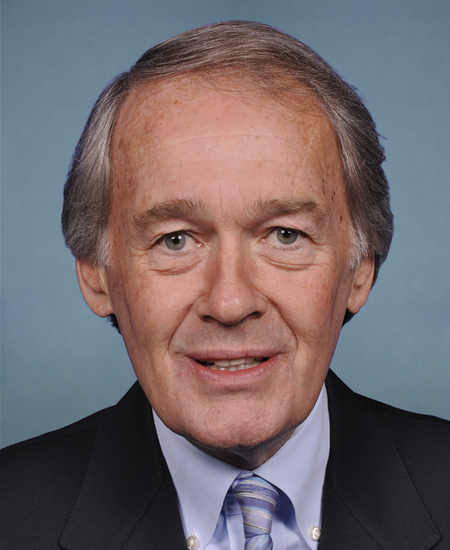
Sen. Edward J. Markey
Sponsored bills
Maddy summarySRES 21 is a symbolic Senate resolution designating January 1-February 1, 2023, as National Trafficking and Modern Slavery Prevention Month. It encourages awareness-raising activities during this period to support efforts against human trafficking and modern slavery, linking the observance to National Freedom Day on February 1. The resolution does not create new laws or allocate funds; it serves as a non-binding call for coordinated awareness campaigns by federal, state, tribal, and local entities. It directly affects public awareness efforts rather than specific populations, though it references trafficking statistics and victim support frameworks. The resolution aligns with existing federal anti-trafficking laws but focuses solely on commemorative recognition.
Maddy summaryThe FAIR Fees Act of 2023 requires the U.S. Department of Transportation to create regulations within 270 days that prohibit airlines from charging unreasonable or disproportionate fees for specific services. It targets fees for changing/canceling reservations, checked baggage, seat selection, and other flight-related charges. The regulations must ensure fees align with actual costs airlines incur, like processing changes or handling baggage, and require airlines to seat families with children under 13 together at no extra cost. This applies to all airlines operating under U.S. aviation regulations (those holding a DOT air carrier certificate).
Maddy summaryS 173, "Ethan's Law," requires firearm owners to store guns securely in homes where minors (under 18) or individuals ineligible to own firearms might access them. It amends federal law to make non-compliant storage an offense punishable by a $500 fine per violation, with enhanced penalties (up to 5 years in prison) if injury or death results. The bill creates a federal grant program to support states with laws matching its secure storage requirements, offering funding incentives for states that enact similar measures. It directly affects homeowners with firearms in households containing minors or prohibited persons, aiming to reduce accidental child access and firearm-related injuries.
Maddy summaryThe Airline Passengers' Bill of Rights (S 178) establishes new requirements for airlines to compensate passengers for denied boarding and flight delays, with a minimum $1,350 payment for delays exceeding 4 hours. The bill mandates automatic refunds for all delays, requires airlines to provide meal and hotel accommodations for overnight delays, and prohibits airlines from unfairly attributing delays to "force majeure" events when within their control. It also sets standards for seat size, lavatory availability, potable water, and transparency in pricing, while creating private rights of action for passengers to seek legal remedies for violations. The bill increases civil penalties for noncompliance and requires airlines to provide clear disclosure of fees and passenger rights.
Maddy summaryThis resolution (SRES 19) recognizes the importance of establishing a national "Fred Korematsu Day of Civil Liberties and the Constitution" to commemorate Fred Korematsu's lifelong fight against the unjust incarceration of Japanese Americans during WWII and his later warnings against post-9/11 civil liberties violations. It encourages the public to reflect on preserving civil liberties during national emergencies, building on existing state observances (California, Florida, Hawaii, Virginia, and Arizona) that already designate January 30 as Fred Korematsu Day. The resolution does not create new law or policy but formally urges national recognition of Korematsu's legacy for civic education.
Maddy summaryThis bill authorizes the posthumous award of a Congressional Gold Medal to Fred Korematsu, a Japanese American civil rights advocate who challenged the WWII internment of Japanese Americans. It directs the Treasury Secretary to create a single gold medal bearing Korematsu's image and name, which will be displayed at the Smithsonian Institution. The bill also permits the sale of bronze duplicates to cover production costs. The medal recognizes Korematsu's lifelong advocacy for civil liberties and his role in exposing the government's misleading claims that led to the Supreme Court's 1944 Korematsu v. United States decision. This is a commemorative measure with no new legal requirements or policy changes.
Maddy summaryS 129, the Korematsu-Takai Civil Liberties Protection Act of 2023, prohibits federal authorities from detaining individuals solely based on protected characteristics. The bill amends federal law to define "protected characteristics" as race, ethnicity, national origin, religion, sex, gender identity, sexual orientation, disability, and any additional characteristics the Attorney General may designate. It explicitly bans imprisonment or detention based exclusively on these traits, with no allowance for the Attorney General to remove any listed characteristic. This directly affects anyone subject to federal detention, ensuring protections against discrimination in custody decisions under current law.
Maddy summaryThe Justice for Black Farmers Act of 2023 would establish a program to provide land grants to eligible Black farmers and ranchers, purchasing land to convey at no cost (up to 160 acres per grant) with priority given to those with farming experience, family history of land dispossession, or military service. It would create an independent Civil Rights Oversight Board within USDA to review discrimination complaints, establish an Equity Commission to study historical discrimination against Black farmers, and require data collection on racial and gender disparities in USDA programs. The bill would provide additional credit assistance including zero-interest operating loans for the first 7 years, establish a National Socially Disadvantaged Farmer and Rancher Bank to provide financing specifically for Black farmers, and include a foreclosure moratorium for farmers with active civil rights complaints. The legislation also includes provisions to improve access to conservation programs and reform livestock purchasing practices under the Packers and Stockyards Act.
Maddy summaryThis bill, the FAIR Act (S 124), increases federal employee pay raises for calendar year 2024. It mandates a 4.7% base pay increase for all federal employees covered by statutory pay systems (most positions) and prevailing rate systems (based on local wages), effective January 2024. It also sets a 4.0% increase for locality-based pay adjustments under existing law. The bill directly affects all federal civilian employees whose pay is determined by these specific statutory systems.