

Maddy summarySRES 102 is a Senate resolution commemorating the 100th anniversary of jazz guitarist John Leslie "Wes" Montgomery's birth (March 6, 1923). It honors his musical contributions, including his innovative fingerstyle technique and influential albums like *A Day in the Life*, which topped jazz charts. The resolution expresses the Senate's recognition of Montgomery's legacy as a Hoosier musician who inspired global jazz artists. This is a ceremonial resolution with no policy changes or direct impact on individuals or legislation.
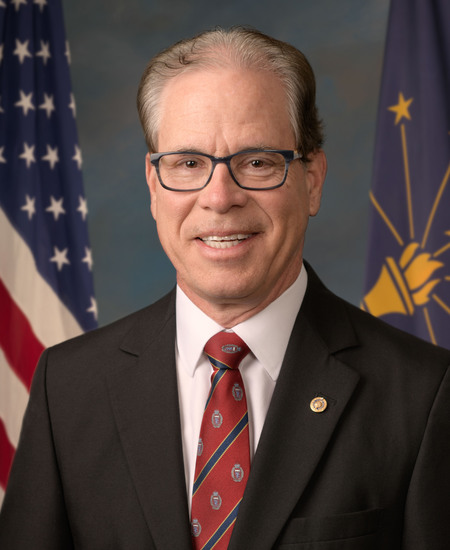
Sen. Mike Braun
Sponsored bills
This resolution designates March 9, 2023, as National Slam the Scam Day to raise awareness about scams involving individuals impersonating government employees, encourage policies to prevent such scams, recognize those who work to prevent such scams, and encourage the public to report and share information about such scams.
Maddy summaryThe Responsible Budget Targets Act of 2023 establishes annual spending limits for federal budgets based on economic growth and historical spending patterns. It sets a "spending ceiling" that automatically adjusts each year by adding a spending growth factor (calculated using GDP growth and past budget balances) to the previous year's primary budget authority (all spending except debt interest). This ceiling applies to both Congress when drafting legislation and the executive branch when preparing budgets, requiring adherence to the determined limit. The bill creates mechanisms to adjust the ceiling for emergencies or economic shifts, while maintaining a requirement that spending cannot exceed the ceiling without specific Congressional action.
Maddy summaryThis bill amends a 1999 appropriations law to prevent U.S. government entities from honoring trademarks tied to confiscated foreign assets. It directly affects businesses or individuals claiming trademark rights over marks previously used in connection with assets seized by foreign governments, unless the original owner or their legal successor consented. The key change requires that anyone asserting trademark rights must have known or had reason to know the mark was linked to confiscated assets. The bill also adds a new requirement that such rights can only be enforced if the claimant had actual knowledge of the confiscation at the time of acquisition.
Maddy summaryThis bill sets two limits on foreign ownership of U.S. debt: it caps total foreign-held debt at 25% of the national debt, and limits any single country's holdings to 5% of the national debt. It requires the Treasury Secretary, with OMB coordination, to calculate and enforce these limits. The President may temporarily waive either limit if deemed necessary for national security, but must notify key congressional committees with a justification. The law directly affects foreign governments, foreign entities, and foreign citizens holding U.S. debt obligations.
Maddy summaryS 741, the Traveler's Gun Rights Act, amends federal gun law definitions to clarify where individuals are considered "residents" for background check purposes. It specifies that active-duty military members can use their duty station state or daily commute location as their "state of residence," and people without a physical home may use a mailbox address. The bill also requires background checks to include either a physical address or mailbox address for the buyer, ensuring consistent application across state lines. This directly affects travelers, military personnel, and individuals using mailboxes when purchasing firearms.
Maddy summaryThe Stop Forced Organ Harvesting Act of 2023 requires the U.S. government to address forced organ harvesting by mandating annual reports on the issue in foreign countries and allowing passport denial or revocation for individuals convicted of organ trafficking. It directs the President to impose sanctions - including asset blocking and visa bans - on individuals or entities involved in forced organ harvesting, with exceptions for humanitarian aid. The bill defines "forced organ harvesting" as organ removal by coercion, deception, or abuse of power, and "trafficking" as recruiting or transporting people for organ removal through similar means. These provisions aim to hold accountable those exploiting vulnerable individuals for organ removal.
Maddy summaryThis bill restricts federal funding for community health centers that provide abortion services, except when necessary to save the mother's life. It amends a federal health law to prohibit funds from being used for abortions, barring health centers receiving such grants from offering abortion care under any other circumstances. The law defines "abortion" as intentionally ending a pregnancy, excluding cases where the procedure is needed to preserve the mother's life or address a non-viable pregnancy. This directly affects federally funded health centers that currently provide abortion services, requiring them to separate funding for abortion care from their federal grants. The policy change applies specifically to health centers receiving funds under Section 330 of the Public Health Service Act.
Maddy summaryThis bill requires federal and state prisons to house inmates based on biological sex (defined by reproductive anatomy and chromosomes at birth), prohibiting co-location of inmates of different biological sexes except for temporary, non-overnight arrangements. It directly affects all federal prisons and state correctional facilities receiving federal funding under the Omnibus Crime Control Act. The law mandates that housing decisions use biological sex and requires states to certify compliance to receive federal correctional funding. It does not address violence prevention measures but focuses solely on housing separation policies.
Maddy summaryThe Sustainable Budget Act of 2023 establishes a 18-member National Commission on Fiscal Responsibility and Reform to address federal budget challenges. The commission, with members appointed by the President and congressional leadership, must develop recommendations to balance the federal budget (excluding interest payments) within 10 years and improve long-term fiscal sustainability, particularly regarding entitlement spending. The bill requires the commission to submit a final report with specific recommendations and a proposed joint resolution to Congress, which would then be considered under expedited procedures without amendments. This commission directly affects federal budget policy and congressional procedures for handling fiscal recommendations. The commission would terminate 30 days after submitting its final report.