

Maddy summaryThe End Government Shutdowns Act (S 2041) would automatically continue federal funding for government programs at the previous fiscal year's level if Congress fails to pass a new budget on time. For the first 120 days, funding would remain at 100% of the prior year's level, then decrease by 1% every 90 days until a new budget is enacted. This prevents shutdowns for programs like national parks, food safety inspections, and federal agency operations by ensuring continuous funding without new legislation. The bill applies to all federal programs requiring annual appropriations, unless another law already specifies their funding.
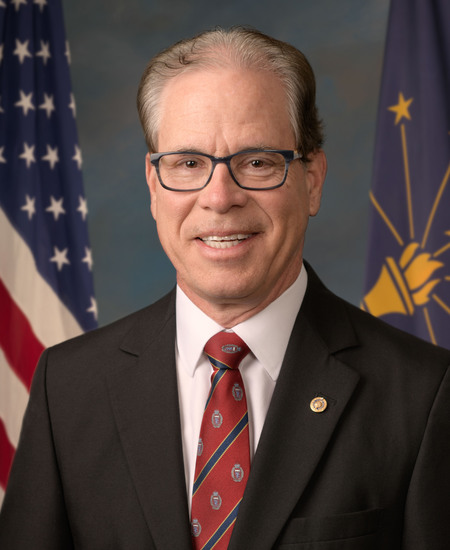
Sen. Mike Braun
Sponsored bills
Maddy summaryThis bill amends federal education privacy rules to make it easier for students to transfer credits between colleges toward completing a credential. It allows a student's previous college to receive their academic records (with the student's written consent) if they want to apply those credits toward a certificate or associate degree at their original school. The change directly affects students who transferred from one institution to another but later want to complete a credential they started at their first school. The key provision requires explicit student consent before records are shared, streamlining the "reverse transfer" process for credential completion.
This resolution celebrates the 246th anniversary of the creation of the U.S. flag, recognizes that the Pledge of Allegiance has been a valuable part of life for the people of the United States for generations, and defends the constitutionality of the pledge.
Maddy summaryS 1964 would eliminate the Office of Financial Research (OFR), a federal agency created under the 2010 Dodd-Frank Act to analyze financial market data and support regulatory decisions. The bill repeals the specific section of law establishing the OFR (Subtitle B of the Financial Stability Act of 2010) and removes all references to the office from other financial regulations. This would directly affect financial regulators and agencies that previously relied on the OFR's data and analysis. The change would streamline certain regulatory processes by removing this specific agency from the financial oversight structure.
Maddy summaryS 305 authorizes the U.S. Mint to produce and sell commemorative coins (gold, silver, and half-dollar denominations) to mark the U.S. Marine Corps' 250th anniversary in 2025. Each coin sale includes a surcharge ($5 to $35 per coin) that will fund the Marine Corps Heritage Center's educational programs, with proceeds paid directly to the Marine Corps Heritage Foundation. The coins will be sold from January 1 to December 31, 2025, and the surcharge structure ensures no net cost to taxpayers by covering production expenses through sales. This bill directly affects the U.S. Mint (in coin production), the Marine Corps Heritage Foundation (as recipient of funds), and the public (as potential buyers).
Maddy summaryThis bill requires the General Services Administration (GSA) to prioritize classical or traditional architectural styles for new or renovated federal buildings costing over $50 million, including courthouses, agency headquarters, and District of Columbia buildings. It defines "preferred architecture" as classical styles (like Neoclassical or Georgian) that "uplift public spaces" and "command respect," while limiting approvals of modern styles like Brutalism or Deconstructivism. The GSA must notify Congress and justify any deviation from preferred designs, including cost comparisons and public input, and submit annual reports on building styles. The bill creates a 5-year advisory council to recommend design policy updates and ensure compliance with these standards.
Maddy summaryThis bill changes school lunch rules to allow schools to serve whole milk as part of the National School Lunch Program. It amends the law to explicitly include "whole, reduced-fat, low-fat, and fat-free" milks as acceptable options. Crucially, it clarifies that milk fat in fluid milk provided under this rule will not count toward the meal's saturated fat limit for compliance purposes. This directly affects school nutrition programs nationwide by expanding milk choices and simplifying meal planning around fat content.
Maddy summaryThis bill directs the U.S. government to oppose treating China as a "developing nation" in international treaties and organizations where both the U.S. and China are members. It requires the Secretary of State to report within 180 days on current treaties with development-based rules and identify international organizations using such classifications. The bill mandates the U.S. to pursue changing China’s status to "developed" in relevant organizations, or propose new mechanisms to do so. This primarily affects U.S. diplomatic efforts and international negotiations involving China’s economic classification.
Maddy summaryThis joint resolution (SJRES 31) seeks to block an Environmental Protection Agency (EPA) rule implementing the "Federal Good Neighbor Plan" for ozone air quality standards established under the 2015 National Ambient Air Quality Standards. If approved, it would nullify the EPA rule (published June 5, 2023) that would have required certain states to address ozone pollution crossing state borders. The resolution uses a specific congressional disapproval process under Title 5 of the U.S. Code to prevent the rule from taking effect. This would directly affect states and industries subject to the ozone pollution regulations outlined in the EPA's submitted rule.
Maddy summaryS 1907, the Federal Firearms Licensee Protection Act of 2023, increases penalties for crimes committed against licensed firearm businesses. It amends federal law to impose a maximum 20-year prison term for knowingly violating firearm licensing rules or attempting to do so. If a burglary or robbery occurs on a licensed dealer’s, manufacturer’s, or importer’s business premises, the law mandates minimum sentences of 3 years for burglary and 5 years for robbery. This bill directly affects federal firearms licensees by strengthening criminal penalties for attacks on their business locations.