

Maddy summarySRES 588 is a symbolic Senate resolution designating April 2022 as "Financial Literacy Month." It does not create new laws or policies but calls for public awareness about the importance of personal financial education. The resolution urges federal, state, local, school, nonprofit, and business entities to observe the month with activities highlighting financial education's role in helping individuals manage debt, build wealth, and make informed money decisions. It references statistics on financial challenges (like high credit card debt and low high school financial literacy requirements) but does not mandate any specific actions or funding. This is a procedural designation with no direct effect on individuals or new legislative requirements.
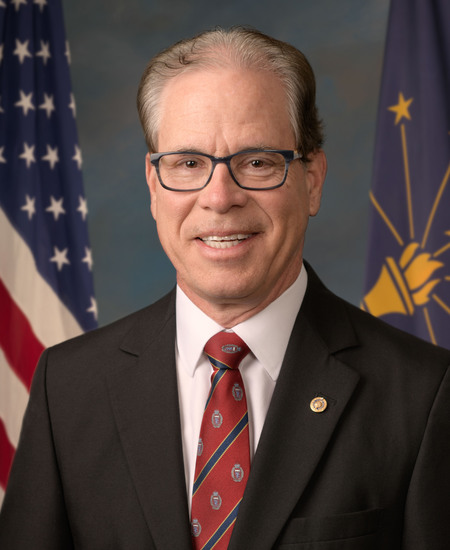
Sen. Mike Braun
Sponsored bills
Transaction and Sourcing Knowledge Act or the TASK Act This bill requires the Securities and Exchange Commission to mandate the reporting of certain information by publicly traded companies. Specifically, companies must report on the sourcing and due diligence involving products imported into the United States utilizing forced labor from Xinjiang, China; transactions with companies on the Department of Commerce's trade restriction list or designated as Chinese military-industrial complex companies; and for U.S. companies with facilities in China, whether there is a Chinese Communist Party committee in the operations of the company, and a summary of that committee's activity.
Stop Reckless Student Loan Actions Act of 2022 This bill limits executive authority to (1) suspend or defer federal student loan payments or interest accrual on such loans, and (2) cancel federal student loans. Specifically, the bill prohibits the President or the Department of Education (ED) from suspending or deferring federal student loan payments or the accrual of interest on such loans for borrowers with annual household incomes over 400% of the federal poverty line. Further, ED may only suspend or defer federal student loan payments or the accrual of interest for such loans for a total of 90 days after the declaration of a national emergency by the President. ED must submit recommendations to Congress on relief necessary for recipients of student financial-aid assistance. Additionally, the bill prohibits the President or ED from cancelling the outstanding balances or portions of balances on student loans due to the COVID-19 national emergency or any other national emergency. Executive or regulatory action to suspend or defer federal student loan payments or to cancel federal student loans shall be subject to congressional review. The bill also revises the definition of affected individual for purposes of the Higher Education Relief Opportunities for Students (HEROES) Act of 2003 to exclude from relief under the act (1) an individual who resides or is employed in an area that is declared a disaster area in connection with a national emergency; or (2) an individual who suffered direct economic hardship as a direct result of a war, military operation, or national emergency.
Sanction Transactions Originating from Pernicious Chinese Companies and Policies Act of 2022 or the STOP CCP Act of 2022 This bill prohibits U.S. persons (generally individuals and entities subject to U.S. jurisdiction) from trading in the publicly traded securities of certain entities that operate or have operated in certain sectors in China, including the defense or surveillance technology sectors.
Dietary Supplement Listing Act of 2022 This bill imposes various requirements on dietary supplements, including by requiring the person (an individual or entity) responsible for introducing a supplement into interstate commerce to register the supplement with the Food and Drug Administration (FDA). Under this bill, the responsible person must register with the FDA specified information about each dietary supplement to be offered for sale, including (1) a list of all ingredients required by regulation to appear on the label; (2) the conditions of use; (3) any warnings and precautions; (4) certain claims characterizing the relationship between certain nutrients in the supplement and a disease or a health-related condition; (5) the responsible person's contact information; and (6) the locations where the supplement is manufactured, packaged, labeled, or held. For a supplement that is offered for sale on the date that is 18 months after this bill's enactment (the effective date), the responsible person must submit the required information to the FDA no later than 60 days after the effective date. A supplement that is not offered for sale on the effective date may not be offered for sale until the responsible person has submitted the required information. The FDA must establish a system that provides a unique identifier for each registered dietary supplement and a publicly accessible electronic database that allows a user to obtain certain information about a registered supplement.
Maddy summarySRES 593 is a Senate resolution honoring former U.S. Senator Kaneaster Hodges, Jr. of Arkansas, who served from 1977 to 1978. The resolution expresses the Senate’s "profound sorrow" at his death and directs the Secretary of the Senate to transmit an enrolled copy to his family. It also calls for the Senate to adjourn as a mark of respect. This is a ceremonial resolution with no policy provisions or direct impact on legislation or constituents.
This resolution expresses the sense of the Senate that the case of Peng Shuai is directly related to broader international concerns around the freedom of speech and safety in China. The resolution expresses that the failure of the International Olympic Committee (IOC) to clearly and forcefully challenge the claims of China concerning Peng's safety raises questions about the ability and willingness of the IOC to stand up for the human rights of athletes participating in the Olympic and Paralympic games in Beijing, as well as in future games. The resolution also expresses that China should (1) allow Peng to provide independent and verifiable proof of her own whereabouts and safety without retribution, (2) allow Peng to engage directly with the Women's Tennis Association and the United Nations to independently verify her safety and explain her absence from public life since making her allegation, (3) open an independent and transparent investigation into Peng's allegations against former senior Vice Premier Zhang Gaoli, (4) publicly commit to holding sexual violence abusers accountable, (5) cease all censorship of reporting and discussions of Peng's case, and (6) allow Peng to leave China if she so desires and prevent any retaliation against her family members remaining there. Finally, the resolution expresses that, by failing to clearly and forcefully challenge the Chinese Communist Party's narrative, the IOC has failed to uphold its own stated commitments with regard to respect for international conventions on protecting human rights.
Simplify, Don't Amplify the IRS Act This bill limits Internal Revenue Service (IRS) enforcement authority and modifies certain IRS reporting requirements. It also eliminates certain restrictions on the use of coronavirus recovery funds. Among other provisions, the bill increases the gross receipts reporting threshold for certain religious and charitable organizations from $5,000 to $50,000; generally increases penalties for unauthorized disclosure of taxpayer information and for such disclosures by tax return preparers; requires the IRS to establish a fellowship program to recruit private sector tax experts to create a task force to. among other things, educate IRS employees on emerging issues, perform audits, and address offshore tax evasion; and sets forth provisions for reducing improper payments to taxpayers. The bill also requires the IRS to report annually on the tax gap estimate for the most recent taxable year. The IRS must use artificial intelligence to calculate an estimate of the tax gap. The bill defines tax gap as the difference between tax liabilities owed to the United States and those liabilities actually collected. The bill restricts funding for IRS audits and enforcement until the IRS publishes an updated tax gap projection.
This bill terminates General License No. 8A, which was issued by the Department of the Treasury's Office of Foreign Assets Control to authorize energy-related transactions involving specified Russian financial institutions. Further, the bill applies property-blocking sanctions to those Russian financial institutions listed in the license.
Locating the Inefficiencies of Bureaucratic Edicts to Reform And Transform the Economy Act or the LIBERATE Act This bill establishes the Regulatory Oversight and Review Task Force to evaluate, and provide recommendations for modification, consolidation, harmonization, or repeal of, federal regulations or guidance that impose substantial burdens on U.S. industries or inhibit other economic interests.