

Choose Medicare Act This bill requires the Department of Health and Human Services (HHS) to establish public health insurance plans and addresses health insurance costs. Such public plans must be offered on health insurance exchanges and (1) meet the requirements of a qualified health plan; (2) cover benefits at the gold plan level; and (3) cover reproductive services, including abortions. Additionally, the bill makes a series of changes related to health insurance costs, including requiring employers to refer employees to health care navigators to assist with enrollment, establishing an annual limit on out-of-pocket costs for services under Medicare, providing HHS with the authority to negotiate prices under the Medicare prescription drug benefit program, expanding the premium-assistance credit by benchmarking the credit amount to the second-lowest cost gold plan and increasing the income threshold for eligibility, requiring qualified health plans to reduce cost sharing for low-income plan holders, providing funding for states to provide reinsurance to health insurance issuers and to assist individuals with out-of-pocket costs for plans offered through health insurance exchanges, applying the premium rate-setting requirements to large group health plans, and requiring HHS or states to take corrective actions to address unreasonable premium rates set by insurance issuers.
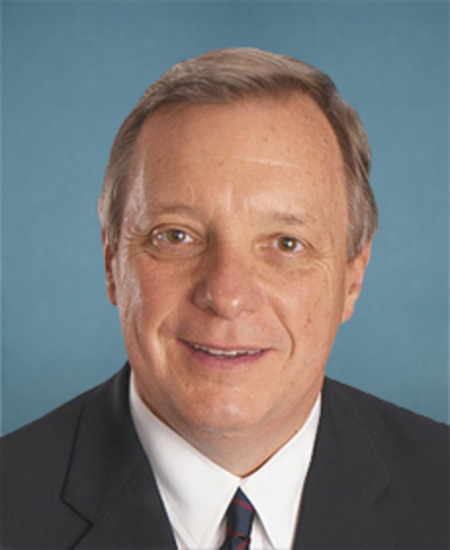
Sen. Richard J. Durbin
Sponsored bills
Investor Choice Act of 2021 This bill prohibits broker-dealers and investment advisers from including mandatory arbitration, forum selection restrictions, or bans on class action suits in a customer or client agreement. Issuers of securities are also prohibited from mandating arbitration in a shareholder agreement.
Rohingya Genocide Determination Act of 2021 This bill requires the Department of State to report to Congress an assessment of the persecution of the Rohingya, a predominantly Muslim group in Burma (Myanmar), by Burma's military and security forces, and whether the situation constitutes genocide under U.S. law. The report shall also contain (1) a description of U.S. government actions to ensure that those responsible are held accountable, and (2) recommendations on further actions to take to ensure accountability and to prevent further mass atrocity crimes in Burma.
Healthy Families Act This bill provides for paid and unpaid sick leave for employees to meet their own medical needs and those of their families. It requires employers with 15 or more employees to provide their employees with at least one hour of earned paid sick leave for every 30 hours worked, up to a maximum of 56 hours of paid sick leave in a year. An employer with fewer than 15 employees may also provide the same amount of paid sick leave, but may opt out of such requirement, in which case such employer must provide its employees at least 56 hours of unpaid leave in a year. An employee may use sick leave for absences (1) resulting from a physical or mental illness, injury or medical condition; (2) resulting from obtaining professional medical diagnosis or care, or preventive medical care; (3) to care for a child, parent, spouse, a domestic partner, or other blood or close relative; and (4) resulting from domestic violence, sexual assault, or stalking. The bill makes it unlawful for any employer to interfere with, restrain, or deny the exercise of an employee's right to accrue sick leave as provided by this bill. An employee may take legal action to enforce the right to sick leave granted by this bill and the Department of Labor must investigate complaints of violations of the requirements of this bill. Labor is authorized to conduct a public awareness campaign to educate and inform the public of the requirements for paid sick leave provided by this bill.
Cultivating Opportunity and Recovery from the Pandemic through Service Act or the CORPS Act This bill expands and modifies the administration of national service programs, including the National Senior Corps, to address the COVID-19 pandemic and its recovery period (i.e., through FY2024). The bill also (1) revises certain living allowances of particular national service corps participants; (2) expands the Senior Service Corps; (3) establishes a COVID-19 educational award; (4) implements a pilot program under which state commissions may directly place individuals in approved national service positions; and (5) excludes from gross income, for income tax purposes, any living allowance provided to national public service participants and any national service educational award.
Tax Fairness for Workers Act This bill allows an above-the-line tax deduction for union dues and expenses. (An above-the-line deduction is subtracted from gross income and is available whether or not a taxpayer itemizes other deductions.) The bill also reinstates the miscellaneous itemized tax deduction for unreimbursed expenses attributable to the performance of services as an employee (Under current law, all miscellaneous itemized deductions are suspended through 2025).
Reserve Employers Comprehensive Relief and Uniform Incentives on Taxes Act of 2021 or the RECRUIT Act of 2021 This bill allows employers with less than 500 employees a new tax credit for 40% of the wages paid to a member of the National Guard or a reserve component of the Armed Forces. The employer may elect to claim a payroll tax credit for wages paid to such service members.
This resolution recognizes the accomplishments and example of Cesar Estrada Chavez. The resolution also encourages the people of the United States to commemorate his legacy and to always remember his rallying cry, "Si, se puede!" (which means "Yes, we can!").
Keep Americans Safe Act This bill establishes a new criminal offense for the import, sale, manufacture, transfer, or possession of a large capacity ammunition feeding device (LCAFD). The bill does not prohibit certain conduct with respect to an LCAFD, including the following: importation, sale, manufacture, transfer, or possession related to certain law enforcement efforts, or authorized tests or experiments; importation, sale, transfer, or possession related to securing nuclear materials; and possession by a retired law enforcement officer. The bill permits continued possession of, but prohibits sale or transfer of, a grandfathered LCAFD. Newly manufactured LCAFDs must display serial number identification and the date of manufacture. Additionally, the bill allows a state or local government to use Edward Byrne Memorial Justice Assistance Grant Program funds to compensate individuals who surrender an LCAFD under a buy-back program.
This resolution commemorates the centennial of the establishment of the Hashemite Kingdom of Jordan, expresses admiration and gratitude for the friendship of the Jordanian people, and looks forward to continued cooperation with Jordan on shared national priorities.