

Debt-Free College Act of 2021 This bill establishes measures to cover the unmet financial need of students who are enrolled at certain institutions of higher education (IHEs). Unmet financial need refers to the difference between a student's cost of attendance and the student's expected family contribution, plus any federal, state, and local sources of grant aid. In addition, the bill makes certain Dreamer students (i.e., students who have been granted Deferred Action for Childhood Arrivals status) eligible for federal financial aid. First, the bill requires the Department of Education (ED) to award grants for state-federal partnerships with a goal of providing debt-free college for all eligible students at in-state public IHEs. Eligible student refers to an individual who (1) is enrolled or is eligible to enroll in an in-state public IHE, (2) completes a Free Application for Federal Student Aid or demonstrates eligibility for a Federal Pell Grant through institutional financial-aid eligibility forms, and (3) demonstrates satisfactory academic progress. Next, the bill requires ED to award grants to historically Black colleges and universities and minority-serving institutions to cover the unmet financial need of enrolled students. ED must establish an office to administer grants and provide oversight. In addition, the bill makes Dreamer students who entered the United States before the age of 16 and who meet certain educational criteria eligible for federal student aid.
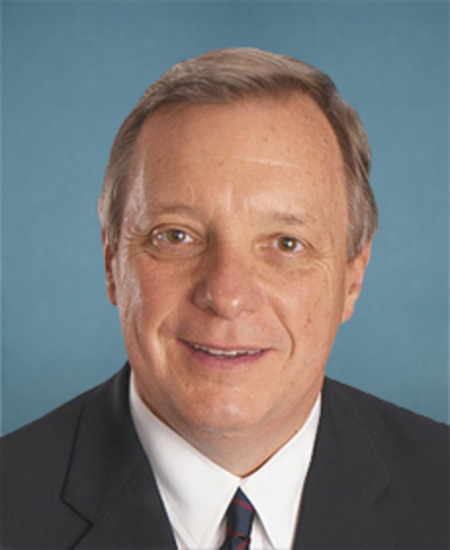
Sen. Richard J. Durbin
Sponsored bills
Northern Rockies Ecosystem Protection Act This bill designates specified National Forest System lands, National Park System lands, and public lands in Idaho, Montana, Oregon, Washington, and Wyoming as wilderness and as components or additions to existing components of the National Wilderness Preservation System. The bill also designates specified federal lands as biological connecting corridors and as special corridor management areas. The Department of the Interior and the Department of Agriculture (USDA) shall accept the donation of valid existing permits or leases authorizing grazing on specified public lands or National Forest System lands. The bill designates segments of specified rivers and creeks in Idaho, Montana, and Wyoming as components of the National Wild and Scenic Rivers System. The bill designates specified areas as wildland recovery areas. USDA shall develop a wildland recovery plan for each recovery area. A panel of independent scientists shall study roadless lands greater than 1,000 acres that are within the National Forest System in the Wild Rockies bioregion in Idaho, Montana, Oregon, Washington, or Wyoming, but not designated as components of the National Wilderness Preservation System, for their role in maintaining biological diversity. The bill prohibits road construction, timber harvest, oil or gas leasing, mining, or other development that impairs the natural and roadless qualities of the land.
Recovering Excessive Funds for Unused and Needless Drugs Act of 2021 or the REFUND Act of 2021 This bill requires drug manufacturers to issue rebates to the Centers for Medicare & Medicaid Services (CMS) in relation to discarded amounts (i.e., amounts remaining after administration) of single-dose vial drugs that are covered under Medicare. Manufacturers that fail to comply are subject to civil penalties. The CMS must determine rebate amounts based on payment claims from providers. (Currently, providers may receive payment under Medicare for discarded amounts of single-dose vial drugs through the use of a specific claims modifier.)
Medicare at 50 Act This bill establishes a Medicare buy-in option for certain qualifying individuals and also repeals restrictions relating to prescription drug prices under the Medicare prescription drug benefit. Specifically, the bill allows individuals aged 50 to 64 to enroll in Medicare if such individuals would otherwise qualify for Medicare at the age of 65. The Centers for Medicare & Medicaid Services (CMS) must determine enrollment periods and set premiums for the buy-in option established under the bill, in accordance with specified requirements. The CMS must also award grants to states and nonprofit organizations for outreach and enrollment activities relating to the buy-in option. The bill also repeals provisions that prohibit the CMS from negotiating the prices of prescription drugs or from establishing a formulary under the Medicare prescription drug benefit.
Minority Business Resiliency Act of 2021 This bill permanently authorizes the Minority Business Development Agency (MBDA) and requires the MBDA to promote and administer programs that assist the development of minority business enterprises (MBEs). Specifically, the bill requires the MBDA to (1) provide assistance to MBEs in domestic and foreign markets by making available specified resources, (2) promote the position of MBEs in local economies, and (3) collect data on the causes of MBE success or failure and research how economic conditions affect the development of MBEs. The bill establishes formal processes for the MBDA Business Center Program and the MBDA Rural Business Center Program through which business centers provide programs and services to support MBEs. The bill also establishes new initiatives to promote economic resiliency for minority businesses, including (1) an annual forum to review problems and programs relating to capital formation by MBEs, (2) a study and report on alternative financing solutions for MBEs, and (3) entrepreneurship education grants for certain institutions of higher education to develop and implement entrepreneurship curricula. Further, the bill establishes grants for (1) certain nonprofit organizations that provide services to MBEs as one of their primary activities, and (2) MBEs for the purpose of supporting MBEs or helping MBEs remain in business. The Government Accountability Office must report on the programs carried out pursuant to the bill.
Access to Contraception for Servicemembers and Dependents Act of 2021 This bill addresses Department of Defense (DOD) contraceptive care and family planning services. Specifically, the bill prohibits cost-sharing requirements with respect to TRICARE beneficiaries for specified prescription contraceptives. Additionally, the bill prohibits cost-sharing requirements for TRICARE Select and TRICARE Prime beneficiaries in relation to any in-network method of contraception or contraceptive care (including with respect to insertion, removal, and follow-up), any sterilization procedure, or any related patient education or counseling service. The bill requires DOD to provide information on all methods of emergency contraception and care to sexual assault survivors at its medical treatment facilities. Upon request by a sexual assault survivor, DOD must provide such emergency contraception or a prescription for emergency contraception. Finally, DOD must establish a uniform standard curriculum for education programs on family planning for all members of the Armed Forces. Such education programs must be provided to service members during their first year of service and at other appropriate times, as determined by each military department.
Investing in Tomorrow's Workforce Act of 2021 This bill (1) directs the Department of Labor, beginning after the earlier of submission of the Government Accountability Office's study on automation or October 1, 2022, to award grants to eligible partnerships to support demonstration and pilot projects relating to the training needs of workers who are, or are likely to become, dislocated workers as a result of automation; (2) expands training programs for such workers, including activities that prepare the individuals for occupations in the technology sector; (3) authorizes the award of national dislocated worker grants to provide employment and training assistance to workers affected by advances in automation technology; and (4) expands funding for national dislocated worker grants.
Big Cat Public Safety Act This bill revises requirements governing the trade of big cats (i.e., species of lion, tiger, leopard, cheetah, jaguar, or cougar or any hybrid of such species). Specifically, it revises restrictions on the possession and exhibition of big cats, including to restrict direct contact between the public and big cats.
This resolution expresses the Senate's solidarity with the members of the San Isidro Movement, an organization of artists, activists, academics, and journalists protesting increased censorship and persecution in Cuba. Further, it calls on Cuba to release arbitrarily imprisoned artists and journalists, repeal laws that violate freedom of expression, and engage with activists seeking to advance freedom of expression in Cuba.
Family Medical Leave Modernization Act This bill expands who is permitted to take qualifying family and medical leave and provides additional leave for parents and family caregivers. The bill grants leave to private sector and federal employees to care for a domestic partner and any individual whose close association with such employees is like a family relationship, regardless of biological or legal relationship, if (1) such individual has a serious health condition, or (2) there is a qualifying exigency due to such employees' active duty in the Armed Forces. The bill entitles an employee who is a domestic partner, next of kin of a member of the Armed Forces, or any individual whose close association is like a family relationship, regardless of biological or legal relationship, to take leave to care for the service member. The bill entitles private sector and federal employees to take additional leave to participate in or attend their children's and grandchildren's school or community organization activities, meet routine family medical care needs, or care for their elderly relatives.