

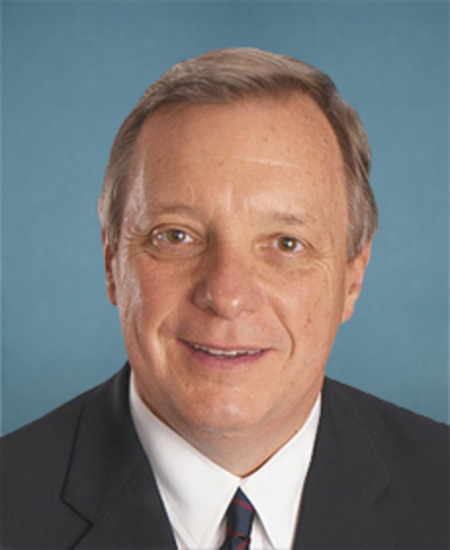
Photo of Richard J. Durbin
D United States Senate · Illinois

Sen. Richard J. Durbin

Compare
Total votes
1,044
all sessions
Attendance
97%
35 missed
Near the chamber average
With party
97%
of cast votes
Near the chamber average
Bipartisan score
2%
crosses aisle rarely
Near the chamber average
Sponsored
2,016
bills & resolutions
Higher than 87% of chamber peers
Committees
12
assignments
2,016 bills and resolutions

Sponsored bills

Total
2,016
Primary
386
Co-sponsor
1,630
This page
2,016
matching current filters
Co-sponsor SRES 249
In committee · United States Senate · Co-sponsor
A resolution honoring women in the United States for their service in World War II and recognizing the role of Representative Edith Nourse Rogers in establishing the Women's Army Auxiliary Corps and the Women's Army Corps.

This resolution honors, commends, and recognizes the women who served the United States in military capacities during World War II to aid the war effort. Additionally, the resolution honors the contributions of Congresswoman Edith Nourse Rogers for supporting the establishment of the Women's Army Auxiliary Corps and the Women's Army Corps.

In committee May 27, 2021 1 co-sponsor
Co-sponsor S 1891
In committee · United States Senate · Co-sponsor
NO BAN Act

National Origin-Based Antidiscrimination for Nonimmigrants Act or the NO BAN Act This bill imposes limitations on the President's authority to suspend or restrict aliens from entering the United States. It also prohibits religious discrimination in various immigration-related decisions, such as whether to issue an immigrant or nonimmigrant visa, unless there is a statutory basis for such discrimination. The President may temporarily restrict the entry of any aliens or class of aliens after the Department of State determines that the restriction would address specific and credible facts that threaten U.S. interests such as security or public safety. The bill also imposes limitations on such restrictions, such as requiring the President, State Department, and the Department of Homeland Security (DHS) to (1) only issue a restriction when required to address a compelling government interest, and (2) narrowly tailor the suspension to use the least restrictive means to achieve such an interest. Before imposing a restriction, the State Department and DHS shall consult with Congress. The State Department and DHS shall report to Congress about the restriction within 48 hours of the restriction's imposition. If such a report is not made, the restriction shall immediately terminate. Individuals or entities present in the United States and unlawfully harmed by such a restriction may sue in federal court. DHS may suspend the entry of aliens traveling to the United States on a commercial airline that failed to comply with regulations related to detecting fraudulent travel documents.

In committee May 27, 2021 1 co-sponsor
Co-sponsor S 1907
In committee · United States Senate · Co-sponsor
Clean Water Standards for PFAS Act of 2021

Clean Water Standards for PFAS Act of 2021 This bill directs the Environmental Protection Agency (EPA) to develop requirements and incentives to limit the discharge of perfluoroalkyl and polyfluoroalkyl substances (PFAS) into certain waters of the United States. PFAS are man-made and may have adverse human health effects. A variety of products contain the compounds, such as nonstick cookware or weatherproof clothing. Within two years, the EPA must publish water quality criteria for each measurable perfluoroalkyl substance, polyfluoroalkyl substance, and class of PFAS. The water quality criteria must determine how much of these substances can be present in water before it is likely to harm human health. Within four years, the EPA must publish a final rule that establishes, for each priority industry category specified in the bill, effluent limitations guidelines and standards for the discharge of each measurable perfluoroalkyl substance, polyfluoroalkyl substance, and class of PFAS. Under the Clean Water Act, effluent limitations restrict the quantities, rates, and concentrations of chemical, physical, biological, and other constituents which are discharged from point sources (e.g., a discernible source such as a pipe) into navigable waters, the ocean, or other specified waters. In addition, the EPA must award grants to owners and operators of publicly owned treatment works for implementing the effluent limitations guidelines and standards.

In committee May 27, 2021 1 co-sponsor
Primary S 1903
In committee · United States Senate · Lead sponsor
A bill to require the Administrator of the Environmental Protection Agency to revise certain ethylene oxide emissions standards under the Clean Air Act, and for other purposes.

This bill requires the Environmental Protection Agency (EPA) to amend its regulations to revise the standards for the emission of ethylene oxide. Specifically, regulations must be revised based on results from the National Center for Environmental Assessment report titled Evaluation of the Inhalation Carcinogenicity of Ethylene Oxide . The bill also requires revisions to apply maximum achievable control technology requirements to chamber exhaust vents. Maximum achievable control technology standards are established for sources of hazardous air pollutants to limit or control emissions. Additionally, the revisions must apply to area sources and major sources of ethylene oxide. The EPA must carry out a residual risk assessment with respect to the revised standards. Finally, the EPA must notify the public of violations under the revised standards, and failure to do so will result in an investigation to assess the health risks and prevent a future failure of notification.

In committee May 27, 2021 0 co-sponsors
Co-sponsor S 1912
In committee · United States Senate · Co-sponsor
Access to Counsel Act of 2021

Access to Counsel Act of 2021 This bill provides various protections for covered individuals subject to secondary or deferred inspections when seeking admission into the United States. Covered individuals include U.S. nationals, lawful permanent residents, aliens in possession of a visa, returning asylees, and refugees. The Department of Homeland Security shall ensure that a covered individual subject to secondary or deferred inspection has a meaningful opportunity to consult with counsel and certain related parties, such as a relative, within an hour of the start of the secondary inspection and as necessary during the inspection process. The counsel and related party shall be allowed to advocate on behalf of the covered individual, including by providing evidence and information to the examining immigration officer. A lawful permanent resident subject to secondary or deferred inspection may not abandon lawful permanent resident status until the individual has had a meaningful opportunity to seek advice from counsel, unless the individual voluntarily and knowingly waives in writing this opportunity to seek counsel's advice.

In committee May 27, 2021 1 co-sponsor
Co-sponsor S 1898
In committee · United States Senate · Co-sponsor
Affordable Medications Act

Affordable Medications Act This bill revises and expands various requirements relating to prescription drug pricing and affordability.  Specifically, the bill expands financial reporting requirements for drug manufacturers and establishes corresponding civil penalties for noncompliance; it also adds reporting requirements for certain nonprofit patient-assistance programs. Further, the bill requires the Centers for Medicare & Medicaid Services (CMS) to negotiate prices for certain prescription drugs under Medicare and requires the Centers for Medicare and Medicaid Innovation within the CMS to test specified models for negotiating drug prices. It also establishes reporting requirements, and corresponding civil penalties for noncompliance, for pharmaceutical companies with respect to spikes in prescription drug prices. The bill establishes an excise tax on prescription drugs subject to price spikes, lessens prescription drug cost-sharing requirements under qualified health plans and group health plans, and modifies requirements for the importation of prescription drugs. It also requires drug manufacturers to provide rebates for drugs dispensed to certain low-income individuals under the Medicare program and limits the time frame that trade agreements are required to provide market exclusivity for biological products. Additionally, the bill (1) requires the Food and Drug Administration to establish a database of generic drugs; (2) modifies other provisions related to generic drugs, prescription drug advertising, disclosure of wholesale acquisition prices, and patent-infringement proceedings; and (3) revises certain time frames and conditions related to drug exclusivity. Finally, it establishes an innovation incentive fund for new or more effective treatments of bacterial infections and establishes the Center for Clinical Research within the National Institutes of Health.

In committee May 27, 2021 1 co-sponsor
Co-sponsor S 1848
In committee · United States Senate · Co-sponsor
John Lewis Every Child Deserves a Family Act

John Lewis Every Child Deserves a Family Act This bill prohibits discrimination on the basis of sexual orientation, gender identity, marital status, or religion in the provision of child welfare programs and services by entities receiving federal funding. The Department of Health and Human Services (HHS) must provide technical assistance to help states follow this requirement, including (1) guidance for bringing state laws into compliance, (2) developing training to increase cultural competency related to social identity, and (3) training for judges and attorneys involved in child welfare cases, among other supports. Additionally, HHS must establish the National Resource Center on Safety, Well-Being, Placement Stability, and Permanency for LGBTQ Children and Youth Involved with Child Welfare Services to provide training, technical assistance, and guidance to applicable state and local agencies and service providers. Further, the Religious Freedom Restoration Act may not be the basis for challenging the application or enforcement of this bill. The Government Accountability Office must study and report on states' compliance with the requirements of the bill no later than three years after enactment.

In committee May 26, 2021 1 co-sponsor
Co-sponsor S 1858
In committee · United States Senate · Co-sponsor
Keeping All Students Safe Act

Keeping All Students Safe Act This bill prohibits the use of seclusion and limits the use of physical restraint in schools and Head Start programs that receive federal funding. Specifically, the bill prohibits the use of seclusion, which is the involuntary confinement of a student alone in a room or area from which the student is physically prevented from leaving. The term does not include a time out, which may involve separating the student from others in a non-locked setting. The bill prohibits the use of mechanical or chemical restraints or physical restraints that restrict breathing or are life threatening. The bill outlines the requirements for the use of physical restraint, including that the student's behavior must pose an imminent danger of serious physical injury to the student or other individual. Each state must ensure that a sufficient number of program personnel are trained and certified by a state-approved crisis intervention training program. Additionally, each program must establish procedures to follow after an incident involving physical restraint. Further, the bill establishes enforcement provisions, including a private right of action for a student who has been subjected to unlawful seclusion or restraint. The Department of Education and the Department of Health and Human Services must withhold payments from a program for unlawful seclusion or restraint. Finally, the bill requires each state educational agency (SEA) to establish, implement, and enforce policies and procedures required by the bill. It also creates a grant program to assist SEAs with these activities.

In committee May 26, 2021 1 co-sponsor
Showing 1,751 to 1,760 of 2,016 bills