

Greater Leadership Overseas for the Benefit of Equality Act of 2021 or the GLOBE Act of 2021 This bill contains provisions related to (1) the protection of LGBTQI individuals globally; and (2) immigration protections for vulnerable individuals. The bill establishes (1) an interagency group to respond to urgent threats to LGBTQI people in foreign countries, and (2) a permanent Special Envoy for the Human Rights of LGBTQI Peoples in the Department of State. The President shall impose visa-blocking sanctions on foreign persons responsible for violating the human rights of individuals based on sexual orientation, gender identity, or sex characteristics. The State Department shall establish the Global Equality Fund to provide assistance to nongovernmental organizations working to advance and protect human rights. The U.S. Agency for International Development shall establish the LGBTQI Global Development Partnership to work with the private sector and nongovernmental organizations to support LGBTQI rights. The bill contains several immigration-related provisions, such as those establishing that persecution based on sexual orientation or gender identity may form the basis of an asylum request, allowing certain applicants to file asylum claims more than a year after their arrival in the United States, including a permanent partnership between two partners as a marriage for immigration law purposes, providing for free counsel in certain immigration proceedings, and granting U.S. citizenship to a child born abroad through assistive reproductive technology from a U.S. citizen who is the child's nonbiological parent.
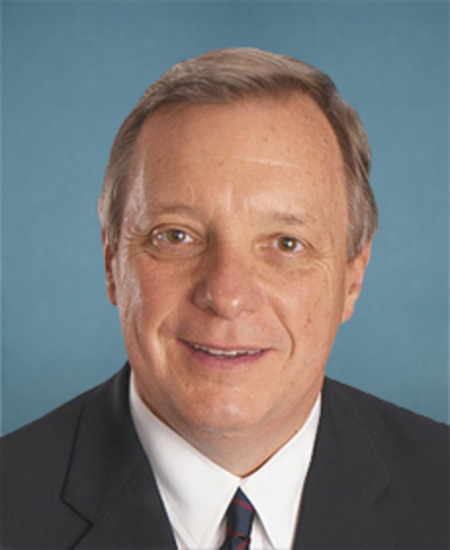
Sen. Richard J. Durbin
Sponsored bills
This resolution expresses support for the rights, freedoms, and equal treatment of lesbian, gay, bisexual, transgender, and queer (LGBTQ) individuals. The resolution r ecognizes that LGBTQ rights are human rights and protected by the laws of the United States and international treaties. Additionally, the resolution encourages the celebration of LGBTQ Pride Month in June.
Clean Water For Military Families Act This bill requires the Department of Defense (DOD) to conduct investigations into releases of perfluoroalkyl and polyfluoroalkyl substances (PFAS) at or surrounding DOD installations located in the United States, formerly used defense sites, and state-owned facilities of the National Guard. PFAS are man-made and may have adverse human health effects. DOD must also conduct response actions relating to PFAS contamination at the mentioned locations if any detection of PFAS exceeds specified standards for contamination or DOD finds remediation to be appropriate to protect human health or the environment.
Women's Health Protection Act of 2021 This bill prohibits governmental restrictions on the provision of, and access to, abortion services. Specifically, governments may not limit a provider's ability to prescribe certain drugs, offer abortion services via telemedicine, or immediately provide abortion services when the provider determines a delay risks the patient's health. Furthermore, governments may not require a provider to perform unnecessary medical procedures, provide medically inaccurate information, comply with credentialing or other conditions that do not apply to providers whose services are medically comparable to abortions, or carry out all services connected to an abortion. In addition, governments may not (1) require patients to make medically unnecessary in-person visits before receiving abortion services or disclose their reasons for obtaining such services, or (2) prohibit abortion services before fetal viability or after fetal viability when a provider determines the pregnancy risks the patient's life or health. The bill also prohibits other governmental measures that are similar to the bill's specified restrictions or that otherwise single out and impede access to abortion services, unless a government demonstrates that the measure significantly advances the safety of abortion services or health of patients and cannot be achieved through less restrictive means. The Department of Justice, individuals, or providers may bring a lawsuit to enforce this bill, and states are not immune from suits for violations. The bill applies to restrictions imposed both prior and subsequent to the bill's enactment.
Filthy Fifty Act This bill requires the Department of Defense (DOD) to complete testing for perfluoroalkyl and polyfluoroalkyl substances (PFAS) at all military installations, formerly used defense sites, and state-owned facilities of the National Guard in the United States. PFAS are man-made and may have adverse human health effects. Not later than 60 days following the detection of PFAS at a military installation, formerly used defense site, or state-owned facility of the National Guard, DOD must take removal actions to ensure that all individuals served by a drinking water source contaminated by PFAS have access to drinking water that meets the applicable standard, regardless of whether DOD is the drinking water purveyor. Additionally, DOD must complete all physical construction required for the remediation of PFAS at such sites not later than 10 years after the enactment of this bill. DOD must report to Congress identifying the status of remediation efforts at 50 specified sites, such as England Air Force Base, Louisiana. DOD must complete all physical construction required for the remediation of PFAS at the 50 specified sites not later than five years after the enactment of this bill.
COVID-19 Safer Detention Act of 2021 This bill expands statutory authority for federal prisoners to be released before completing their sentences or to be placed in the community to serve the final portion of their sentences. First, the bill makes changes to the early release pilot program which authorizes the Bureau of Prisons to release early and place on home confinement elderly offenders and terminally ill offenders who meet eligibility criteria. This bill expands eligibility to offenders serving time for an offense under the laws of the District of Columbia, reduces the amount of time an offender must serve by the good time credits earned by the offender, and creates a judicial review process for prisoners. Second, the bill modifies the compassionate release process which authorizes federal courts to reduce a prisoner's sentence and impose a term of probation or supervised released in certain circumstances. This bill expands eligibility to prisoners sentenced before November 1, 1987; and specifies that vulnerability to COVID-19 is a basis for compassionate release. Regarding the judicial review of these release authorities, the bill also (1) authorizes federal courts to appoint counsel to assist defendants, (2) applies statutory rights for crime victims to these proceedings, and (3) shortens the waiting period during the COVID-19 pandemic. Additionally, the bill requires the Government Accountability Office to study postrelease, probation, and pretrial services, including recent changes. Finally, the bill directs the Administrative Office of the U.S. Courts to request resources to address staffing needs in each judicial district, including resources that may be necessary as a result of this bill.
This resolution expresses the Senate's condolences to the people of Afghanistan and the Hazara, an ethnic minority community in Afghanistan. The resolution also condemns all forms of violence against women and girls in Afghanistan and supports U.S. and international efforts to ensure that girls in Afghanistan can safely attend school. (On May 8, 2021, a bomb attack at the Sayed Ul-Shuhada High School in Kabul killed more than 85 people.)
Doctors of Community Act or the DOC Act This bill reauthorizes and provides mandatory funding for graduate medical education programs operated by teaching health centers. The bill sets out funding levels through FY2033. Funding for FY2034 and beyond equals the preceding fiscal year's amount adjusted for medical inflation.
This resolution offers the condolences of the Senate regarding the death of Senator John William Warner and expresses deep appreciation for his outstanding and important service to his country.
This resolution recognizes the significance of Asian/Pacific American Heritage Month as an important time to celebrate the contributions of Asian Americans and Pacific Islanders to the history of the United States. The resolution also recognizes that the Asian American and Pacific Islander communities enhance the rich diversity of the United States.