No TikTok on Government Devices Act This bill requires the social media video application TikTok to be removed from the information technology of federal agencies. Specifically, the bill requires the Office of Management and Budget to develop standards for executive agencies that require TikTok and any successor application from the developer to be removed from agency information technology (e.g., devices). Such standards must include exceptions for law enforcement activities, national security interests, and security researchers.
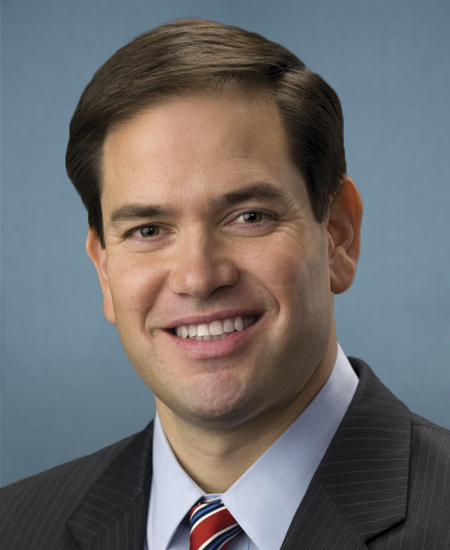
Sen. Marco Rubio
Sponsored bills
Continuity for Operators with Necessary Training Required for ATC Contract Towers Act of 2021 or the CONTRACT Act of 2021 This bill exempts certain air traffic controllers from a required reduction in their retirement annuity payment on account of earnings from certain work performed while entitled to such annuity. Under current law, retired Federal Aviation Administration air traffic controllers receive an annuity payment during the period between the mandatory retirement age of 56 and the Social Security minimum age of 62. Such annuity payment is required to be reduced by a certain percentage of any excess earnings during this period. The bill exempts from such reduction in annuity payments an air traffic controller who participates in the Air Traffic Control Contract Program (a public-private partnership for air traffic control services) following mandatory retirement.
This joint resolution nullifies a Department of Education rule published on July 6, 2022, concerning final priorities, requirements, definitions, and selection criteria for the Charter Schools Program.
This resolution supports the annual recognition of Interscholastic Athletic Administrators' Day on December 14, 2022. In addition, the resolution commends (1) athletic administrators for their commitment to secondary school student athletes, and (2) the National Interscholastic Athletic Administrators Association for providing continuous learning and preparation to athletic administrators.
Hong Kong Economic and Trade Office (HKETO) Certification Act This bill requires the President to periodically determine whether to allow the Hong Kong Economic and Trade Offices (HKETOs) to continue to operate in the United States. (The HKETOs are the official representative offices for Hong Kong, a semi-autonomous city that was established as a British colony in 1841. The United Kingdom transferred sovereignty over Hong Kong to China in 1997). Under this bill, the President must periodically (at least once a year) certify to Congress a determination as to whether the HKETOs should be covered by the International Organizations Immunities Act. (The act provides immunities and privileges to certain international organizations, such as immunity from certain lawsuits and exemption from property taxes.) If the President certifies that the HKETOs no longer merit receiving such privileges and immunities, the HKETOs must terminate operations in the United States no later than 180 days after the certification is delivered to Congress. If the President certifies that the HKETOs continue to merit such privileges and immunities, the HKETOs may continue operations for another year, unless Congress enacts a joint resolution disapproving of the certification. The President may also revoke the application of such privileges and immunities to the HKETOs. A federal government entity may enter into an agreement or partnership with an HKETO only if the HKETOs are still authorized to operate in the United States under this bill.
Small Business Child Care Investment Act This bill deems certain nonprofit child care providers to be small business concerns so that they may participate in loan programs administered by the Small Business Administration.
Averting the National Threat of Internet Surveillance, Oppressive Censorship and Influence, and Algorithmic Learning by the Chinese Communist Party Act or the ANTI-SOCIAL CCP Act This bill requires the President to impose property-blocking sanctions on TikTok, its parent company ByteDance Ltd., and larger social media companies with ties to certain foreign countries. Specifically, the sanctions shall apply if the relevant property interests are (1) in the United States; or (2) in the possession or control of a U.S. person, if blocking the transaction is necessary to prevent the company's commercial operation in the United States. These sanctions shall also apply to larger social media companies involved with countries or persons (entities or individuals) of concern, generally defined as any foreign government or person engaged in activities adverse to U.S. security and safety and includes specific countries such as China, Russia, and North Korea. For the purposes of this bill, a person of concern also includes private companies and individuals domiciled in a country of concern and subject to the substantial influence of the government. Specifically, in addition to TikTok and ByteDance, the sanctions shall apply to any social media company that is based in or organized under the laws of a country of concern; where a country or person of concern owns 10% of its outstanding voting stock or shares; that uses software or algorithms controlled by a country or person of concern, including through export controls; or where a country or person of concern has substantial influence over the company's data sharing or content moderation practices.

National Development Strategy and Coordination Act of 2022 This bill establishes the Interagency Committee for the Coordination of National Development Financing Programs within the Executive Office of the President. The committee must develop a national strategy to (1) address vulnerabilities in the domestic supply chains of critical industries, (2) strengthen U.S. industrial and manufacturing capabilities, and (3) support targeted job growth and economic development. The bill authorizes the Federal Financing Bank to provide financing assistance to carry out certain directives made by the committee.
U.S. Hostage and Wrongful Detainee Day Act of 2022 This bill designates March 9 as Hostage and Wrongful Detainee Day. The bill also designates the Hostage and Wrongful Detainee Flag as a symbol of the commitment of the United States to recognizing, and prioritizing the freedom of, citizens and lawful permanent residents held as hostages or wrongfully detained abroad.
DHS Industrial Control Systems Capabilities Enhancement Act of 2021 This bill requires the Cybersecurity and Infrastructure Security Agency (CISA) to maintain certain capabilities to identify and address threats to industrial control systems. Specifically, the bill requires CISA's National Cybersecurity and Communications Integration Center to ensure that its activities address the security of both information and operational technology, including industrial control systems. Additionally, CISA must maintain capabilities to identify and address threats and vulnerabilities to products and technologies intended for use in the automated control of critical infrastructure processes by (1) leading efforts to identify and mitigate cybersecurity threats to industrial control systems; (2) maintaining threat hunting and incident response capabilities to respond to cybersecurity risks and incidents; (3) providing cybersecurity technical assistance to stakeholders; and (4) collecting, coordinating, and providing vulnerability information to the industrial control systems community. CISA shall provide to the homeland security committees a briefing on its industrial control systems capabilities at specified intervals. The Government Accountability Office must review and report on implementation of the bill's requirements.