

Maddy summaryThis Senate resolution (SRES 234) designates May 2023 as "Older Americans Month" to symbolically honor older adults in the U.S. It encourages public recognition of their community contributions, opportunities for them to share wisdom with younger generations, and acknowledgment of their value to society. The resolution has no legal effect or new policy changes - it is purely ceremonial, aligning with longstanding tradition to highlight seniors' roles without altering programs or funding.
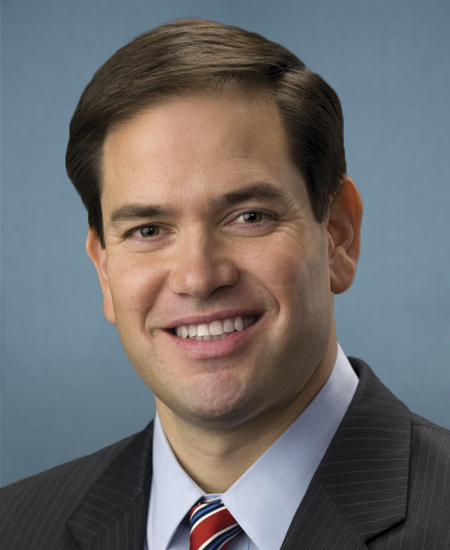
Sen. Marco Rubio
Sponsored bills
Maddy summarySRES 236 is a ceremonial Senate resolution designating June 2, 2023, as "National Rough Rider Day" to honor the 125th anniversary of the Rough Riders' arrival in Tampa, Florida, ahead of the Spanish-American War. It has no binding policy impact and does not affect any individuals or groups through legislative action. The resolution simply encourages the American public to observe this date with appropriate ceremonies, commemorating the historical service of the 1st U.S. Volunteer Cavalry Regiment during the 1898 conflict. As a procedural resolution, it focuses solely on historical recognition without implementing new laws or regulations.
This resolution expresses support for the designation of DIPG Awareness Day. DIPG refers to diffuse intrinsic pontine glioma, a terminal childhood brain cancer.
Maddy summaryS 1795, the Fairness in Higher Education Accreditation Act, prohibits accrediting agencies from considering an institution’s diversity, equity, and inclusion (DEI) policies or the racial composition of its students, faculty, or staff when granting or maintaining accreditation. This applies to all higher education institutions (both public and private) subject to accreditation under the Higher Education Act of 1965. The bill adds a new requirement that accrediting agencies must disregard these factors during their evaluation process. Institutions harmed by accreditation decisions violating this rule may pursue civil action under existing Higher Education Act provisions.
Maddy summaryS.Res. 229 designates May 2023 as "National Brain Tumor Awareness Month" in the U.S. Senate. The resolution encourages public awareness of brain tumors, supports research for better treatments, and honors individuals affected by the disease, including those living with or battling brain tumors. It does not create new laws or allocate funding but serves as a symbolic recognition of the health impact of brain tumors.
Maddy summaryS 1768, the Taliban Sanctions Act of 2023, imposes U.S. sanctions on individuals and entities (including Taliban members) who support terrorism, commit serious human rights abuses, or facilitate narcotics trafficking in Afghanistan. It requires the President to block assets and deny visas to those meeting these criteria, effective 90 days after enactment. The bill also directs U.S. diplomacy to maintain UN sanctions against the Taliban and mandates regular congressional briefings on sanctions implementation and humanitarian impacts. It includes limited waivers for national security interests and specific exceptions for intelligence activities or humanitarian access.
Maddy summaryThis bill expands U.S. sanctions against individuals and entities involved in human rights abuses against Uyghurs and other ethnic groups in Xinjiang, China. It requires the Treasury Secretary to identify Chinese entities complicit in serious human rights abuses and add them to sanctions lists, and mandates disclosures to the Securities and Exchange Commission about business ties to Xinjiang-related entities. The bill authorizes physical and psychological support for Uyghurs, Kazakhs, and other ethnic groups who have experienced atrocities in China and are now outside China. It also includes provisions for countering Chinese propaganda about the situation in Xinjiang and prohibits U.S. government contracts with certain entities.
Maddy summarySRES 221 is a Senate resolution supporting National Minority Health Month in April 2023 by raising awareness of health disparities affecting specific minority populations. It highlights documented inequities, such as higher rates of diabetes, cancer, and mortality among American Indians, Alaska Natives, Asian Americans, African Americans, Hispanics, and Native Hawaiians or Pacific Islanders compared to non-Hispanic White populations. The resolution does not create new laws or allocate funding but serves as a symbolic acknowledgment of these disparities through a series of cited statistics from health data. It aims to promote public understanding of these issues during the designated awareness month.
Maddy summaryThe "No START Treaty Act" declares that the New START Treaty with Russia is no longer in U.S. national security interests due to Russia's non-compliance (including refusing inspections) and China's rapid nuclear expansion, directing the U.S. to withdraw from the treaty. It mandates a 90-day report from the Secretary of Defense assessing U.S. nuclear deterrence capabilities and proposing specific improvements, such as increasing bomber alert status and restoring submarine missile capacity. The bill sets strict conditions for future arms control agreements, requiring limits on China's nuclear arsenal, robust verification for both China and Russia, and coverage of non-strategic weapons and emerging systems like hypersonic weapons. Additionally, it prohibits unilateral U.S. nuclear reductions without a treaty meeting these conditions and blocks funding for the New START Treaty or successor agreements that fail to satisfy these requirements.
Maddy summaryThe Disclose Government Censorship Act (S 1672) requires U.S. government employees to publicly disclose communications with social media platforms about restricting user content. It mandates that most such communications be posted online within 7 days, unless related to law enforcement or national security (which must be shared with Congress within 60 days). The bill applies to executive and legislative branch employees discussing content moderation actions, including algorithmic decisions. It creates dedicated public websites for these disclosures and imposes penalties for non-compliance. The law aims to increase transparency around government influence on online content without defining or regulating platform content policies.