

Guaranteeing Healthcare Access to Personnel Who Served Act This bill addresses the administration and provision of health care to veterans through the Department of Veterans Affairs (VA) and non-VA providers. First, the bill provides statutory authority for the eligibility thresholds for when a veteran must receive non-VA care under the Veterans Community Care Program (VCCP) for primary care, mental health care, noninstitutional extended care services, specialty care, or specialty services. Additionally, the bill establishes access to care standards for non-VA care under the VCCP, meaning a veteran's appointment must be within specified distances and time frames. Among other requirements, the VA must also implement an 18-month pilot program to allow certain veterans to use a website or mobile application to request, schedule, and confirm medical appointments with VCCP providers; ensure that VCCP third party administrators and credentials verification organizations comply with specified requirements to help ensure that certain health care providers are excluded from providing non-VA health care services; develop a strategic plan to ensure the effectiveness of the telehealth technologies and modalities delivered by the VA; and establish an online health care education portal for veterans. The bill requires the Government Accountability Office to report on (1) the VA program under which third parties provide transportation for veterans who are seeking VA services or benefits, (2) VA telehealth services, and (3) the VA's Foreign Medical Program. Finally, the Paperwork Reduction Act does not apply to the voluntary collection of information during research conducted by the Veterans Health Administration.
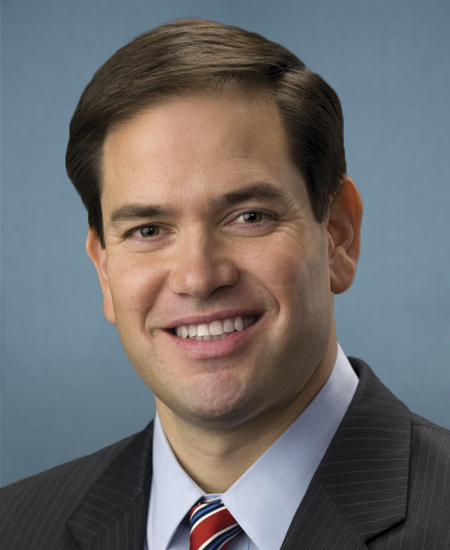
Sen. Marco Rubio
Sponsored bills
This bill expands eligibility for Department of Veterans Affairs hospital care, medical services, and nursing home care to include veterans of World War II who are not already covered.
UNRWA Accountability and Transparency Act This bill makes changes to U.S. foreign policy in matters concerning the United Nations Relief and Works Agency for Palestine Refugees in the Near East (UNRWA). For purposes of this policy, the bill defines Palestinian refugee as a person who (1) resided from June 1946 to May 1948 in Mandatory Palestine (a region controlled by Britain until 1948), (2) was personally displaced as a result of the 1948 Arab-Israeli conflict, and (3) has not accepted citizenship or other permanent adjustment in status in another country. The bill withholds U.S. funding for the UNRWA unless the Department of State makes certifications concerning the UNRWA's staff, partners, and funding. Specifically, the State Department must certify that neither UNRWA staff and partners nor its funding and facilities are affiliated with terrorism or engaged in the dissemination of anti-American, anti-Israel, or anti-Semitic ideologies. Additionally, the State Department must certify that the UNRWA is subject to comprehensive financial audits by an independent auditing firm and is unaffiliated with any financial institutions that the United States considers to be complicit in money laundering or terror financing. The bill also requires the State Department to implement a plan to encourage other countries to align their activities and efforts regarding the UNRWA with U.S. policy objectives, including the phase out of the UNRWA by resettling Palestinian refugees in countries other than Israel and in territories not controlled by Israel. The State Department must report to Congress on this plan.
Anti-BDS Labeling Act This bill provides statutory authority for the continuation of U.S. policy related to country of origin marking for imported goods that are produced in the West Bank or Gaza. Currently, such goods must carry specified markings that indicate their origin. Further, the bill prohibits the use of any funds made available to the Department of State or to U.S. Customs and Border Protection to rescind or change this policy.
American Shores Protection Act This bill extends a moratorium on oil and gas drilling in the Gulf of Mexico through June 30, 2032, and expands the moratorium to include the South Atlantic Planning Area and the Straits of Florida Planning Area.
This resolution calls on the Russian government to immediately release Trevor Reed (a U.S. citizen) and all other political prisoners. It also condemns the Russian government's use of politically motivated imprisonment.
Federal Firearms Licensee Protection Act of 2021 This bill modifies criminal penalties for an offense involving the theft of a firearm from a licensed importer, manufacturer, or dealer, or from their business premises. Specifically, the bill does the following: increases from 10 to 20 years the maximum prison term, and creates a 3- or 5-year mandatory minimum prison term for an offense that occurs during the commission of a burglary or robbery. An attempt to commit an offense is subject to the same penalties as a substantive offense.
This resolution congratulates the Tampa Bay Lightning for becoming the 2021 National Hockey League Stanley Cup champions.
This resolution declares that the Pledge of Allegiance has been a valuable part of life for the people of the United States for generations and defends its constitutionality.
Flood Insurance Rate Map Interagency Technology Act of 2021 or the FIRM IT Act of 2021 This bill modifies technical requirements for National Flood Insurance Program (NFIP) rate maps (community maps delineating flood hazard areas, flood elevations, and flood risk zones that are applicable to flood insurance rate determination). Specifically, the Federal Emergency Management Agency (FEMA) must consult with the Department of Defense, the U.S. Geological Survey, and the National Oceanic and Atmospheric Administration to obtain information relevant to NFIP rate maps. FEMA may include this data, as well as specified property survey information, in NFIP rate maps. The format of NFIP rate maps must conform to specified data and protocols.