

Countering the Chinese Government and Communist Party's Political Influence Operations Act This bill directs the Department of State and the Department of Homeland Security to devise a long-term strategy to counter the Chinese government's political influence operations. The strategy must seek to counter the ruling Chinese Communist Party's campaigns to corrupt democratic countries and undermine democratic institutions, both in the United States and elsewhere. It must also seek to increase awareness of such campaigns and help other countries develop the capacity to counter them. The strategy must also ensure that Chinese nationals living in the United States, as well as Chinese Americans and members of the Uyghur, Mongolian, Korean, Taiwanese, and Tibetan diaspora, are protected against malign political influence operations, such as surveillance and intimidation. The State Department must annually report to Congress about Chinese government efforts to exert influence in the United States and in U.S. partner countries, and suggestions for countering such efforts. The report shall address issues including attempts to (1) influence government institutions and officials, (2) undermine democratic institutions and freedom of speech, and (3) suppress public information.
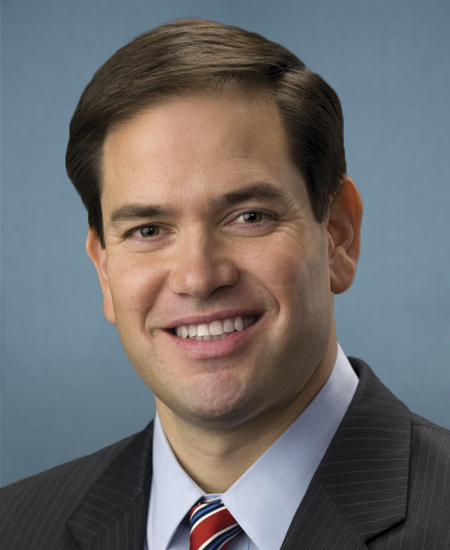
Sen. Marco Rubio
Sponsored bills
This resolution recognizes and expresses support for efforts to promote democracy and human rights in Cuba.
This bill requires the Department of the Treasury to instruct the U.S. executive directors at certain multilateral development banks, such as the Asian Development Bank, to oppose providing a loan, financial assistance, or technical assistance to China. The executive directors must also advocate and vote to end lending and assistance to a country that has exceeded certain income thresholds.
Greater Insight into Foreign Transactions in Higher Education Act of 2021 or the GIFTs in Higher Education Act This bill revises certain disclosure requirements for institutions of higher education (IHEs). Under current law, an IHE must disclose to the Department of Education (ED) a gift or contract from a foreign source that is valued at $250,000 or more, considered alone or in combination with all other gifts from or contracts with that foreign source. This bill extends the disclosure requirement to include faculty, professional staff, and all staff engaged in research and development at the IHE. Further, an IHE (including faculty and staff) must disclose to ED a gift or contract from a designated foreign adversary source that is valued at $50,000 or more, considered alone or in combination with all other gifts from or contracts with that foreign adversary source within a calendar year. The IHE must, within 30 days of receipt of the gift or contract, file a disclosure report with ED. ED must, within 30 days of submission, publish online these disclosure reports. Next, the bill requires each federal agency to ensure that no federal funds are distributed to an IHE that knowingly or willfully violates these disclosure requirements. The bill also prohibits an IHE that knowingly or willfully violates these disclosure requirements from receiving federal education funds, with an exception for federal student-aid program funding.
Directed Energy Threat Emergency Response Act This bill requires actions to address anomalous health incidents. The President must designate an appropriate senior official as the Anomalous Health Incidents Interagency Coordinator. The interagency coordinator must (1) coordinate the U.S. government's response to anomalous health incidents, (2) ensure that affected personnel and dependents get access to care, and (3) ensure adequate training and education for relevant U.S. government personnel. The bill also requires certain agencies, including the Department of Defense and the Office of the Director of National Intelligence, to designate an appropriate senior official to serve as the Anomalous Health Incident Agency Coordination Lead. These officials must (1) work with the interagency coordinator to achieve objectives related to anomalous health incidents, and (2) jointly provide quarterly briefings to Congress on its activities. Such agencies must also develop updated workplace guidance to address anomalous health incidents, including processes to self-report suspected exposure to a possible anomalous health incident.
This bill designates the area between the intersections of 16th Street, NW and Fuller Street, NW and 16th Street, NW and Euclid Street, NW in the District of Columbia as Oswaldo Paya Way.
This resolution expresses the condolences of the Senate regarding the death of the Honorable Carl Levin, former Senator for Michigan.
This resolution expresses the condolences of the Senate regarding the death of the Honorable Mike Enzi, former Senator for Wyoming.
Protecting Students From Racial Hostility Act This bill prohibits school curriculums or teachings that promote certain concepts based on race. Specifically, the bill prohibits schools from promoting concepts that result in a racially hostile environment , which the bill defines as an environment in which (1) racial discrimination has created an adverse setting, (2) an individual is fearful due to a racially intimidating or offensive environment, or (3) an individual is restricted from participating in or benefiting from a program or activity on the basis of race. Prohibited concepts include the idea that (1) one race is inherently superior to another, (2) the United States is fundamentally racist, and (3) an individual bears responsibility for the past actions of others of the same race. The bill makes the use of such curriculums or teachings a violation of Title VI of the Civil Rights Act of 1964, which prohibits discrimination based on race, color, or national origin in federally funded programs or activities. Any intimidation, threat, or other interference with respect to an individual's rights or participation in related proceedings (e.g., the ability to file complaints about the use of prohibited curriculums) shall also be considered a violation of Title VI. The bill applies to elementary and secondary schools and to colleges and universities.
Social Security Disability Insurance Return to Work Act This bill makes various changes to Social Security Disability Insurance (SSDI), with a particular focus on returning individuals who receive SSDI to employment. Among other changes, the bill limits the amount of time an individual with a disability for which medical improvement is likely or expected may receive SSDI benefits, and it requires the Social Security Administration to establish a process to allow such individuals who return to employment before their benefits expire and whose earnings exceed a specified limit to receive an adjusted SSDI benefit.