

Clean Water Allotment Modernization Act of 2021 This bill revises the formula the Environmental Protection Agency (EPA) uses to determine how to distribute funds from the Clean Water State Revolving Fund (SRF) program. Under the program, the EPA allocates funding to states for water quality infrastructure projects, such as wastewater systems and stormwater management projects. In FY2022-FY2026, the EPA must provide an initial allotment to each state that is equal to the amount the state received in FY2023. The EPA must also provide an additional allotment to each state that is based on its share of the U.S. population. In FY2027 and each subsequent fiscal year, the EPA must use an updated allotment formula, which is based on the needs of states as identified in the most recently available clean watersheds needs survey. Beginning in FY2022, the formula must also provide allotments for Indian tribes and territories. In addition, the formula must provide an allotment for EPA's oversight of SRF projects to ensure they use American iron and steel.
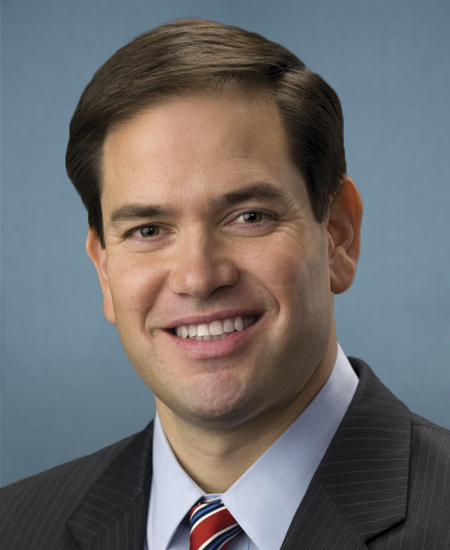
Sen. Marco Rubio
Sponsored bills
This resolution supports the designation of October 3-October 9, 2021, as National 4-H Week. It also (1) recognizes the important role of 4-H in youth development and education, and (2) encourages all citizens to recognize 4-H for the significant impact the organization and members have made and continue to make by empowering young people with the skills needed to lead for a lifetime.
Viral Gain of Function Research Moratorium Act This bill prohibits the award of federal research grants to institutions of higher education or research institutes that conduct gain-of-function research. Gain-of-function research refers to any research that (1) may be reasonably anticipated to confer attributes to influenza, MERS, or SARS viruses such that the virus would have enhanced pathogenicity or transmissibility in an organism; or (2) involves the enhancement of potential pandemic pathogens or related risky research with potentially dangerous pathogens.
This resolution recognizes (1) the celebration of Hispanic Heritage Month from September 15 - October 15, 2021; and (2) the integral role of Latinos and their manifold heritage in the economy, culture, and identity of the United States.
Denying Earnings to the Military Oligarchy in Cuba and Restricting Activities of the Cuban Intelligence Apparatus Act or the DEMOCRACIA Act This bill provides for asset- and visa-blocking sanctions for conduct relating to Cuba. It also establishes an interagency task force to facilitate access to uncensored internet in Cuba. The President must sanction foreign persons that provide financial support to Cuban government sectors involved in human rights abuses or terrorism (e.g., the defense sector). This includes foreign persons that (1) are military contractors or mercenaries operating on behalf of the Cuban government, or (2) violate laws restricting trade with Cuba. Specified transactions, including remittances to immediate family members (subject to some limitations) and payments related to U.S. military and diplomatic sites, are not subject to these sanctions. The President must also sanction (1) foreign persons complicit or engaged in human rights abuses or corruption, (2) foreign persons supporting such conduct, and (3) specified Cuban government officials and their affiliates. The bill provides humanitarian exceptions to these sanctions, for example, donating food or agricultural commodities to organizations or individuals unaffiliated with the Cuban government. The President may not license sanctionable conduct, and U.S. persons seeking to engage in a permitted transaction must submit a written request to the Office of Foreign Asset Control of the Department of the Treasury. The President may waive the sanctions in the interest of U.S. national security. To terminate the sanctions, the President must certify that the Cuban government has legalized all political activities and taken other steps to promote political rights and freedoms. Congress must then enact a joint resolution approving the termination.
Helping American Victims Afflicted by Neurological Attacks Act of 2021 or the HAVANA Act of 2021 This bill specifically authorizes the Central Intelligence Agency, the Department of State, and other agencies to provide payments to agency personnel who incur brain injuries from hostilities while on assignment. Specifically, the bill allows agency personnel and their families to receive payments for brain injuries that are incurred (1) during a period of assignment to a foreign or domestic duty station; (2) in connection with war, insurgency, hostile acts, terrorist activity, or other agency-designated incidents; and (3) not as the result of willful misconduct. The bill's authority applies to injuries incurred before, on, or after the date of the bill's enactment. Agencies must submit classified reports on the bill's implementation, including the number of payments made and the amount of each payment. Since 2016, some intelligence, diplomatic, and other governmental personnel have reported experiencing unusual cognitive and neurological impairments while on assignment (particularly abroad), the source of which is currently under investigation. Symptoms were first reported by personnel stationed in Cuba and have since been collectively referred to as Havana Syndrome .
Maddy summarySRES 372 is a symbolic Senate resolution designating the week beginning September 13, 2021, as "National Hispanic-Serving Institutions Week." It recognizes Hispanic-Serving Institutions (HSIs) - colleges and universities with at least 25% Hispanic undergraduate enrollment - as vital providers of higher education to underserved students, particularly Hispanic learners. The resolution calls on the public and organizations to observe the week with events supporting these institutions, which serve 2.3 million Hispanic students nationwide. This is a non-binding commemorative measure with no policy changes or funding impacts.
This bill directs the Department of the Treasury to consider sanctioned transactions involving precious metals when assessing whether a jurisdiction, financial institution, class of transactions, or type of account is of primary money laundering concern for purposes of reporting, recordkeeping, and certain account restrictions.
Homes for Every Local Protector, Educator, and Responder Act of 2021 or the HELPER Act of 2021 This bill establishes a program administered by the Department of Housing and Urban Development to provide mortgage assistance to law enforcement officers, elementary and secondary school teachers, firefighters, or other first responders. Specifically, these individuals may be eligible for a one-time mortgage on a primary family residence with no down payment and no monthly mortgage insurance premium.
FDA Modernization Act of 2021 This bill allows an applicant for market approval for a new drug to use methods other than animal testing to establish the drug's safety and effectiveness. Under this bill, these alternative methods may include cell-based assays, organ chips and microphysiological systems, computer modeling, and other human biology-based test methods.